







Wood Shaving & Wood Chip
Wood Shaving & Wood Chip Baler Buyer Guide
How to Choose the Right Wood Shaving Baling Machine
Wood shavings and wood chips are common by-products of woodworking, furniture manufacturing, sawmills, wood processing, and biomass production. Because these materials are relatively bulky and lightweight, baling can significantly reduce loose-material volume and make storage, transportation, and handling more efficient.
However, choosing a wood shaving baler is not simply a matter of selecting the highest compression force.
The right machine depends on:
- Material type and particle size
- Material bulk density
- Material moisture content
- Required bale weight
- Desired bale dimensions
- Required production capacity
- Feeding method
- Required bale density
- Final application of the bale
SINOBALER manufactures hydraulic balers and bagging balers for wood shavings, wood chips, wood flakes, and other wood-processing residues. We recommend selecting the machine based on your actual material and required bale specifications rather than relying on material name alone.
Quick Answer: Which Baler Is Right for Wood Shavings?
For lightweight wood shavings, wood flakes, and similar fluffy materials, a suitable bagging baler can provide an economical solution when the required bale weight and density are moderate.
For larger, harder, or denser wood chips, a stronger hydraulic baler may be more appropriate.
A practical starting point is:
Your Requirement | Baling Consideration |
Lightweight wood shavings | Smaller compression force may be sufficient |
Fluffy / curly shavings | Larger chamber volume may be more important |
Small wood flakes | Suitable for bagging-type baling solutions |
Large wood chips | Consider stronger hydraulic compression |
Heavy bales | Higher compression force and/or multiple feeding cycles |
High-density transportation bales | Higher compression force may be beneficial |
Animal bedding | Balance density with ease of bale opening |
Biomass fuel | Higher density may improve transportation efficiency |
The final recommendation should always be confirmed using the actual material.
If possible, send SINOBALER material photos or videos, required bale weight, bale dimensions, and processing capacity for a more accurate recommendation.
1. What Wood Materials Can Be Baled?
SINOBALER can provide baling solutions for various wood-processing residues, including:
- Wood shavings
- Wood chips
- Sawdust
- Wood pulp
- Planer shavings
- Woodworking residues
- Wood-processing by-products
- Lightweight wood bedding materials
- Selected biomass wood residues
Although these materials are all derived from wood, their baling characteristics can be very different.
Particle size, shape, hardness, moisture, and bulk density all affect the amount of material that can be loaded into the compression chamber and the final bale density.
Wood Shavings Are Not the Same as Sawdust
Fine sawdust normally has much smaller particles and can behave very differently during compression.
If your material is primarily fine sawdust, please see our dedicated:
Sawdust Baling Press Application
For wood chips and larger wood particles, machine selection should instead focus on particle size, material hardness, bulk density, and required bale specifications.
2. What Is the Most Important Factor When Choosing a Wood Shaving Baler?
There is no single “best” wood shaving baler.
The most important question is:
What bale do you need to produce from your specific material?
A machine that works well for one type of wood shaving may not produce the same result with another material.
For example, two customers may both describe their material as “wood shavings,” but one may have:
- Small, relatively dense shavings
while the other may have:
- Long, curly, fluffy shavings
The two applications can require different chamber sizes, feeding cycles, and compression forces.
Therefore, SINOBALER recommends evaluating the following five specifications first:
① Material
Send photos or videos of the actual wood shavings or chips.
② Bale Weight
Tell us how many kilograms you want in each bale.
③ Bale Size
Provide your preferred bale width, height, and approximate length.
④ Production Capacity
Tell us how many kilograms or tons you need to process per hour, day, or month.
⑤ End Use
Explain whether the bales are intended for:
- Animal bedding
- Transportation
- Storage
- Biomass fuel
- Recycling
- Further processing
- Other applications
These details allow the machine configuration to be matched to the real application.
3. How Does Compression Force Affect Wood Shaving Bales?
Compression force determines how strongly the material can be compacted inside the baling chamber.
For certain lightweight wood shavings, a 15-ton compression force can be an appropriate starting point.
An example chamber configuration is:
Compression chamber: 550 × 250 mm
Bale ejecting chamber: 400 × 250 mm
This configuration can be suitable for applications where the target bale weight and density are within the machine's working range.
However, if you want a larger chamber or heavier, denser bales, a higher compression force may be required.
Depending on the application, this could include:
25 tons → 30 tons → 40 tons → 60 tons
The correct choice depends on the relationship between chamber size, material characteristics, target bale weight, and required density.
4. Does Higher Compression Force Always Mean a Better Baler?
No.
This is an important point when buying a wood shaving baler.
A higher compression force can help produce a denser bale, but the highest possible density is not necessarily the best solution.
For example:
Animal Bedding
Wood shavings are frequently used as animal bedding.
In this application, the bale should be compact enough to reduce transportation and storage costs but still be reasonably easy for the end user to open and distribute.
Biomass Fuel
If the compressed wood material is intended for fuel, a higher-density bale may be more desirable because compact material can be easier to store and transport.
Therefore:
The correct compression force should be selected according to the final application, not simply the maximum force available.
5. How Does Chamber Size Affect Bale Weight?
Compression force and chamber size should be considered together.
Suppose you use a relatively small chamber with a higher compression force.
You may be able to produce:
- Denser bales
- Heavier material per unit volume
- Shorter bale length for the same target weight
On the other hand, increasing the chamber size provides more volume for lightweight material, but the larger chamber may require a higher compression force to achieve the desired density.
This creates an important balancing relationship:
Chamber size + compression force + material bulk density = achievable bale characteristics
Therefore, choosing a baler based only on “tons of hydraulic force” can result in the wrong machine.
6. Why Material Size Matters So Much
Wood shavings can vary considerably in size and shape.
Some are relatively small and compact, while others can be:
- Long
- Thin
- Curly
- Fluffy
- Irregular
- More than 3 cm in length
Large, curly wood shavings often have a very low bulk density.
This means that a large volume of material may contain relatively little weight.
One Feeding Cycle vs. Multiple Feeding Cycles
For smaller wood shavings, one feeding cycle may be sufficient to reach the desired bale weight.
For larger and fluffier shavings, the chamber may reach its volume limit before enough material weight has been loaded.
In this situation, the machine may need:
First feeding → compression → second feeding → final compression
Therefore, larger wood pieces do not necessarily mean higher production output.
This is one of the most important practical considerations when calculating the required capacity of a wood shaving baling system.
7. How to Calculate Your Required Baling Capacity
When customers ask:
“How many tons per hour can this wood shaving baler process?”
The answer cannot be determined from hydraulic force alone.
Practical output depends on:
Material bulk density × bale weight × number of feeding cycles × machine cycle time
For example, if fluffy wood shavings require multiple feeding cycles to produce one bale, the actual throughput can be lower than that of a denser material using the same machine.
Therefore, when comparing machines, do not compare only:
- Hydraulic force
- Motor power
- Chamber dimensions
Also compare:
- Actual material bulk density
- Bale weight
- Number of feeding cycles
- Cycle time
- Feeding method
- Required output
8. How Can Wood Shavings Be Fed into the Baler?
The feeding method is an important part of the overall wood shaving baling system. The best option depends on the material characteristics, production capacity, available space, and level of automation required.
SINOBALER can consider manual feeding, conveyor feeding, or cyclone feeding for different wood shaving and wood-processing applications.
Manual Feeding
Manual feeding can be suitable for:
- Small or medium production volumes
- Flexible production
- Applications where material is already collected close to the baler
- Customers who prefer a simple and economical setup
The operator manually loads the wood shavings into the baling chamber or feeding hopper.
Conveyor Feeding
A conveyor can continuously transport wood shavings, wood chips, or wood flakes from the collection point to the baler.
Conveyor feeding is suitable for:
- Higher production volumes
- Continuous material handling
- Production lines with a fixed layout
- Applications where the material is collected at a distance from the baler
Depending on the material and layout, the system may include:
Collection → Conveyor → Baler → Bale Output
For larger systems, the conveyor and baler should be designed together to provide a stable material flow.
Cyclone Feeding System
For lightweight, fluffy wood shavings, wood flakes, and similar fine or low-density materials, a cyclone feeding system can be considered.
A cyclone system uses an air stream to transport lightweight material through ducting before separating and collecting the material at the baler feeding point.
A typical system may be arranged as:
Wood Processing Machine → Dust/Material Collection → Air Duct → Cyclone → Baler → Bale Output
Cyclone feeding can be particularly useful when:
- The wood material is very lightweight
- Material needs to be transported over a longer distance
- The production line already uses pneumatic material collection
- Manual handling needs to be reduced
- The material needs to be separated from the conveying air before baling
Cyclone Feeding vs. Conveyor Feeding
Feeding Method | Best Suited For | Main Consideration |
Manual feeding | Small/medium production | Simple but requires labor |
Chips, flakes and heavier materials | Stable mechanical conveying | |
Lightweight shavings and fluffy wood particles | Requires suitable air-flow and cyclone design |
Important: Cyclone feeding is not automatically suitable for every wood material. Material particle size, moisture, bulk density, conveying distance, airflow requirements, and the characteristics of the upstream processing equipment should be evaluated before selecting a pneumatic feeding system.
SINOBALER can help evaluate the feeding + cyclone + baling configuration according to your actual material and production requirements.
Choosing the Right Feeding Method
As a general guide:
Lightweight + fluffy material → Cyclone feeding may be suitable
Heavier chips/flakes + fixed production line → Conveyor feeding may be suitable
Small-scale/flexible operation → Manual feeding may be suitable
For a customized recommendation, send us your material photos/videos, material size, required capacity, feeding distance, and target bale weight.
9. What Bale Density Should You Choose?
There is no universal target bale density for wood shavings.
The appropriate density depends on what happens to the bale after it leaves the machine.
If the bales are for transportation:
Higher density can reduce the volume required for shipping.
If the bales are for warehouse storage:
Higher density can reduce storage space.
If the bales are for animal bedding:
The bale should remain practical for opening and distributing the wood shavings.
If the bales are for biomass fuel:
A higher-density bale may improve material handling and transportation efficiency.
Therefore, the best bale is not necessarily the densest bale—it is the bale that best fits the customer's complete logistics and end-use requirements.
10. Wood Shaving Baler Selection Example
Consider a customer who has lightweight wood shavings and wants compact bales for transportation.
The customer provides:
- Lightweight wood shavings
- Relatively large and fluffy particles
- Moderate bale weight
- Manual feeding
- Bales for animal bedding
In this case, the priority may be:
Suitable chamber volume + practical bale density + easy bale opening
rather than simply selecting the highest compression force.
Another customer may have harder wood chips and require:
- Higher bale density
- Heavier bales
- Continuous feeding
- Higher throughput
- Transportation over long distances
That application may require a significantly different baler configuration.
This is why SINOBALER recommends application-based machine selection.
11. Wood Shaving Baler Buying Checklist
Before requesting a quotation, prepare the following information.
Wood Shavings/Chips Characteristics
☐ Approximate particle size
☐ Long / short / curly / fluffy
☐ Hard or soft
☐ Moisture content, if known
☐ Approximate bulk density, if known
Bale Requirements
☐ Bale weight
☐ Bale width
☐ Bale height
☐ Bale length
☐ Required density
Production Requirements
☐ Tons per hour
☐ Tons per day
☐ Tons per month
☐ Manual or automatic feeding
End Use
☐ Animal bedding
☐ Biomass fuel
☐ Storage
☐ Transportation
☐ Other
The more information you provide, the more accurately SINOBALER can recommend the machine configuration.
12. Why Send Material Photos or Videos?
A material name alone is often not enough to select a baler.
“Wood shavings” can refer to materials with completely different:
- Particle sizes
- Shapes
- Bulk densities
- Moisture levels
- Compression characteristics
A simple photo or short video can help our engineers understand the material much faster.
If available, also provide:
Material sample → target bale → required capacity
This allows SINOBALER to evaluate the application from the material-handling side rather than simply recommending a standard machine.
13. Wood Shavings vs. Sawdust: Which Baler Do You Need?
Material | Typical Characteristics | Baling Consideration |
Fine sawdust | Very small particles and low bulk density | Usually requires a different compression approach |
Small wood shavings | Larger particles and relatively easy to compress | Suitable for an appropriately sized baler |
Large wood shavings | Long, curly and fluffy | May require multiple feeding cycles |
Wood flakes | Lightweight and irregular | Chamber volume is important |
Wood chips | Larger and potentially harder | May require stronger hydraulic compression |
If your material is below approximately 1 mm and resembles sawdust, visit our:
Sawdust Baling Press Application
If your material consists of larger wood pieces, flakes, or chips, continue with this application guide.
14. Do You Need a Wood Shredder Before Baling?
Not every wood-processing application requires shredding before baling.
If your material already has a suitable particle size for the selected baler, it may be possible to feed it directly into the baling machine.
However, large wood pieces, discarded pallets, and bulky wood waste may require size reduction before baling.
For these applications, you can explore:
Wood Pallet Shredder & Wood Shredding Solutions
Related equipment:
- Wood Pallet Shredding and Nail Separating System with Auger Conveyor
- Wood Pallet Shredder in Operation
15. Why Choose SINOBALER for Wood Shaving Baling?
SINOBALER focuses on application-based baling solutions, rather than supplying one standard machine for every material.
For wood shavings and wood chips, we can evaluate:
- Compression force
- Chamber dimensions
- Bale dimensions
- Bale weight
- Feeding method
- Number of feeding cycles
- Required density
- Production capacity
- End-use requirements
This approach helps customers avoid selecting a machine based solely on a catalogue specification that may not match their actual material.
Get a Wood Shaving Baler Recommendation
Tell Us What You Need to Bale
Send SINOBALER:
1. Material photos or videos
2. Material particle size
3. Required bale weight
4. Desired bale dimensions
5. Required capacity
6. Moisture content, if known
7. Feeding method
8. Final application
Our sales engineers can evaluate your requirements and recommend a suitable:
Compression Force + Chamber Size + Feeding Method + Baling Configuration
Request a Customized Wood Shaving Baling Solution
Have wood shavings, wood flakes, or wood chips to bale? Send us your material information and target bale specifications. SINOBALER will help you identify a practical baling solution for your application.
Email: inquiry@sinobaler.com
Technical Note
The bale weight, bale density, production capacity, and required compression force stated on this page are application-dependent. Actual results vary according to material particle size, bulk density, moisture, feeding method, chamber dimensions, and desired bale specifications.
For an accurate machine recommendation, material testing or evaluation of representative material samples is recommended.
VIDEOS

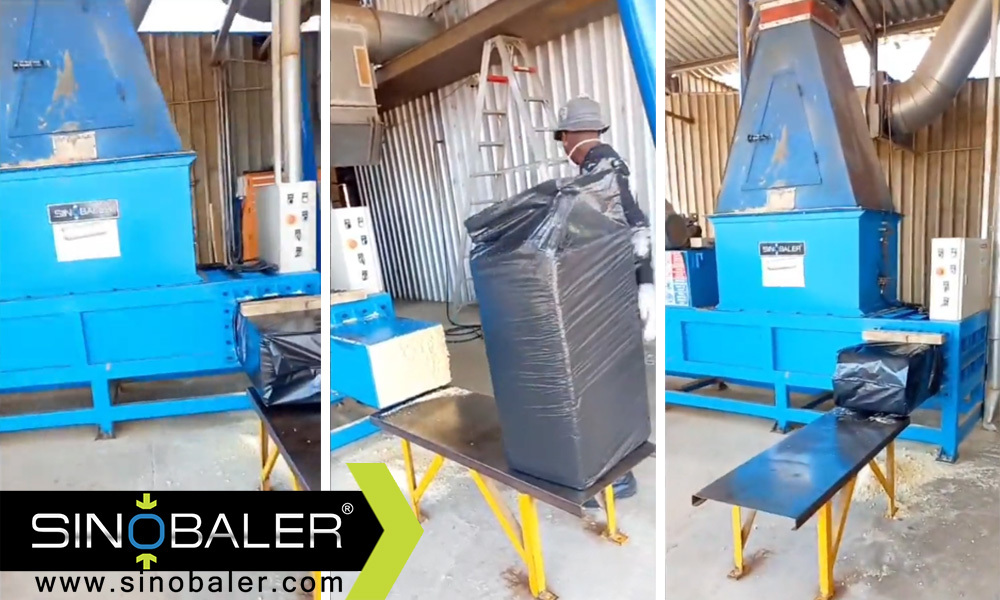
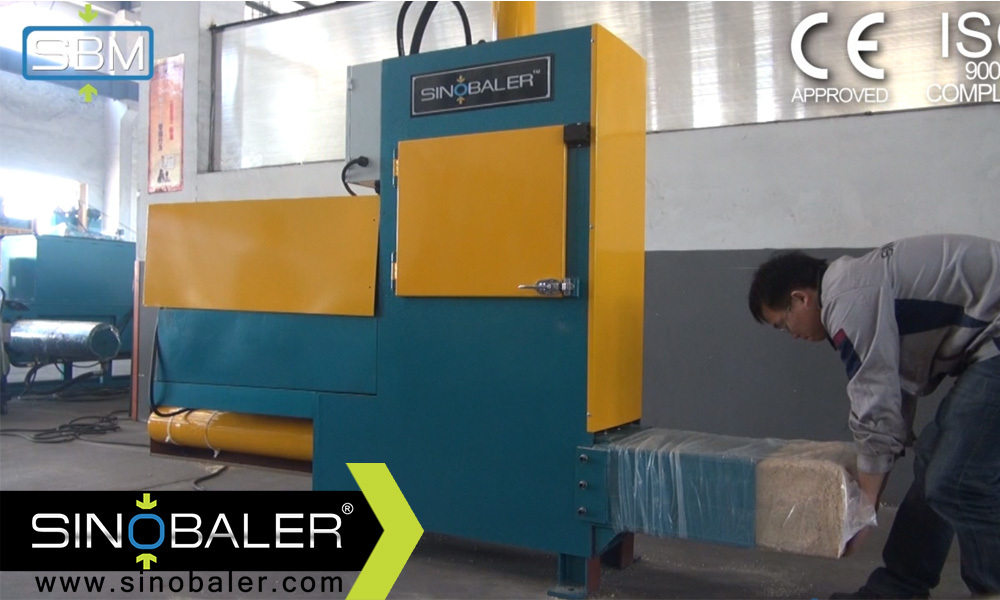
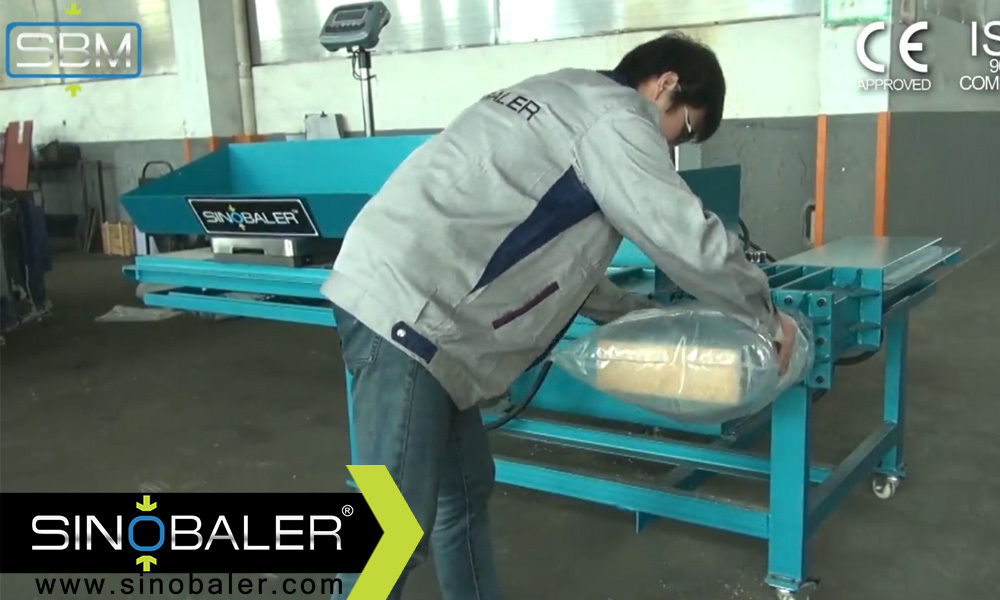
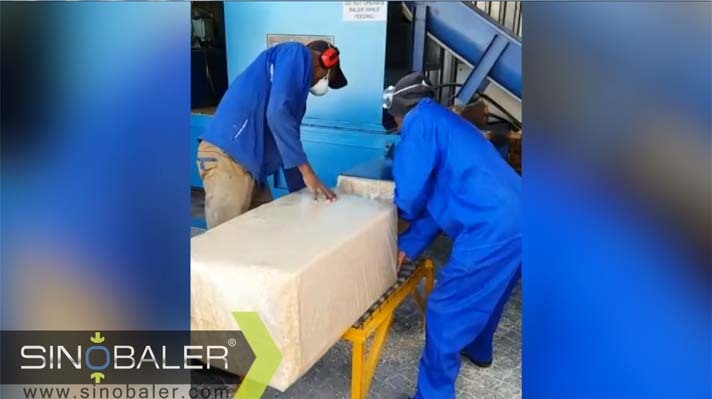
PICTURES

APPLICABLE MACHINE

Vertical Bagging Baler Machine
Vertical bagging baler machines are perfect for compressing and bagging small, loose materials for easy handling and transport. They press materials into compact bales and bag them in one step, ideal for factories handling pet food, animal bedding, fertilizers, fabrics, and more. Suitable materials include peanut shells, cotton seeds, chopped straw, hay, wood shavings, fibers, and rice hulls. One person can produce up to 30 bales per hour, each weighing 44–66 lbs. The removable bag feature adds versatility, allowing the machine to bale other materials without bagging when needed.

Scale Weighing Horizontal Bagging Baler
Scale weighing horizontal bagging baler is ideal for packing loose materials like rags, straw, hay, wood shavings, pet food, and textile scraps. Commonly used in pet food plants, farms, fertilizer factories, and recycling centers, it helps turn loose waste into valuable, bagged bales. Equipped with PLC control, one-button operation, and a hopper sensor switch, it can produce 25kg bales (700×400×310mm) at up to 60 bales/hour. The built-in scale ensures precise bale weight. It automatically compresses, bags, and ejects materials for easy handling, storage, and transport.

Heavy Duty Horizontal Bagging Machine
One main use of a horizontal baling and bagging machine is for loose materials like sawdust, wood chips, rags, peanut shells, cotton seeds, and rice hulls. These are hard to handle, but this machine automatically feeds, compresses, and bags them for easier storage, transport, or resale. Sinobaler’s Horizontal Baling & Bagging Machine features PLC control, one-button operation, and a safety sensor switch. It produces 60 bales/hour (88 lbs each, 28×16×12 in). Ideal for textile recyclers, pet food plants, farms, fertilizer factories, and any site generating loose waste.

A biomass bagging baler is an industrial machine designed to compress loose biomass materials and pack them into bags for convenient storage, handling, and transportation. It is widely used in biomass power plants, agricultural processing facilities, waste-to-energy projects, and recycling centers. By reducing volume and stabilizing loose biomass, bagging balers help improve logistics efficiency and protect materials from moisture and contamination.
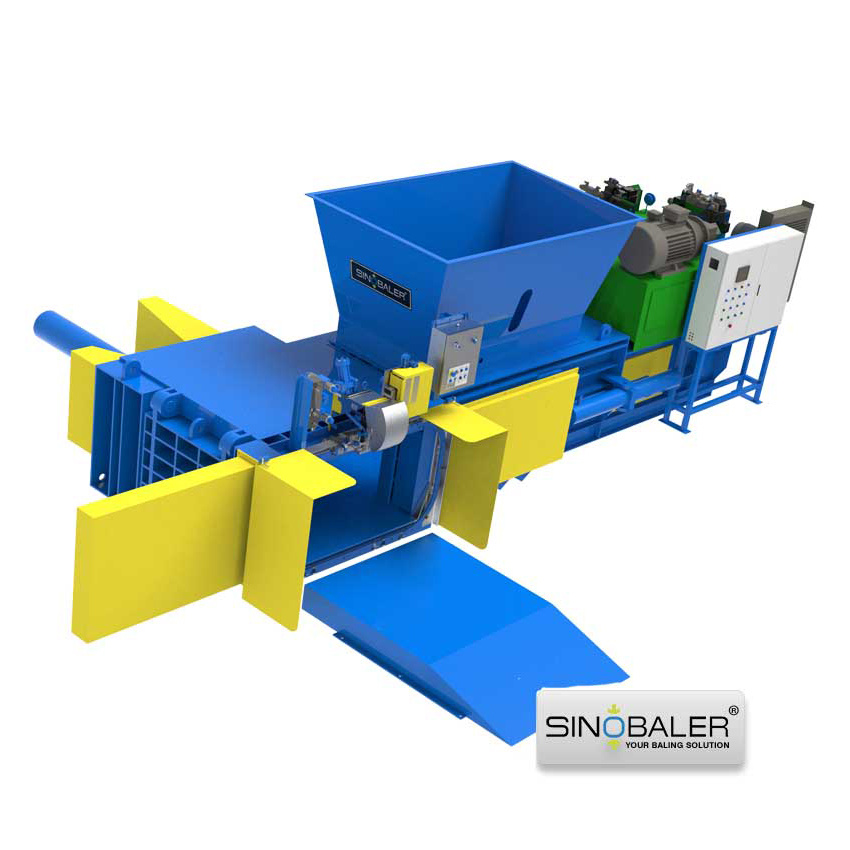
L-type Two Ram Automatic Horizontal Baler
The L-type two ram automatic horizontal baler is ideal for baling a wide range of recyclable waste. Compared to single ram balers, it offers greater versatility, supports both wire and plastic strapping, and produces high-density bales thanks to its separate strapping unit. Its flexible design can include features like a pre-compression lid to prevent cutting sensitive materials like textiles. Perfect for high-volume recycling centers, fodder exporters needing plastic straps, and municipal waste handlers seeking to avoid jams common in single ram balers.

Horizontal Briquetting Machine / Block Making Machine
Our horizontal briquetting machine is a smart solution for compressing loose materials like sawdust, chopped straw, rice husks, and peanut shells—materials that are hard to bale or transport. Instead of bagging, this machine compacts them into hard, regular-shaped briquettes that are easy to handle, store, or even burn as fuel. With a PLC system and hydraulic lifting door, it operates automatically and continuously. When paired with automatic feeding, no operator is needed. Compact in size, it fits almost anywhere and is widely used in farms, fertilizer plants, and bedding material factories.
Media and Gallery
Follow us


PRIVACY POLICY
We collect information from you when you fill out an inquiry or contact form. When submitting the form on our site, you may be asked to enter your name and contact details such as: e-mail address, mailing address and/or phone number, etc. Alternatively, you can choose not to complete our forms and visit our site anonymously. Any of the information we collect from you may be used to help us to better respond to your individual needs, and/or enable us to more effectively respond to your customer service requests and support needs. The email address you provided may also be used to send you information and updates pertaining to your inquiry and/or order, in addition to receiving occasional company news, updates, related product or service information, etc. SINOBALER does not sell, trade, or otherwise transfer to outside parties your personally identifiable information. This does not include trusted third parties who assist us in operating our website, conducting our business, or servicing you, so long as those parties agree to keep this information confidential. We may also release your information when we believe release is appropriate to comply with the law, enforce our site policies, or protect ours or others rights, property, or safety.
By using our site, you consent to our online privacy policy. If we decide to change our privacy policy, we will post those changes on this page. If you have any questions or concerns regarding our privacy policy, please e-mail info@sinobaler.com or mail your question to us at 1206 Yinzhou Shanghui Nan Lou, 1299 Yinxian Avenue, Yinzhou District, Ningbo 315192, P.R. China.
EXTERNAL LINKS & DISCLAIMER
Our web site has links to many other organizations with their permission. Upon leaving the SINOBALER web site, you are subject to the privacy policy of the new site which are not under our control. SINOBALER is not responsible for the content of any linked site or any link contained in a linked site. These links are provided to you as a service for you to better understand the different business relationships that SINOBALER has established, and/or to point the reader to other possible relevant resources.