







Category:
Long Stroke Baler (eg. Hollow Plastic Baler, PET Bottle Baler, Aluminum Can Baler)
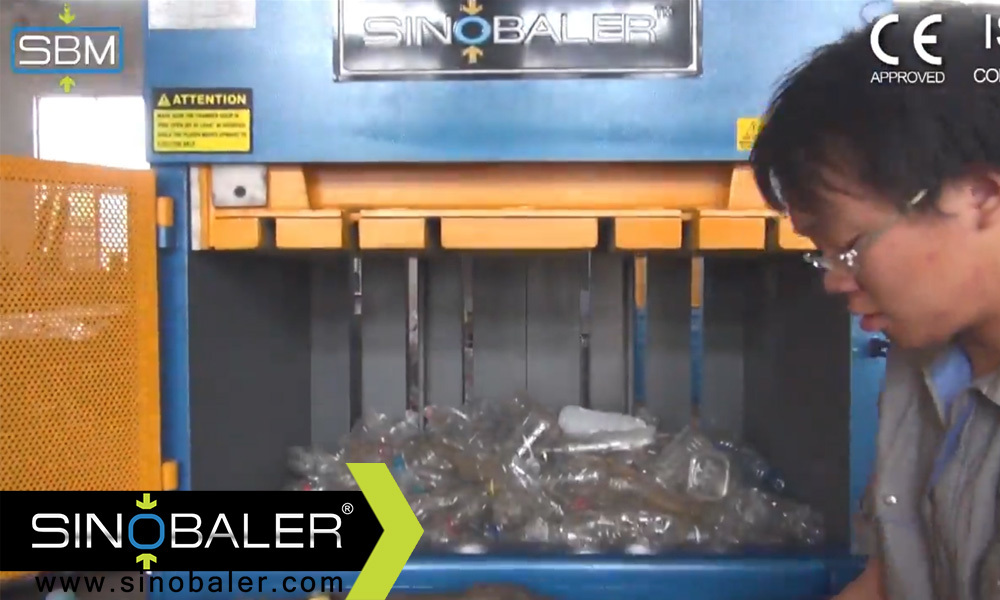
The long stroke baler is ideal for compacting plastic bottles (like PET) and aluminum cans into tight, manageable bales. This vertical hydraulic press is designed for long-stroke compression, combining baling and draining in one step with a liquid tray that collects residual fluids, keeping recycling areas clean and safe. It can produce bales up to 770 lbs, depending on material density, with a volume reduction ratio up to 25:1 for maximum compaction. SINOBALER offers various models and chamber sizes to meet different business needs for baling hollow products.


Product description
The long stroke baler machine is also popular as perfect plastic bottle baler (such as PET bottle baler) and aluminum can baler. This vertical hydraulic press is designed for long stroke pressing and known as bottle baling machine or can press. It is a must-have piece of equipment for any plastic or can recycling operation, and is ideal for crushing hollow products such as PET bottles and aluminum cans into tight and compact bales for easy handling, storage and transportation.
One time saving factor is that it combines baling and draining in one step. The liquid tray drainage system serves to catch fluid residues in bottles and cans. This is excreted during the crushing process. It makes for a far neater and safer recycling area.
In terms of force and bale sizes, our long stroke bottle baler models can produce up to 770lb bales. Of course the final weight will depend on the pre-bale density of hollow materials. Volume reduction ratio can reach 25:1 which is a very high compaction ratio. This is one of the main advantages of the long-stroke baler. Because it ensures full compaction of materials like cans and bottles. SINOBALER has several different PET bottle baler models with varying chamber sizes which ensure there is a model for every business. Of course, we can work with you and set the chamber size so it’s suitable for your specific hollow products baling needs.
Choose from the baler models below, or contact us for customized baling solution that will meet your needs. We’ll be happy to answer any of your questions on any waste recycling equipment within our catalog. View plastic bottle shredders and granulators.
Main Features
- Fixed Retainer Claws
prevents the compacted material from rebounding View Image

- Chain Bale Ejector
for easy and efficient bale ejecting with the lifting up of the chain. View Image

- Liquid Drainage Channel
for draining residual liquid in the containers out of the baler to keep the recycling area neater and safer. View Image

- Long Stroke
for efficient and full compaction of every hollow article in the bale. - Sliding Door
for convenient opening/closing and also reducing space occupation. When platen goes up, the door will be lifted up automatically, which promotes work efficiency and saves labor - Electric Controlled
for easy operation, simply by operating on buttons and switches to fulfill platen moving and bale ejecting - Hydraulic Driven Chamber Door is Optional
to enable door opening/closing only with an operation on a rotary switch, which promotes work efficiency and saves labor
Specifications
| Model | Bale size | Bale weight (for PET bottle) | Throughput | Strapping | ||
|---|---|---|---|---|---|---|
| Length | Width | Height | ||||
| SVBB2-300 |
800 mm (31 inch) |
600 mm (24 inch) |
200-800 mm (8-31 inch) |
35-100 kg (77-220 lbs) |
2-3 bales/hr |
PP/PET strap, steel wire, etc. |
| SVBB2-400 |
1000 mm (39 inch) |
600 mm (24 inch) |
300-900 mm (12-35 inch) |
50-140 kg (110-308 lbs) |
1-2 bales/hr |
|
| SVBB2-500 |
1100 mm (43 inch) |
700 mm (28 inch) |
300-1000 mm (12-39 inch) |
70-230 kg (154-506 lbs) |
1-2 bales/hr |
|
| SVBB2-700 |
1500 mm (59 inch) |
760 mm (30 inch) |
300-1000 mm (12-39 inch) |
100-380 kg (220-836 lbs) |
1-2 bales/hr |
|
CUSTOMER CASES

BALING Applications
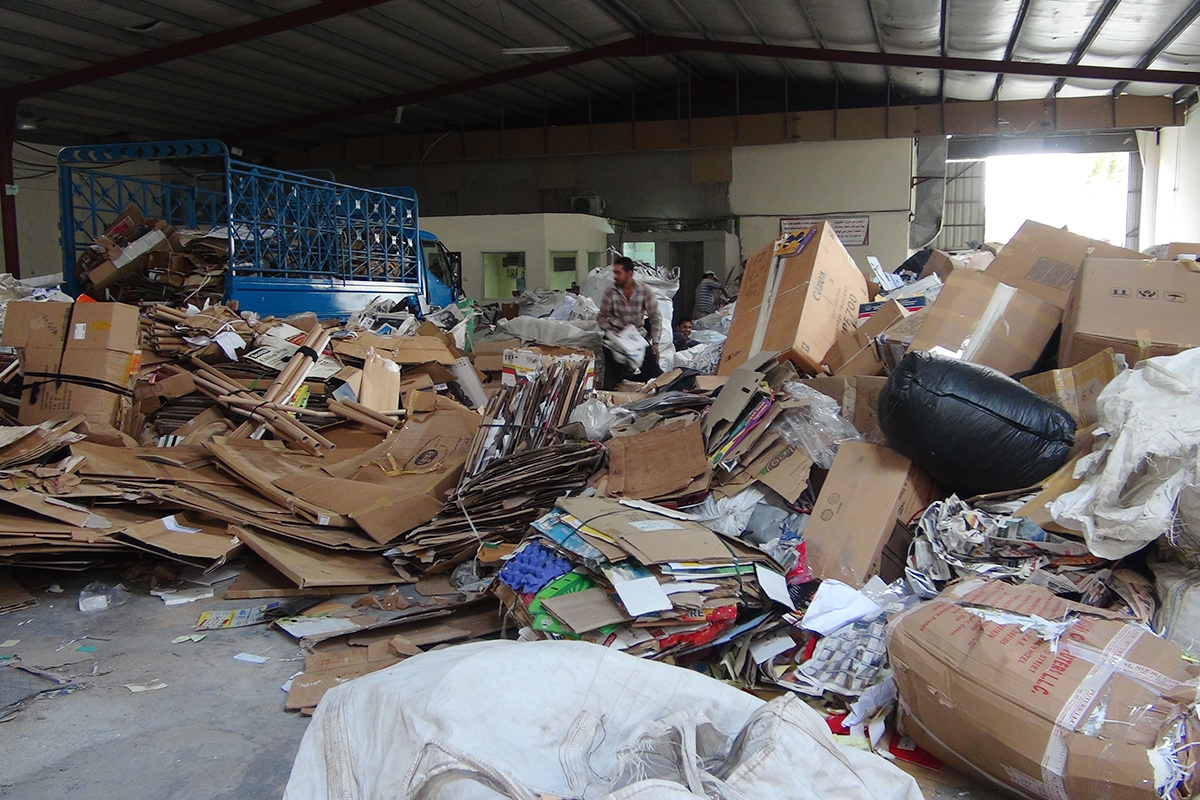
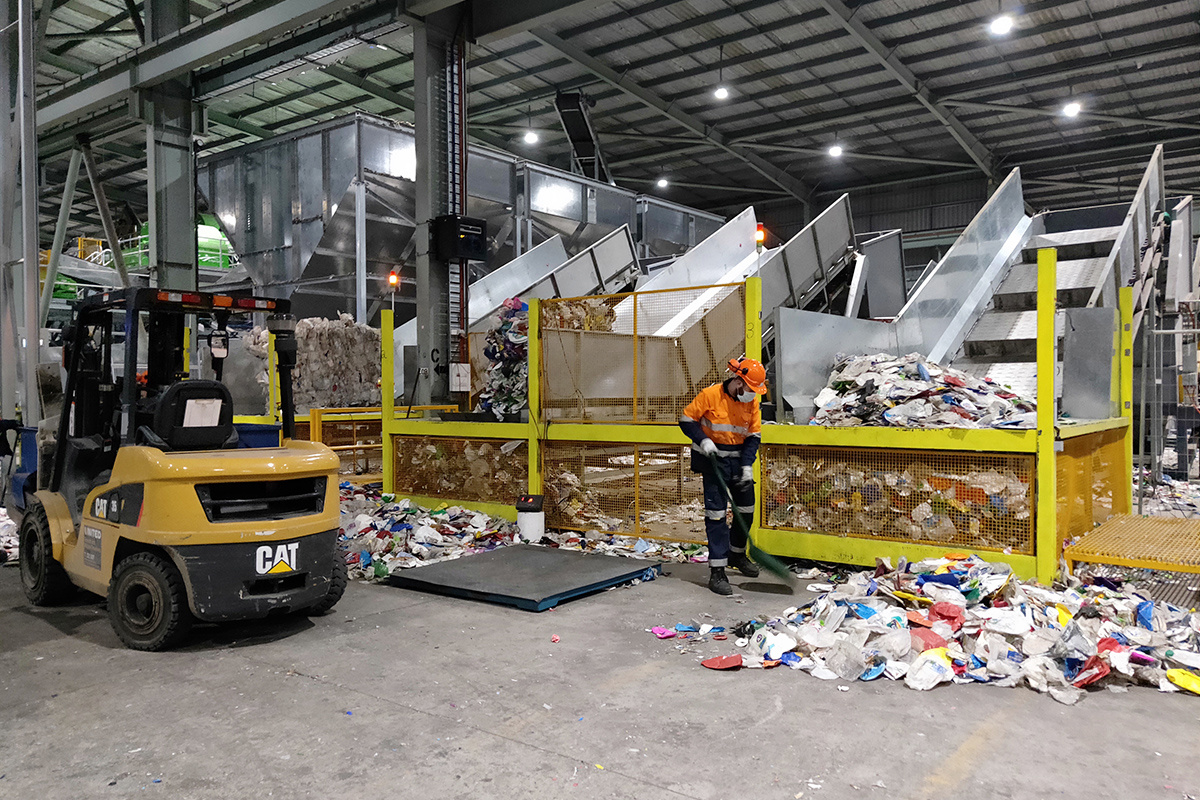
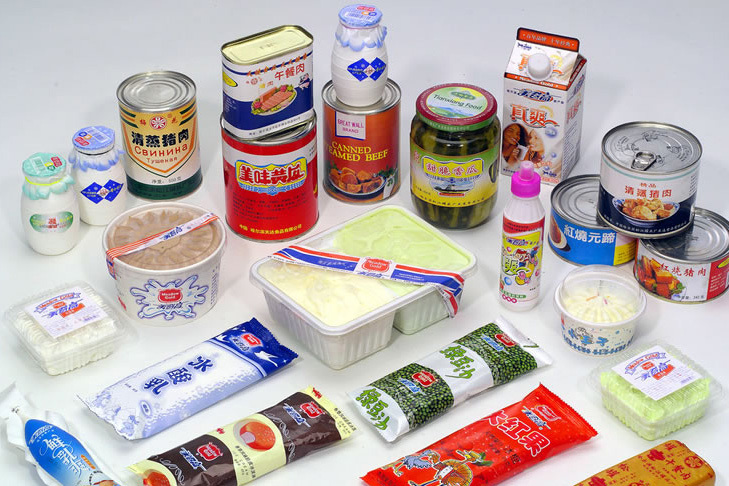
PET bottles, disposable plastic tableware, HDPE/PP jars, pop / soda cans, etc.
RELATED Baler & Accessories
FAQ about this machine
All our vertical balers are equipped with the adjustable bale height function, allowing the users to have the flexibility to adjust bale height according to their preference and requirements.
There are 2 types of devices to control bale height:
Type 1 – by Limit Switch
Type 2 – by Trigger Ring
Therefore, please refer to the appropriate device of your baler, and make the necessary adjustment as follow:
Type 1 – Limit Switch
• Move limit switch as per picture below within the adjustable range to adjust bale height as per your preference.

Type 2 – Trigger Ring
• Move trigger ring as per picture below within the adjustable range to adjust bale height as per your preference.

Increasing or decreasing the compressing pressure will directly affect the density of your bale. Please follow the steps below to learn how to adjust compressing pressure on your baler. Remember to refer to the safety working pressure stated on your Operator Instruction Manual to ensure you don’t go above the limit.
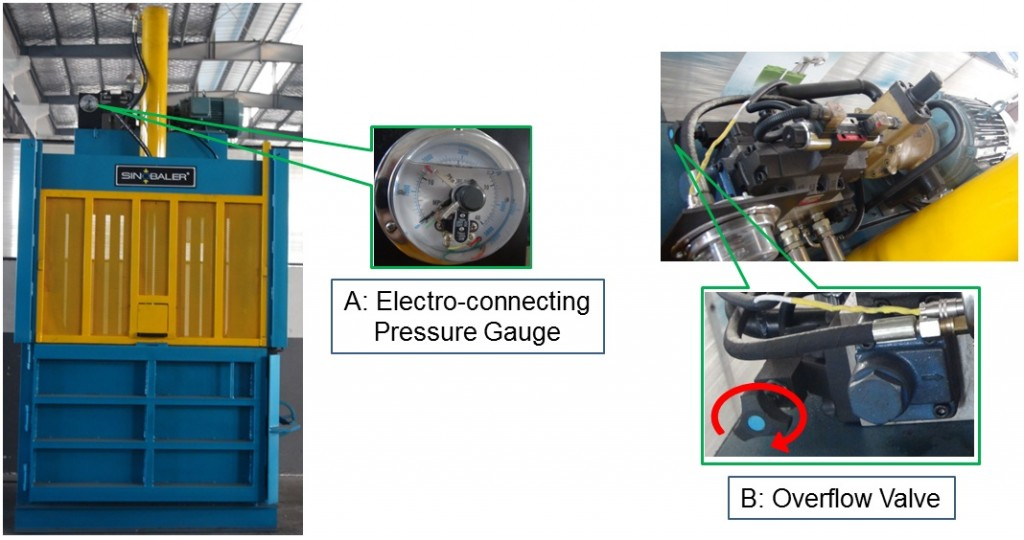
Pressure adjustment steps for Long Stroke Baler:
1. Turn on the power and start the motor.
2. Adjust overflow valve (see B) by turning knob clockwise as per the red arrow during baling, you will see the pointer of electro-connecting pressure gauge (see A) increase during the process. Turning the knob anti-clockwise, you will see a decrease of pressure.
NOTE:
– Adjust the valve slowly to achieve higher pressure, check the pressure gauge at all time so as to not increase too much at one time.
– The recommended pressure has already been set at our factory before delivery. Therefore, do not make any adjustment to pressure unless it is necessary.
Upon releasing your baling machine from our factory, we will indicate the required amount of hydraulic oil based on your working condition and environment temperature, and reflect it as Best Oil Level for your baler.
You can easily refer to the “Best Oil Level” stickers as a gauge when you are filling up the oil tank and conduct regular checks on oil level (as seen on picture, slight variation above or below the level line is acceptable).
Taking into consideration that actual operation hours and conditions may varies from time to time, regular checks on oil temperature and level is strongly recommended.
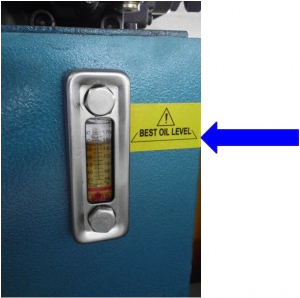
Best Oil Level sticker
It is important that clean hydraulic oil is in the pump before running the machine in order to lubricate the bearings and transmission system.
Therefore, do check the pump once you filled up the oil tank, steps as follow:
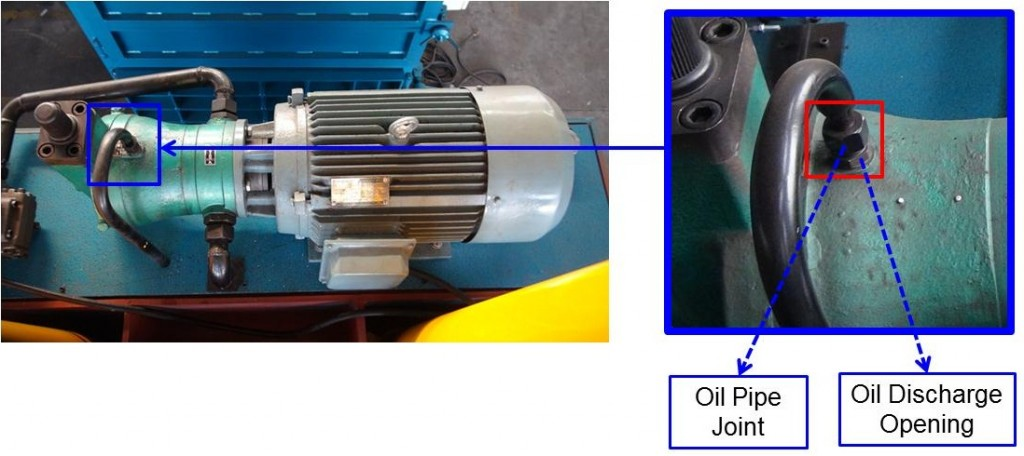
• Unscrew and remove the oil pipe joint using a wrench.
• Once joint and oil pipe is removed, you can see the oil discharge opening. Fill hydraulic oil through the opening until it is full to the brim. (If there is air in the pump, it will create loud noise when you run it, which might cause damages)
• Reconnect the oil pipe and ensure the joint is tightly fastened.
Ejecting a bale from a baler depends on the type of baler (vertical or horizontal) and the material being baled. Here’s a detailed guide:
Safety First
- Ensure the baling cycle is fully complete and the compression ram is fully retracted.
- Clear the area around the ejection path.
- Use appropriate PPE (gloves, shoes, safety goggles).
The Type of Balers
- Common for: Small to medium bales, light materials like cardboard, textiles, aluminum, or plastic.
- Steps to Eject:
- Ensure the baling cycle is complete and the ram is fully retracted.
- Open the front door or chamber door.
- The compressed bale usually drops onto the built-in floor or rollers. You may need to push it slightly with a lever or tool.
- Remove the bale manually or with a pallet jack/forklift if needed.
- Close the door and reset the baler for the next cycle.
- Ensure the baling cycle is complete and the ram is fully retracted.
- Common for: Larger bales, heavier materials like metals, plastics, hay or textiles.
- Steps to Eject:
- Complete the baling and tying cycle.
- Activate the bale ejection system (often hydraulic). This pushes the bale out of the compression chamber. For fully automatic balers, the system automatically ejects the bale onto a conveyor or into a receiving area after compressing and tying.
- The bale is pushed onto the bale chute, conveyor, or floor, depending on the model. For fully automatic balers, operators only need to ensure the path is clear for the bale.
- Use a forklift, pallet jack, or grabber to move the bale to storage or shipment.
- Complete the baling and tying cycle.
Manual or the Available Equipment
1. Manual Handling (Small Bales)
- Suitable for lightweight bales.
- Steps:
- Ensure the baler has completed the compression and tying process.
- Open the ejection door carefully.
- Slide the bale out onto a pallet or a flat, stable surface.
- Use proper lifting techniques to avoid injury (bend knees, keep back straight).
- Ensure the baler has completed the compression and tying process.
⚠️ Safety tip: Always wear gloves and steel-toed shoes when handling metal bales.
2. Using a Forklift or Pallet Jack
- Recommended for medium to large bales.
- Steps:
- Position the forklift or pallet jack at the end of the baler where the bale is ejected.
- If the baler has a bale chute or roller table, let the bale slide onto it first.
- Lift the bale carefully using forks or a pallet, ensuring the load is balanced.
- Transport the bale to storage or shipping area.
- Position the forklift or pallet jack at the end of the baler where the bale is ejected.
💡 Many balers have a built-in roller conveyor that helps bales slide onto a pallet or forklift platform automatically.
3. Using a Grabber or Crane (Heavy/Industrial Bales)
- For very heavy bales (eg. large metal bales).
- Steps:
- Attach a bale grabber or hook to the crane.
- Engage the grabber securely around the bale.
- Lift the bale gently and move it to the storage area.
- Release the bale slowly, ensuring it lands safely.
- Attach a bale grabber or hook to the crane.
⚠️ Safety tip: Always check that the crane or grabber’s lifting capacity exceeds the bale weight.
General Tips
- Always wait until the compression ram has fully retracted before opening doors.
- Regularly maintain rollers or conveyor systems to ensure smooth bale movement.
- Keep hands and tools clear of the ejection path to avoid injury.
- For heavy bales, always use mechanical assistance (forklift, grabber, or conveyor).
- Check the baler’s manual for specific ejection controls and safety interlocks.
I agree that my personal data collected by SINOBALER is processed, used and stored in compliance with data protection exclusively for the purpose of processing my request.
Media and Gallery
Follow us

PRIVACY POLICY
We collect information from you when you fill out an inquiry or contact form. When submitting the form on our site, you may be asked to enter your name and contact details such as: e-mail address, mailing address and/or phone number, etc. Alternatively, you can choose not to complete our forms and visit our site anonymously. Any of the information we collect from you may be used to help us to better respond to your individual needs, and/or enable us to more effectively respond to your customer service requests and support needs. The email address you provided may also be used to send you information and updates pertaining to your inquiry and/or order, in addition to receiving occasional company news, updates, related product or service information, etc. SINOBALER does not sell, trade, or otherwise transfer to outside parties your personally identifiable information. This does not include trusted third parties who assist us in operating our website, conducting our business, or servicing you, so long as those parties agree to keep this information confidential. We may also release your information when we believe release is appropriate to comply with the law, enforce our site policies, or protect ours or others rights, property, or safety.
By using our site, you consent to our online privacy policy. If we decide to change our privacy policy, we will post those changes on this page. If you have any questions or concerns regarding our privacy policy, please e-mail info@sinobaler.com or mail your question to us at 1206 Yinzhou Shanghui Nan Lou, 1299 Yinxian Avenue, Yinzhou District, Ningbo 315192, P.R. China.
EXTERNAL LINKS & DISCLAIMER
Our web site has links to many other organizations with their permission. Upon leaving the SINOBALER web site, you are subject to the privacy policy of the new site which are not under our control. SINOBALER is not responsible for the content of any linked site or any link contained in a linked site. These links are provided to you as a service for you to better understand the different business relationships that SINOBALER has established, and/or to point the reader to other possible relevant resources.