







LDPE Film
Need to bale large volumes of loose LDPE film, plastic bags, stretch film, or packaging film? SINOBALER provides hydraulic baling solutions designed to compress lightweight, bulky LDPE film into compact bales for easier storage, handling, transportation, recycling, and resale.
Unlike rigid plastics, LDPE film has a very low bulk density and tends to expand after compression. Selecting the right baler therefore requires more than simply choosing a machine with high pressing force. The feeding method, compression chamber, bale dimensions, bale density, tying method, and expected production volume all need to be considered together.
Tell us your LDPE film type, daily volume, desired bale weight, and available power supply. SINOBALER can recommend a suitable film baling solution for your application.
What Types of LDPE Film Can Be Baled?
SINOBALER baling solutions can be considered for a wide range of flexible polyethylene film applications, including:
Material | Typical Source | Baling Consideration |
Stretch film | Warehouses, logistics centers | Lightweight and highly elastic |
Shrink film | Packaging operations | May require controlled feeding |
Retail and commercial waste | Very low bulk density | |
Packaging film | Manufacturing & distribution | May be mixed with labels |
Pallet wrapping film | Warehouses & factories | Often generated continuously |
Industrial PE film | Manufacturing plants | Volume and contamination vary |
Agricultural LDPE film | Agricultural operations | May contain soil or moisture |
Important: The exact baler configuration should be selected according to the film thickness, contamination level, moisture, bale weight, production volume, and final bale requirements.
Which LDPE Film Baler Is Right for Your Application?
There is no single baler configuration that is ideal for every LDPE film application.
The right machine depends primarily on how much film you generate and what you want the finished bale to look like.
Option 1: Vertical LDPE Film Baler
A vertical baler can be suitable for smaller or medium-volume operations where floor space and investment budget are important considerations.
Typical applications include:
- Retail stores
- Warehouses
- Small recycling operations
- Manufacturing facilities
- Distribution centers
- Commercial waste collection
Advantages
- Compact footprint
- Relatively simple operation
- Suitable for lower-volume film collection
- Lower initial investment for many applications
- Convenient for decentralized waste collection
The operator typically loads the loose LDPE film into the chamber, starts the compression cycle, and secures the finished bale.
Option 2: Horizontal LDPE Film Baler
For recycling plants, distribution centers, manufacturing facilities, and other operations generating larger quantities of LDPE film, a horizontal baler can provide a more efficient production workflow.
Horizontal balers can be configured with different feeding and bale-tying arrangements depending on production requirements.
Possible feeding methods include:
- Manual feeding
- Conveyor feeding
- Forklift-assisted feeding
- Automatic feeding from an upstream sorting or recycling line
Why Choose a Horizontal LDPE Film Baler?
A horizontal baling system is particularly attractive when the customer needs:
- Higher production capacity
- Continuous material feeding
- Larger bale sizes
- Integration with conveyors
- Reduced manual handling
- Automatic or semi-automatic operation
For high-volume LDPE film recycling, a horizontal baler can become part of an integrated recycling and waste-management system rather than operating as a standalone machine.
Manual-Tie vs. Automatic-Tie LDPE Film Baler
The tying method has a major effect on labor requirements and production efficiency.
Manual-Tie LDPE Film Baler
After compression, operators manually tie the bale using suitable bale-tying material.
This configuration can be a cost-effective choice when:
- Production volume is moderate
- Labor is available
- Initial equipment investment needs to be controlled
- Fully automatic operation is not required
Automatic-Tie LDPE Film Baler
An automatic tying system can significantly reduce manual bale handling.
It can be considered when:
- Film volume is high
- Continuous production is required
- Labor costs are significant
- The baler is integrated into an automated recycling line
- Consistent bale production is important
The best choice is not necessarily the most automated machine. The tying system should match your actual production volume and labor conditions.
How Should LDPE Film Be Fed into the Baler?
Feeding is one of the most important factors in an LDPE film baling system.
Manual Feeding
Manual feeding is suitable for relatively small quantities or operations where plastic film is collected in bags, bins, cages, or loose piles.
Typical flow:
Film Collection → Manual Loading → Baler → Bale Tying → Bale Ejection
This is usually the simplest configuration.
Conveyor Feeding
For larger quantities, a conveyor can continuously deliver LDPE film to the baler.
Film Collection → Sorting → Conveyor → Baler → Bale Tying → Bale Ejection
A conveyor-fed system can reduce manual loading and improve production consistency.
The conveyor design should take into account the low density and flexible nature of plastic film.
Integrated Recycling Line
For larger recycling plants, LDPE film can be collected, sorted, compacted, and baled as part of an integrated material recovery process.
A typical system may include:
Plastic Film Collection
↓
Sorting
↓
Contaminant Removal
↓
Conveying
↓
LDPE Film Baler
↓
Automatic Bale Tying
↓
Bale Ejection
↓
Weighing / Labeling
↓
Warehouse Storage
This configuration is particularly useful when consistent daily production is required.
What Bale Weight Can Be Achieved?
Bale weight depends on several variables, including:
- LDPE film thickness
- Material cleanliness
- Film type
- Moisture content
- Bale dimensions
- Compression force
- Compression density
- Feeding consistency
- Tying method
For this reason, bale weight should not be estimated from hydraulic force alone.
If you need a specific bale weight—for example, 20 kg, 50 kg, 100 kg, 150 kg, or another target—provide the desired bale dimensions and material characteristics so the appropriate baler configuration can be evaluated.
LDPE Film Baler Selection Guide
Before purchasing a plastic film baler, we recommend answering the following questions.
1. How much LDPE film do you generate?
Provide:
- kg/hour
- tons/day
- tons/month
- or approximate volume/day
This is the starting point for determining the required production capacity.
2. What type of film are you processing?
For example:
- Stretch film
- Shrink film
- Plastic bags
- Packaging film
- Agricultural film
- Industrial LDPE film
Different film types can behave differently during compression.
3. What is the target bale weight?
A target bale weight helps determine the appropriate chamber size and compression configuration.
4. How dense do you need the bale?
Some customers primarily want to reduce storage volume, while others need dense bales optimized for transportation and recycling.
These are not necessarily the same requirement.
5. How will the film be fed?
Choose between:
Manual feeding → Conveyor feeding → Automated line integration
6. How will the bales be secured?
Possible configurations include:
Manual tying → Semi-automatic operation → Automatic tying
7. What is your power supply for LDPE film baler?
Provide the local:
- Voltage
- Phase
- Frequency
For example:
380V / 3 Phase / 50Hz
Or
415V / 3 Phase / 50Hz
Or
220V / 3 Phase / 60Hz
The electrical configuration should be confirmed before manufacturing.
LDPE Film Baling for Recycling
For recycling companies, baling is often the final stage of the material preparation process.
The objective is not simply to compress the film.
The finished bale should be:
- Stable
- Compact
- Easy to handle
- Suitable for forklift handling
- Efficient to store
- Efficient to transport
- Suitable for the customer's downstream recycling process
A properly selected baler can therefore reduce the amount of storage space required and improve transportation efficiency.
For recycling companies selling recovered LDPE film, consistent bale size and stable bale formation can also make downstream handling easier.
LDPE Film Baler for Warehouses & Distribution Centers
Warehouses and distribution centers can generate substantial quantities of stretch film and pallet wrapping film every day.
Instead of storing loose film in large bags or cages, a baler can consolidate the material into compact bales.
Typical Application
Pallet Wrapping
↓
Waste Stretch Film Collection
↓
Temporary Storage
↓
LDPE Film Baler
↓
Compact Film Bales
↓
Recycling / Resale
For facilities with continuous film generation, a conveyor-fed horizontal baler may be more appropriate than a small standalone vertical baler.
LDPE Film Baler for Plastic Recycling Plants
Plastic recycling facilities often handle multiple material streams.
LDPE film may be separated from:
- PET bottles
- HDPE containers
- PP plastics
- Cardboard
- Mixed municipal waste
- Other packaging materials
After sorting, the LDPE film can be directed to a dedicated baling station.
For larger plants, the baler can be integrated with the existing conveyor and sorting system.
The objective is to match the baler capacity with the upstream material flow.
An oversized baler can increase investment without providing meaningful benefits, while an undersized baler can become a bottleneck in the recycling line.
LDPE Film Baler vs. Plastic Compactor
These terms are sometimes used interchangeably, but the equipment configuration can be different.
An LDPE film baler is designed to form the compressed material into a retained bale that can be removed and handled as a unit.
A compactor may instead focus primarily on reducing the volume of waste inside a container or chamber.
If your objective is to produce transportable and recyclable bales, a dedicated baling system is generally the more appropriate solution.
Why Choose SINOBALER for LDPE Film Baling?
SINOBALER specializes in hydraulic baling equipment and customized recycling applications.
For LDPE film, we do not recommend selecting a machine only according to the material name.
Instead, we evaluate the complete application:
Material → Volume → Feeding → Compression → Bale Formation → Tying → Ejection → Handling
This approach allows the baler to be configured around the customer's actual operating conditions.
SINOBALER can provide solutions for:
- LDPE film
- Stretch film
- Plastic bags
- Packaging film
- Textile waste
- Cardboard
- Paper waste
- PET bottles
- Agricultural waste
- Biomass
- Other recyclable materials
What Information Should You Send Us for an LDPE Film Baler Quote?
To recommend a suitable machine, please send us the following information:
1. Material:
What type of LDPE film are you processing?
2. Capacity:
How many kg/day or tons/day?
3. Bale weight:
What target bale weight do you need?
4. Bale size:
Do you have a required bale dimension?
5. Feeding:
Manual, conveyor, or automatic?
6. Bale tying:
Manual tying or automatic tying?
7. Power supply:
Voltage / Phase / Frequency
8. Installation:
Indoor or outdoor?
9. Final application:
Storage, transportation, resale, or recycling?
10. Material photos/videos:
Photos or a short video of your actual LDPE film are highly recommended.
Send Us Your LDPE Film Baling Requirements
Looking for an LDPE film baler for a recycling plant, warehouse, factory, or distribution center?
Send SINOBALER your film type, daily quantity, target bale weight, feeding method, and power supply.
We will evaluate your application and recommend a suitable LDPE film baling machine and system configuration based on your actual requirements.
Your material determines the machine. Let's design the right baling solution for your application.
Explore more LDPE film size reduction solutions from PROSINO shredders and granulators.
VIDEOS



PICTURES

Similar Applications
APPLICABLE MACHINE
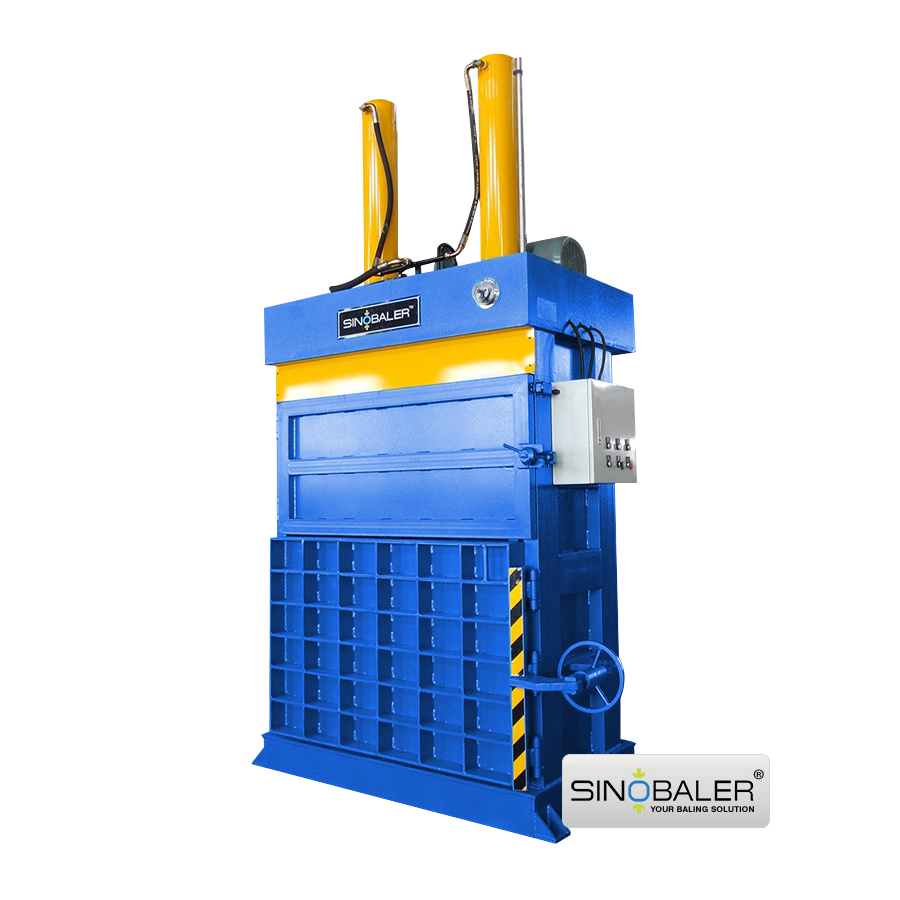
The Sinobaler Heavy Duty Dual Ram Baler delivers 80–200 tons of press force via its dual-ram system, ideal for compacting tough, fibrous, or rebounding materials, as well as soft ones requiring high bale density for optimized loading. It's perfect for natural and synthetic fibers, metal panels, tubes, profiles, and hard plastics like electronics shells and pipes. This baler reduces storage space, cuts transport costs, and boosts efficiency—making it a smart investment for modern recycling and waste handling.
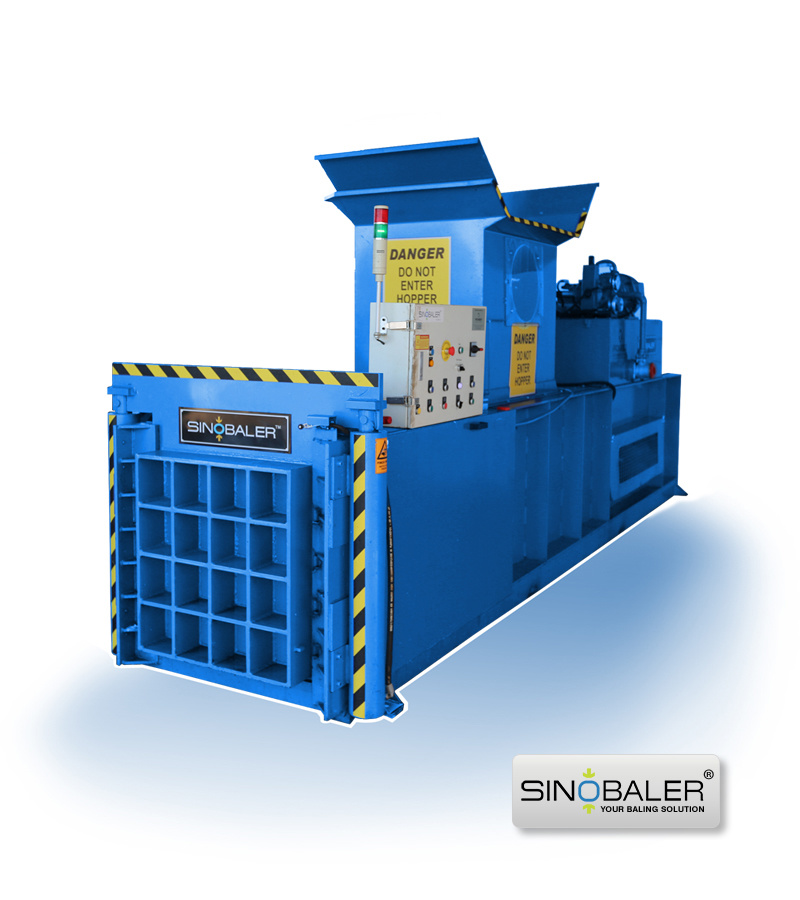
Sinobaler’s Manual Tie Horizontal Baler, also called a semi-automatic horizontal baler, handles solid and hollow waste like cardboard, PET bottles, textiles, and more. Ideal for facilities processing under 4 tons/hour with low labor costs, it offers automatic feeding, compressing, door control, and bale ejection—only the tying is manual. Press force ranges from 40 to 120 tons, with bale weights from 200kg to 850kg. Custom chamber sizes, power packs (up to 45kW), and conveyor options are available to boost productivity up to 5 bales/hour.
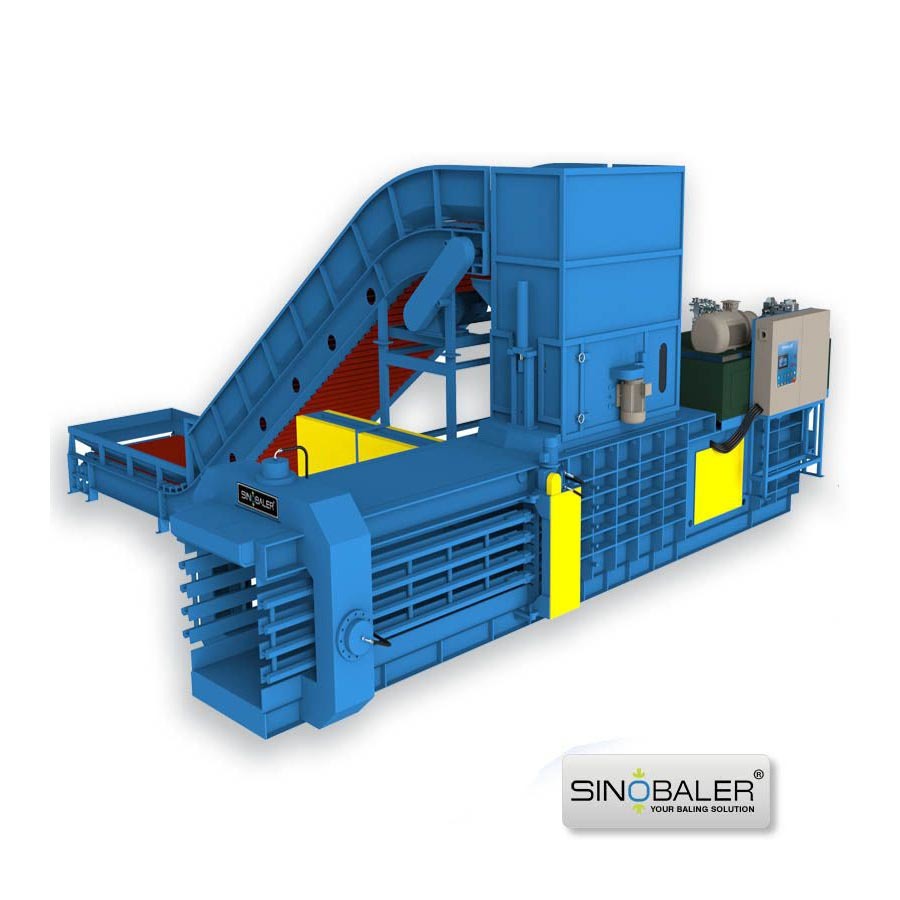
Fully Automatic Horizontal Baler
Sinobaler’s fully automatic horizontal baler (20–120 tons pressure) processes up to 15 tons/hour, ideal for high-volume recyclers handling cardboard/OCC, paper, plastic film, textile waste, and more. As our flagship open-end auto-tie baler, it features Mitsubishi PLC control, remote support, and simple operation. Bale weight/length is programmable via a touch screen for optimized container loading. The SHBA2-1200 model produces dense 1200kg rectangular bales, easy for transport/storage. CE-compliant with safety interlocking, SHBA2 is the perfect solution for large-scale soft waste recycling.

Open-end Manual-tie Horizontal Baler With Wire Threader
This open-end manual-tie horizontal baler with wire threader offers nearly all functions of a fully automatic baler—except automatic tying. The built-in threading mechanism pushes wire or belt into strapping slots automatically, unlike standard manual-tie balers. While its productivity is about 20% less than a full-auto baler of the same size, it allows flexible strapping materials like steel wire, PET belt, or rope. Ideal for medium-scale recyclers or producers of solid waste, animal bedding, or feed who need efficient, cost-effective baling without sharp metal in bales. Best suited for soft or solid waste, not hollow plastic containers.

Open-end Manual-tie Horizontal Baler
Sinobaler SHB1-O series open-end manual-tie horizontal baler features an open-end design for continuous bale output, improving productivity by 50% over close-end balers. Strapping setup is needed only once, saving labor like a fully automatic baler. It supports various strapping materials—steel wire, PET strap, rope, etc.—making it ideal for high-volume solid waste or biomass baling. Not suited for hollow plastics due to lower density. A cost-effective choice for mid-scale recyclers or facilities needing efficient, labor-saving baling with limited investment.

Cardboard Baler (eg. Mill Size Baler)
The standard mill size baler is one of Sinobaler’s most popular vertical baling machines, ideal for handling cardboard and carton waste. Also known as a cardboard or carton baler, it suits recycling centers, cardboard manufacturers, supermarkets, stores, and print shops generating large cardboard waste. It compresses waste into dense bales up to 520kg with a size of 1520×760×1220mm, reducing volume by about 12:1. Easy to operate with manual door opening and auto bale ejection, it saves storage space, transport, and labor costs while meeting safety standards.

Mini Baler / Marine Baler / Multi Purpose Baling Machine
Sinobaler’s Multi-purpose Baler (Mini Baler) is a compact, versatile vertical baler ideal for malls, hotels, offices, hospitals, houses, and vessels, making it popular as a Marine Baler due to its small footprint and height. It meets marine industry needs with standard, waterproof, and explosion-proof versions, helping over 300 vessels reduce waste storage and disposal costs by up to 60%. This baler handles soft waste like cardboard, paper, cans, bottles, and film, with 10–20 tons press force, up to 800×600×800mm bale size, 20–100kg bale weight, and 12:1 compaction ratio for easy storage and transport.
Media and Gallery
Follow us


PRIVACY POLICY
We collect information from you when you fill out an inquiry or contact form. When submitting the form on our site, you may be asked to enter your name and contact details such as: e-mail address, mailing address and/or phone number, etc. Alternatively, you can choose not to complete our forms and visit our site anonymously. Any of the information we collect from you may be used to help us to better respond to your individual needs, and/or enable us to more effectively respond to your customer service requests and support needs. The email address you provided may also be used to send you information and updates pertaining to your inquiry and/or order, in addition to receiving occasional company news, updates, related product or service information, etc. SINOBALER does not sell, trade, or otherwise transfer to outside parties your personally identifiable information. This does not include trusted third parties who assist us in operating our website, conducting our business, or servicing you, so long as those parties agree to keep this information confidential. We may also release your information when we believe release is appropriate to comply with the law, enforce our site policies, or protect ours or others rights, property, or safety.
By using our site, you consent to our online privacy policy. If we decide to change our privacy policy, we will post those changes on this page. If you have any questions or concerns regarding our privacy policy, please e-mail info@sinobaler.com or mail your question to us at 1206 Yinzhou Shanghui Nan Lou, 1299 Yinxian Avenue, Yinzhou District, Ningbo 315192, P.R. China.
EXTERNAL LINKS & DISCLAIMER
Our web site has links to many other organizations with their permission. Upon leaving the SINOBALER web site, you are subject to the privacy policy of the new site which are not under our control. SINOBALER is not responsible for the content of any linked site or any link contained in a linked site. These links are provided to you as a service for you to better understand the different business relationships that SINOBALER has established, and/or to point the reader to other possible relevant resources.