







Acrylic Fiber
An Acrylic Fiber Baler is a specialized baling machine designed to compress acrylic fiber waste into dense, manageable bales. Acrylic fiber, also known as 腈纶 in Chinese, is a synthetic fiber widely used in textiles, clothing, upholstery, and various industrial applications. The production and processing of acrylic fibers generate significant amounts of waste, and managing this waste efficiently is essential.
Baling acrylic fiber waste is essential for several operational, environmental, and financial reasons. Acrylic fibers are lightweight and bulky, making them difficult to manage without proper compression. Below are the key reasons for baling acrylic fiber:
1. Space Optimization
Reason: Acrylic fiber waste takes up a significant amount of space when left uncompressed, leading to inefficient use of storage areas.
Benefit: Baling compresses the fibers into dense, manageable bales, freeing up valuable storage and production space in factories and recycling facilities. This allows for better organization and more efficient material handling.
2. Cost-Efficient Transportation
Reason: Uncompressed acrylic fiber waste occupies more volume, resulting in higher transportation costs due to the larger number of trips required to transport the same amount of waste.
Benefit: Baling reduces the volume of acrylic fiber waste, allowing more material to be transported in fewer trips, which directly reduces shipping and fuel costs. This is particularly beneficial for companies that regularly ship waste to recycling centers or disposal facilities.
3. Improved Waste Management
Reason: Loose acrylic fiber can create clutter and potential hazards in the workplace, making waste management less efficient and increasing the risk of accidents.
Benefit: By baling acrylic fiber, businesses can streamline their waste management process. Bales are easier to store, handle, and transport, ensuring a cleaner, safer, and more organized working environment.
4. Enhanced Recycling Efficiency
Reason: Acrylic fiber is recyclable, but loose fibers are difficult to handle in recycling facilities.
Benefit: Baled acrylic fibers are easier to process and transport to recycling centers. This enhances the efficiency of recycling operations, reduces the environmental footprint, and promotes a more circular economy by repurposing the fibers into new products.
5. Compliance with Environmental Regulations
Reason: Many industries are subject to strict waste disposal regulations, especially when dealing with synthetic fibers like acrylic.
Benefit: Baling acrylic fiber waste helps companies comply with waste disposal regulations by ensuring proper management and minimizing environmental impact. This helps avoid potential fines and ensures sustainable practices.
6. Reduction of Fire Hazards
Reason: Loose acrylic fibers are highly flammable and can pose a significant fire risk if not properly managed.
Benefit: Baling the fibers tightly reduces the exposure to air, making them less prone to ignition. Compact bales are also easier to store safely, reducing the overall fire risk in storage and processing areas.
7. Monetization of Waste
Reason: Acrylic fiber waste can have value in recycling markets, particularly in the textile industry.
Benefit: By baling acrylic fiber waste, businesses can sell the compact bales to recycling companies, creating an additional revenue stream. This turns waste into a profitable resource while promoting recycling.
8. Improved Handling and Logistics
Reason: Loose fibers are difficult to handle manually or with machinery, leading to inefficiencies in moving waste within facilities.
Benefit: Baled acrylic fiber is easier to handle, stack, and transport, improving logistics and reducing labor costs. Handling dense bales also allows for better use of forklifts and other mechanical equipment.
9. Minimization of Landfill Usage
Reason: Uncompressed fiber waste takes up significant space in landfills, contributing to environmental issues.
Benefit: By baling acrylic fiber, businesses minimize the volume of waste sent to landfills, reducing environmental harm and promoting more sustainable disposal methods. Baling also supports waste reduction initiatives.
Applications of Acrylic Fiber Balers
Textile Manufacturing: Acrylic fiber is commonly used in the textile industry for creating fabrics, upholstery, and clothing. Fiber waste generated during production can be efficiently compressed using balers, ensuring that the manufacturing process remains environmentally responsible and cost-effective.
Carpet and Rug Production: Acrylic fibers are often used in the production of carpets and rugs. The waste generated during the cutting and weaving processes can be baled for recycling or disposal.
Fiber Recycling Facilities: Specialized facilities that recycle acrylic fiber waste rely on balers to compress materials for easy transport and further processing. The baled fibers are often used in the production of new fiber products, helping to close the recycling loop.
Automotive Industry: Acrylic fibers are sometimes used in automotive interiors, such as seat covers and upholstery. Balers are used to manage fiber waste generated during the production and assembly processes.
An Acrylic Fiber Baler is an essential tool for industries that handle large volumes of acrylic fiber waste. By compressing bulky fibers into compact bales, these machines offer numerous benefits, from space and cost savings to improved safety and environmental sustainability. Whether in textile production, carpet manufacturing, or recycling facilities, acrylic fiber balers play a crucial role in managing fiber waste efficiently and responsibly. Contact SINOBALER for your ideal baling solution.
Quick links:
VIDEOS
PICTURES
Similar Applications
APPLICABLE MACHINE
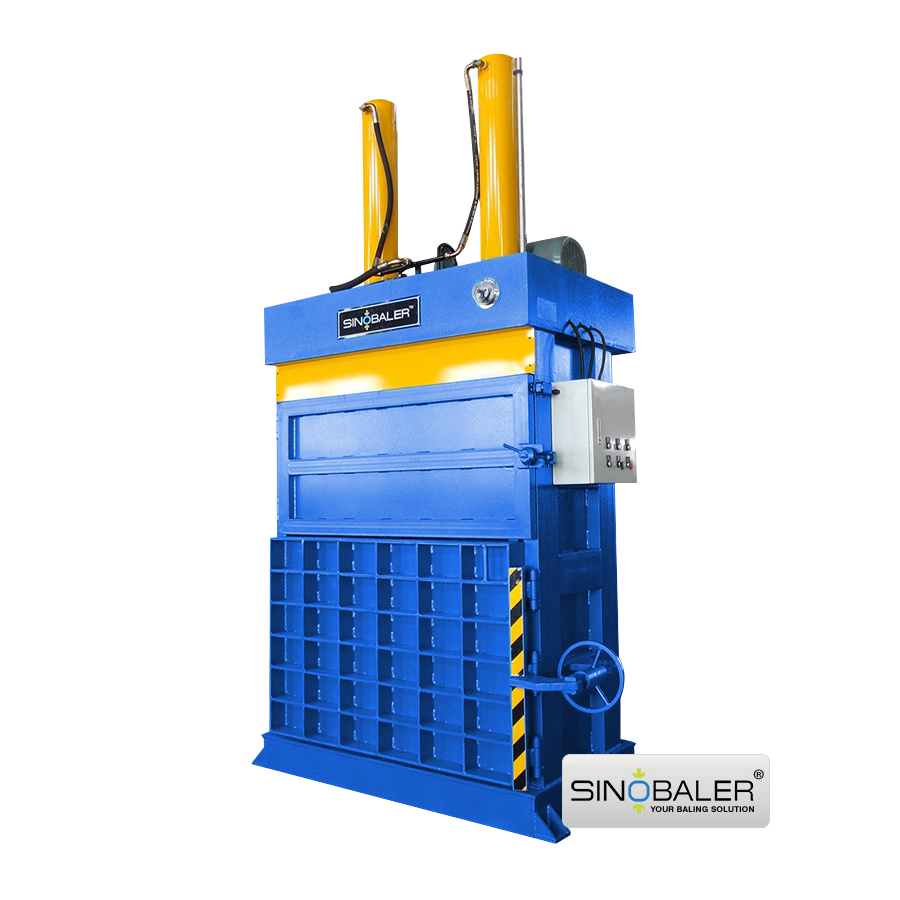
The Sinobaler Heavy Duty Dual Ram Baler delivers 80–200 tons of press force via its dual-ram system, ideal for compacting tough, fibrous, or rebounding materials, as well as soft ones requiring high bale density for optimized loading. It's perfect for natural and synthetic fibers, metal panels, tubes, profiles, and hard plastics like electronics shells and pipes. This baler reduces storage space, cuts transport costs, and boosts efficiency—making it a smart investment for modern recycling and waste handling.

Heavy Duty Baler for Fluffy Material (eg. Heavy Duty Fiber Balers)
These down stroke, manual tie, and feed balers are ideal for fiber recycling where labor is cost-effective. Depending on operator efficiency, throughput can reach up to 5 bales per hour. Sinobaler’s fiber balers offer a 15:1 compression ratio and 1100×700×600 mm bale size, with adjustable bale sizing and up to 120 bales per 40ft container. For custom machines or advanced models, contact our sales team. Auto-tie and conveyor-fed horizontal balers for higher output are also available.

Lifting Chamber Baler / Textile Baler / Clothes Baler
A lifting chamber baler, also called a used clothes or textile baler, is ideal for textile waste recycling. It's perfect for textile manufacturers, used clothing recyclers, second-hand shops, exporters, and rag graders. The lifting chamber design simplifies strapping, wrapping, and bale ejection for easy one-person operation, cutting labor costs. Bale weights range from 30kg to 600kg with up to 150 tons of force. For higher efficiency, the twin lifting chamber model allows simultaneous feeding and baling.

Swivel Twin Lifting Chamber Baler
The Swivel Twin Lifting Chamber Baler features a modern design and advanced engineering, making it an efficient solution for textile waste handling. It has two chambers connected by a central pivot—one chamber loads materials while the other compresses, bales, and straps them. This synchronized operation balances loading and processing, improving productivity. When a bale reaches its set compression, the chamber lifts automatically, signaling cycle completion and reducing downtime. Ideal for textile waste exporters and used clothing dealers, this baler offers efficiency, user-friendliness, and labor savings.
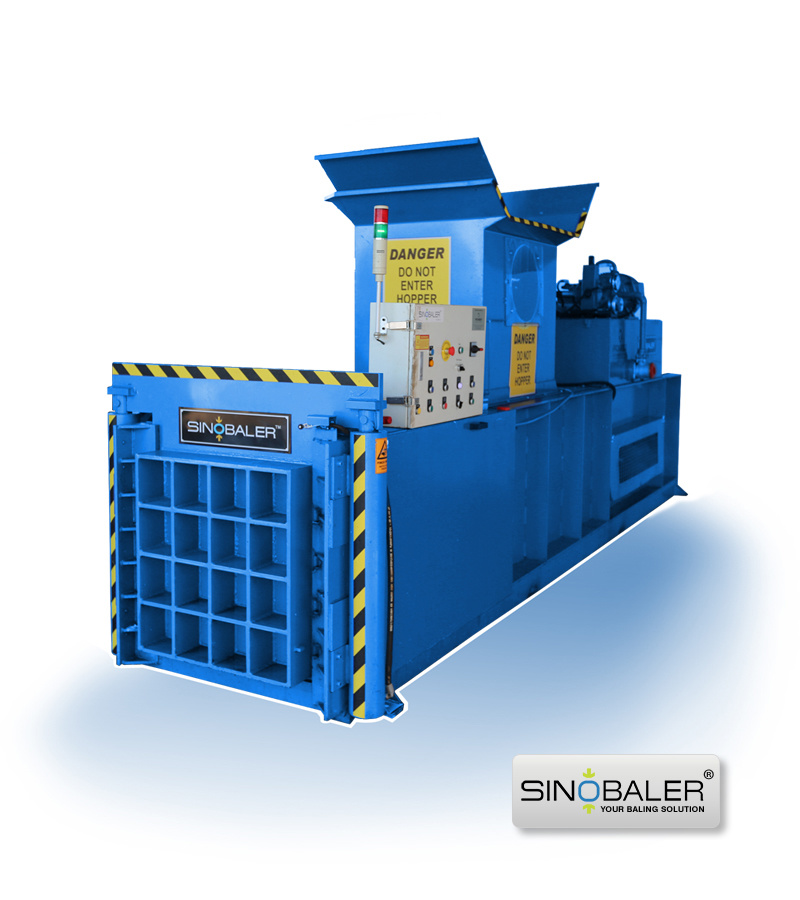
Sinobaler’s Manual Tie Horizontal Baler, also called a semi-automatic horizontal baler, handles solid and hollow waste like cardboard, PET bottles, textiles, and more. Ideal for facilities processing under 4 tons/hour with low labor costs, it offers automatic feeding, compressing, door control, and bale ejection—only the tying is manual. Press force ranges from 40 to 120 tons, with bale weights from 200kg to 850kg. Custom chamber sizes, power packs (up to 45kW), and conveyor options are available to boost productivity up to 5 bales/hour.

Open-end Manual-tie Horizontal Baler
Sinobaler SHB1-O series open-end manual-tie horizontal baler features an open-end design for continuous bale output, improving productivity by 50% over close-end balers. Strapping setup is needed only once, saving labor like a fully automatic baler. It supports various strapping materials—steel wire, PET strap, rope, etc.—making it ideal for high-volume solid waste or biomass baling. Not suited for hollow plastics due to lower density. A cost-effective choice for mid-scale recyclers or facilities needing efficient, labor-saving baling with limited investment.

Open-end Manual-tie Horizontal Baler With Wire Threader
This open-end manual-tie horizontal baler with wire threader offers nearly all functions of a fully automatic baler—except automatic tying. The built-in threading mechanism pushes wire or belt into strapping slots automatically, unlike standard manual-tie balers. While its productivity is about 20% less than a full-auto baler of the same size, it allows flexible strapping materials like steel wire, PET belt, or rope. Ideal for medium-scale recyclers or producers of solid waste, animal bedding, or feed who need efficient, cost-effective baling without sharp metal in bales. Best suited for soft or solid waste, not hollow plastic containers.
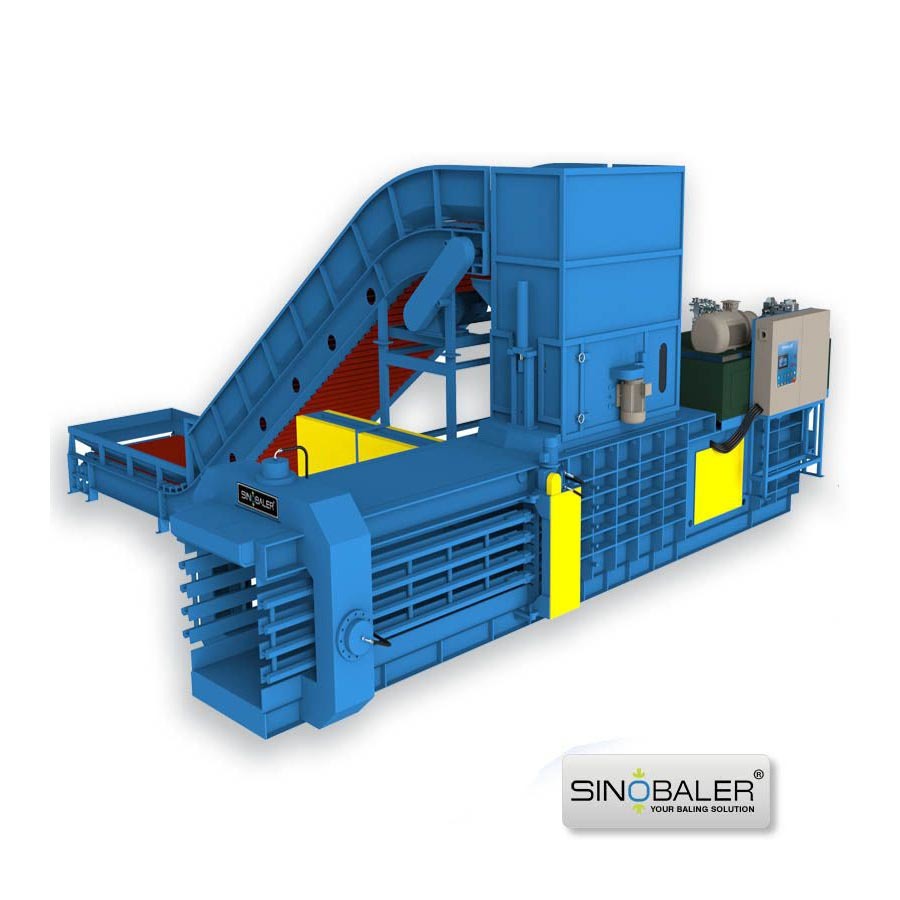
Fully Automatic Horizontal Baler
Sinobaler’s fully automatic horizontal baler (20–120 tons pressure) processes up to 15 tons/hour, ideal for high-volume recyclers handling cardboard/OCC, paper, plastic film, textile waste, and more. As our flagship open-end auto-tie baler, it features Mitsubishi PLC control, remote support, and simple operation. Bale weight/length is programmable via a touch screen for optimized container loading. The SHBA2-1200 model produces dense 1200kg rectangular bales, easy for transport/storage. CE-compliant with safety interlocking, SHBA2 is the perfect solution for large-scale soft waste recycling.
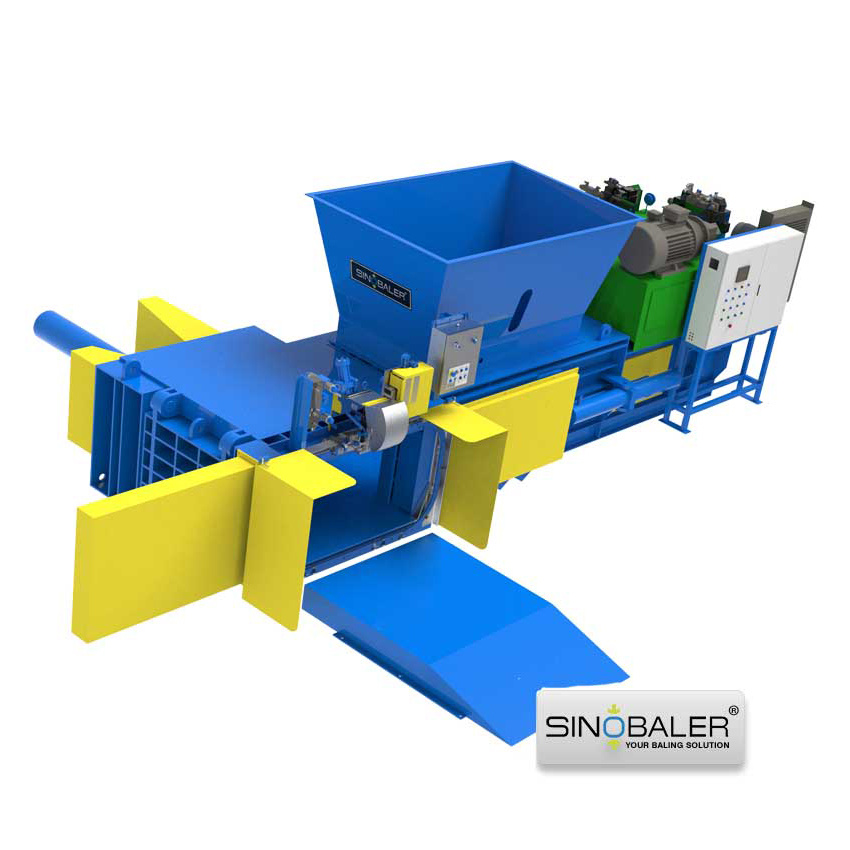
L-type Two Ram Automatic Horizontal Baler
The L-type two ram automatic horizontal baler is ideal for baling a wide range of recyclable waste. Compared to single ram balers, it offers greater versatility, supports both wire and plastic strapping, and produces high-density bales thanks to its separate strapping unit. Its flexible design can include features like a pre-compression lid to prevent cutting sensitive materials like textiles. Perfect for high-volume recycling centers, fodder exporters needing plastic straps, and municipal waste handlers seeking to avoid jams common in single ram balers.

Cardboard Baler (eg. Mill Size Baler)
The standard mill size baler is one of Sinobaler’s most popular vertical baling machines, ideal for handling cardboard and carton waste. Also known as a cardboard or carton baler, it suits recycling centers, cardboard manufacturers, supermarkets, stores, and print shops generating large cardboard waste. It compresses waste into dense bales up to 520kg with a size of 1520×760×1220mm, reducing volume by about 12:1. Easy to operate with manual door opening and auto bale ejection, it saves storage space, transport, and labor costs while meeting safety standards.

Mini Baler / Marine Baler / Multi Purpose Baling Machine
Sinobaler’s Multi-purpose Baler (Mini Baler) is a compact, versatile vertical baler ideal for malls, hotels, offices, hospitals, houses, and vessels, making it popular as a Marine Baler due to its small footprint and height. It meets marine industry needs with standard, waterproof, and explosion-proof versions, helping over 300 vessels reduce waste storage and disposal costs by up to 60%. This baler handles soft waste like cardboard, paper, cans, bottles, and film, with 10–20 tons press force, up to 800×600×800mm bale size, 20–100kg bale weight, and 12:1 compaction ratio for easy storage and transport.
Media and Gallery
Follow us


PRIVACY POLICY
We collect information from you when you fill out an inquiry or contact form. When submitting the form on our site, you may be asked to enter your name and contact details such as: e-mail address, mailing address and/or phone number, etc. Alternatively, you can choose not to complete our forms and visit our site anonymously. Any of the information we collect from you may be used to help us to better respond to your individual needs, and/or enable us to more effectively respond to your customer service requests and support needs. The email address you provided may also be used to send you information and updates pertaining to your inquiry and/or order, in addition to receiving occasional company news, updates, related product or service information, etc. SINOBALER does not sell, trade, or otherwise transfer to outside parties your personally identifiable information. This does not include trusted third parties who assist us in operating our website, conducting our business, or servicing you, so long as those parties agree to keep this information confidential. We may also release your information when we believe release is appropriate to comply with the law, enforce our site policies, or protect ours or others rights, property, or safety.
By using our site, you consent to our online privacy policy. If we decide to change our privacy policy, we will post those changes on this page. If you have any questions or concerns regarding our privacy policy, please e-mail info@sinobaler.com or mail your question to us at 1206 Yinzhou Shanghui Nan Lou, 1299 Yinxian Avenue, Yinzhou District, Ningbo 315192, P.R. China.
EXTERNAL LINKS & DISCLAIMER
Our web site has links to many other organizations with their permission. Upon leaving the SINOBALER web site, you are subject to the privacy policy of the new site which are not under our control. SINOBALER is not responsible for the content of any linked site or any link contained in a linked site. These links are provided to you as a service for you to better understand the different business relationships that SINOBALER has established, and/or to point the reader to other possible relevant resources.