






Stevia Leaves
What Are Stevia Leaves & Why Bale Them
Stevia (Stevia rebaudiana) is a plant whose dried leaves are used for extracting sweet compounds (steviol glycosides), which serve as natural sweeteners. After harvest and drying, stevia leaves are low density and bulky. Baling helps in compressing the leaves into compact bales to save storage space, ease handling, reduce transportation cost, and maintain leaf quality.
According to stevia post-harvest practice:
- Fresh stevia leaves have very high moisture (~80%) and must be dried to ~10% moisture to preserve steviol content and avoid mold or spoilage.
- After drying and cleaning (removing stems etc.), leaves are baled using hydraulic baling presses — vertical or horizontal types.
What Is a Stevia Leaves Baling Press Machine
A stevia leaves baling press machine is a machine designed to compress dried stevia leaves into bales. It may also include functionality to package (bag) the bale. There are typically two main forms:
- Baling presses: Ram/hydraulic cylinder compresses the leaves in a chamber. Post-baling the operator removes or ejects the bale.
- Baling & bagging machines: These often have two hydraulic rams — one to compact/compress, another to eject or package the bale into a bag. This setup is more automated and may include features to speed up handling.
Key Features & What to Look For
When selecting a baling press for stevia leaves, consider:
Feature | Why It Matters |
|---|---|
Bale Density & Compression Force | The higher the compression, the more compact the bale, reducing transport and storage cost. But over-compression might damage leaf structure, reducing quality. Balance is needed. |
Chamber Size / Bale Size | Bale dimensions should align with your storage capacity and how you move the bale (manual handling, forklift, etc.). |
Horizontal vs Vertical Press | Horizontal & bagging machines tend to reduce manual labor and may improve speed. Vertical are simpler and cheaper but often more labor intensive. |
Moisture Content & Drying Process | Since leaves must be well dried before baling to preserve sweetness and avoid spoilage, the timing, drying method, and moisture monitoring are crucial. |
Leaf / Stem Separation Before Baling | Removing stems improves quality of the bale and final extract because stems have little steviol glycoside content. |
Binding / Bagging / Packaging | After compression, proper packaging (e.g. HDPE or LDPE bags, or other breathable yet protective packaging) helps preserve the bale. Some machines include or adapt for bagging. |
Hygiene & Material Contact Surfaces | Since stevia is used in food or sweetener products, material contact parts should be clean, ideally food-grade, to avoid contamination. |
Throughput / Cycle Time | How many bales per hour/day, how long each compression / packaging cycle takes — this dictates capacity and cost effectiveness. |
Power & Operation Cost | Hydraulic systems consume power; efficient design, good maintenance, and optimal operation reduce overall cost. |
Durability & Maintenance | Replaceable parts, robustness of hydraulic cylinders, ease of cleaning, resistance to wear. |
Applications & Benefits
- Easier storage: Compressed bales take less space and are easier to stack in warehouses.
- Reduced transport cost: Denser bales weigh more per volume, so each transport load carries more usable leaf.
- Maintaining product quality: Dry, clean, well-compressed bales help preserve the steviol glycosides and reduce damage or spoilage.
- Environmental benefits: Reducing volume helps reduce fuel usage in transport; reduces waste of leftover leaves.
- Value chain efficiency: For processors, using baled leaves simplifies handling, simplifies feeding into extraction plants.
Quick links:
VIDEOS
PICTURES

Similar Applications
APPLICABLE MACHINE
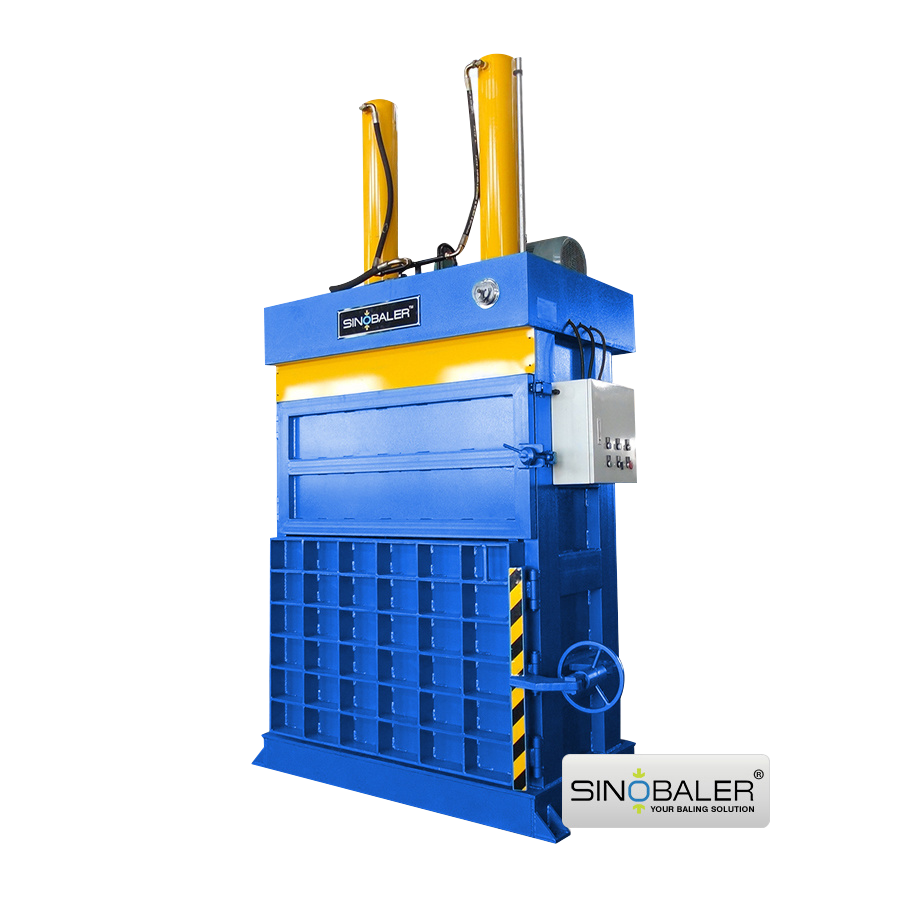
The Sinobaler Heavy Duty Dual Ram Baler delivers 80–200 tons of press force via its dual-ram system, ideal for compacting tough, fibrous, or rebounding materials, as well as soft ones requiring high bale density for optimized loading. It's perfect for natural and synthetic fibers, metal panels, tubes, profiles, and hard plastics like electronics shells and pipes. This baler reduces storage space, cuts transport costs, and boosts efficiency—making it a smart investment for modern recycling and waste handling.

Vertical Bagging Baler Machine
Vertical bagging baler machines are perfect for compressing and bagging small, loose materials for easy handling and transport. They press materials into compact bales and bag them in one step, ideal for factories handling pet food, animal bedding, fertilizers, fabrics, and more. Suitable materials include peanut shells, cotton seeds, chopped straw, hay, wood shavings, fibers, and rice hulls. One person can produce up to 30 bales per hour, each weighing 44–66 lbs. The removable bag feature adds versatility, allowing the machine to bale other materials without bagging when needed.

Scale Weighing Horizontal Bagging Baler
Scale weighing horizontal bagging baler is ideal for packing loose materials like rags, straw, hay, wood shavings, pet food, and textile scraps. Commonly used in pet food plants, farms, fertilizer factories, and recycling centers, it helps turn loose waste into valuable, bagged bales. Equipped with PLC control, one-button operation, and a hopper sensor switch, it can produce 25kg bales (700×400×310mm) at up to 60 bales/hour. The built-in scale ensures precise bale weight. It automatically compresses, bags, and ejects materials for easy handling, storage, and transport.

Heavy Duty Horizontal Bagging Machine
One main use of a horizontal baling and bagging machine is for loose materials like sawdust, wood chips, rags, peanut shells, cotton seeds, and rice hulls. These are hard to handle, but this machine automatically feeds, compresses, and bags them for easier storage, transport, or resale. Sinobaler’s Horizontal Baling & Bagging Machine features PLC control, one-button operation, and a safety sensor switch. It produces 60 bales/hour (88 lbs each, 28×16×12 in). Ideal for textile recyclers, pet food plants, farms, fertilizer factories, and any site generating loose waste.

A biomass bagging baler is an industrial machine designed to compress loose biomass materials and pack them into bags for convenient storage, handling, and transportation. It is widely used in biomass power plants, agricultural processing facilities, waste-to-energy projects, and recycling centers. By reducing volume and stabilizing loose biomass, bagging balers help improve logistics efficiency and protect materials from moisture and contamination.
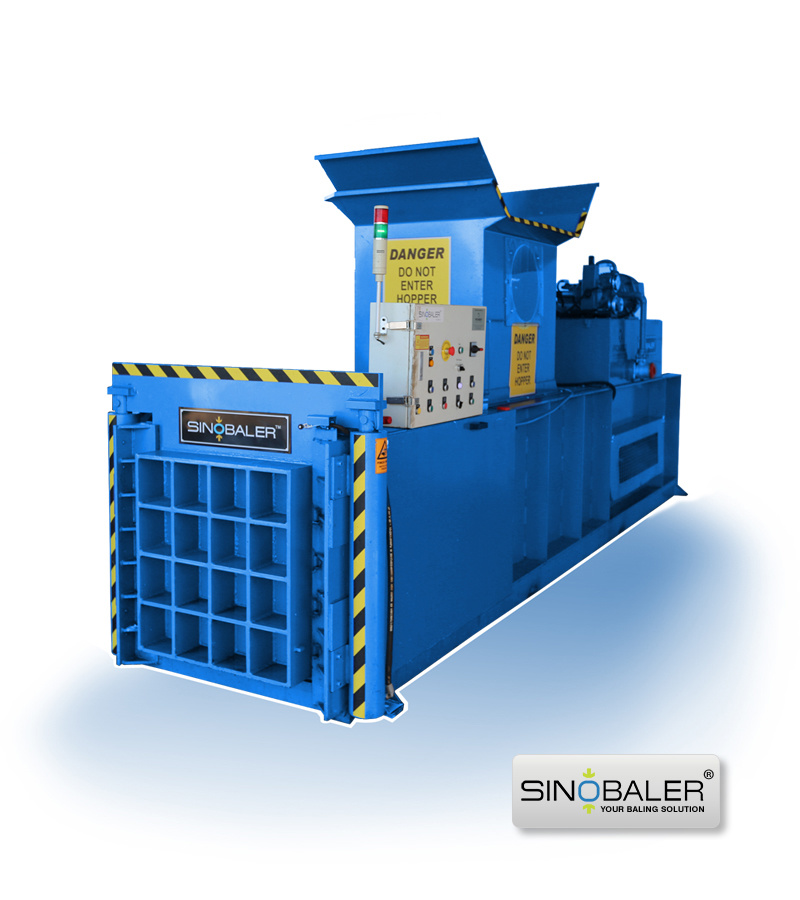
Sinobaler’s Manual Tie Horizontal Baler, also called a semi-automatic horizontal baler, handles solid and hollow waste like cardboard, PET bottles, textiles, and more. Ideal for facilities processing under 4 tons/hour with low labor costs, it offers automatic feeding, compressing, door control, and bale ejection—only the tying is manual. Press force ranges from 40 to 120 tons, with bale weights from 200kg to 850kg. Custom chamber sizes, power packs (up to 45kW), and conveyor options are available to boost productivity up to 5 bales/hour.

Open-end Manual-tie Horizontal Baler
Sinobaler SHB1-O series open-end manual-tie horizontal baler features an open-end design for continuous bale output, improving productivity by 50% over close-end balers. Strapping setup is needed only once, saving labor like a fully automatic baler. It supports various strapping materials—steel wire, PET strap, rope, etc.—making it ideal for high-volume solid waste or biomass baling. Not suited for hollow plastics due to lower density. A cost-effective choice for mid-scale recyclers or facilities needing efficient, labor-saving baling with limited investment.

Open-end Manual-tie Horizontal Baler With Wire Threader
This open-end manual-tie horizontal baler with wire threader offers nearly all functions of a fully automatic baler—except automatic tying. The built-in threading mechanism pushes wire or belt into strapping slots automatically, unlike standard manual-tie balers. While its productivity is about 20% less than a full-auto baler of the same size, it allows flexible strapping materials like steel wire, PET belt, or rope. Ideal for medium-scale recyclers or producers of solid waste, animal bedding, or feed who need efficient, cost-effective baling without sharp metal in bales. Best suited for soft or solid waste, not hollow plastic containers.

Horizontal Briquetting Machine / Block Making Machine
Our horizontal briquetting machine is a smart solution for compressing loose materials like sawdust, chopped straw, rice husks, and peanut shells—materials that are hard to bale or transport. Instead of bagging, this machine compacts them into hard, regular-shaped briquettes that are easy to handle, store, or even burn as fuel. With a PLC system and hydraulic lifting door, it operates automatically and continuously. When paired with automatic feeding, no operator is needed. Compact in size, it fits almost anywhere and is widely used in farms, fertilizer plants, and bedding material factories.

Cardboard Baler (eg. Mill Size Baler)
The standard mill size baler is one of Sinobaler’s most popular vertical baling machines, ideal for handling cardboard and carton waste. Also known as a cardboard or carton baler, it suits recycling centers, cardboard manufacturers, supermarkets, stores, and print shops generating large cardboard waste. It compresses waste into dense bales up to 520kg with a size of 1520×760×1220mm, reducing volume by about 12:1. Easy to operate with manual door opening and auto bale ejection, it saves storage space, transport, and labor costs while meeting safety standards.
Media and Gallery
Follow us


PRIVACY POLICY
We collect information from you when you fill out an inquiry or contact form. When submitting the form on our site, you may be asked to enter your name and contact details such as: e-mail address, mailing address and/or phone number, etc. Alternatively, you can choose not to complete our forms and visit our site anonymously. Any of the information we collect from you may be used to help us to better respond to your individual needs, and/or enable us to more effectively respond to your customer service requests and support needs. The email address you provided may also be used to send you information and updates pertaining to your inquiry and/or order, in addition to receiving occasional company news, updates, related product or service information, etc. SINOBALER does not sell, trade, or otherwise transfer to outside parties your personally identifiable information. This does not include trusted third parties who assist us in operating our website, conducting our business, or servicing you, so long as those parties agree to keep this information confidential. We may also release your information when we believe release is appropriate to comply with the law, enforce our site policies, or protect ours or others rights, property, or safety.
By using our site, you consent to our online privacy policy. If we decide to change our privacy policy, we will post those changes on this page. If you have any questions or concerns regarding our privacy policy, please e-mail info@sinobaler.com or mail your question to us at 1206 Yinzhou Shanghui Nan Lou, 1299 Yinxian Avenue, Yinzhou District, Ningbo 315192, P.R. China.
EXTERNAL LINKS & DISCLAIMER
Our web site has links to many other organizations with their permission. Upon leaving the SINOBALER web site, you are subject to the privacy policy of the new site which are not under our control. SINOBALER is not responsible for the content of any linked site or any link contained in a linked site. These links are provided to you as a service for you to better understand the different business relationships that SINOBALER has established, and/or to point the reader to other possible relevant resources.