







Palm Fiber
What Is Palm Fiber & Why Bale It
Palm fiber refers to fibrous material derived from parts of palm trees or palm oil processing. Common sources include:
- Empty Fruit Bunch fibers (EFB fiber) from oil palm plantations.
- Palm press fiber (PPF), a by-product from extracting palm oil.
These fibres are bulky, loose, low-density when raw, which means they take up a lot of volume for little weight — making storage, transport, handling, and downstream processing inefficient unless compressed. Baling press machines compact this material into dense bales, improving logistics, reducing costs, and enabling broader uses (textiles, biomass fuel, upholstery, crafts, etc.).
How a Palm Fiber Baling Press Machine Works
Here’s a typical workflow / mechanism in such machines:
- Collecting & Preparing the Palm Fiber
The raw palm fiber is gathered (EFB, PPF etc.), possibly dried to reduce moisture content (to avoid mould or decay). Cleaning or removal of very large contaminants may occur. - Feeding / Loading
The prepared palm fiber is loaded into a chamber (vertical or horizontal) either manually or via feeder/conveyor. - Compression / Pressing
Hydraulic rams compress the fiber. Some models use dual rams for balanced force and better platen/rams protection. The hydraulic pressure (tons) is a key metric. For palm fiber, machines may range from ~80-200 tons of hydraulic power. - Bale Formation & Ejection
Once compressed to the required density/size, the bale is bound / tied / strapped. The machine often incorporates mechanisms to eject the bale (chain bale ejector, auto cylinder ejection etc.). - Optional Bagging / Packaging
Some machines include bagging or wrappers, especially for smaller bales or where packaging into bags is useful. Others are simply tie & stack.
Applications of Palm Fiber Baling Press Machines
Palm fiber bales are used in many fields:
- Biomass energy: Compressed fiber bales are used as biomass fuel (e.g. in palm oil mills, boilers, power plants) due to their energy content.
- Textile & Fiber Products: Baled palm fiber is processed into mats, upholstery fillings, cushions, ropes, doors, etc.
- Craft / Handicraft: Artists and small manufacturers use fiber bales for crafts, weaving, etc.
- Composting / Soil Amendment: Palm pressed fiber (especially lightly compressed) can be used as soil conditioner or for horticultural peat-like applications.
- Livestock Bedding / Feed Supplement: In some contexts, palm fiber (processed appropriately) is used for bedding or mixed in feed (though high oil & fiber content may impact digestibility).
Benefits & Advantages
Using a palm fiber baling press machine offers several benefits:
- Reduces Volume & Storage Costs: Compressing palm fibers into dense bales cuts required storage space significantly.
- Improves Transport Efficiency & Lowers Freight Cost: Denser, uniform bales are easier to stack, ship, and handle.
- Enhances Material Handling & Workforce Efficiency: Automatic ejection, easy tying, less handling of loose fiber.
- Enables Diversified Use of Palm Fiber: Converting fiber into bales makes it usable in more downstream processes (textile, biomass, crafts).
- Environmental Gains: Reduces waste, helps use by-products effectively, lowers burning or disposal; supports sustainable resource usage.
Challenges & Things to Consider
- Moisture Control: Palm fiber must be adequately dried; wet fiber causes mould, lower bale quality, and increases weight unnecessarily.
- Dealing with Variability: Fiber length, moisture content, contaminant levels (nuts, shells, dirt) vary a lot; machines need to be robust or adaptable.
- Power & Energy Demand: High hydraulic pressure costs more energy; need to consider motor size, hydraulic system efficiency.
- Equipment Cost & Maintenance: High press force machines cost more; platens, cylinders, hydraulic components, tie mechanisms are wear points.
- Handling & Safety: Fibrous materials tend to spring back, may trap clothing or hands; safety guards, door locks, retainer claws etc. are important.
- Transport & Bale Handling Equipment: Heavier bales require forklifts or bale movers; ensure you have infrastructure.
What to Look for If Buying One
If you are considering purchasing a palm fiber baling press, here’s a checklist of what to verify:
- Hydraulic press force (tons) appropriate for your fiber volume & density goals.
- Motor power (kW), power source (electric / generator) and energy consumption.
- Feeding / chamber dimensions and bale size/weight options.
- Bale density and expected output (bales/hour).
- Bale ejection mechanism (manual, chain or cylinder ejector).
- Retainer claws or other anti-spring back features.
- Adjustability of bale height or shape.
- Durability of components (plates, cylinders, hydraulic circuits).
- Safety features: doors, interlocks, guards.
- Localization of spare parts & service.
- If needed, packaging/bagging or wrapping options.
Quick links:
VIDEOS
PICTURES
APPLICABLE MACHINE
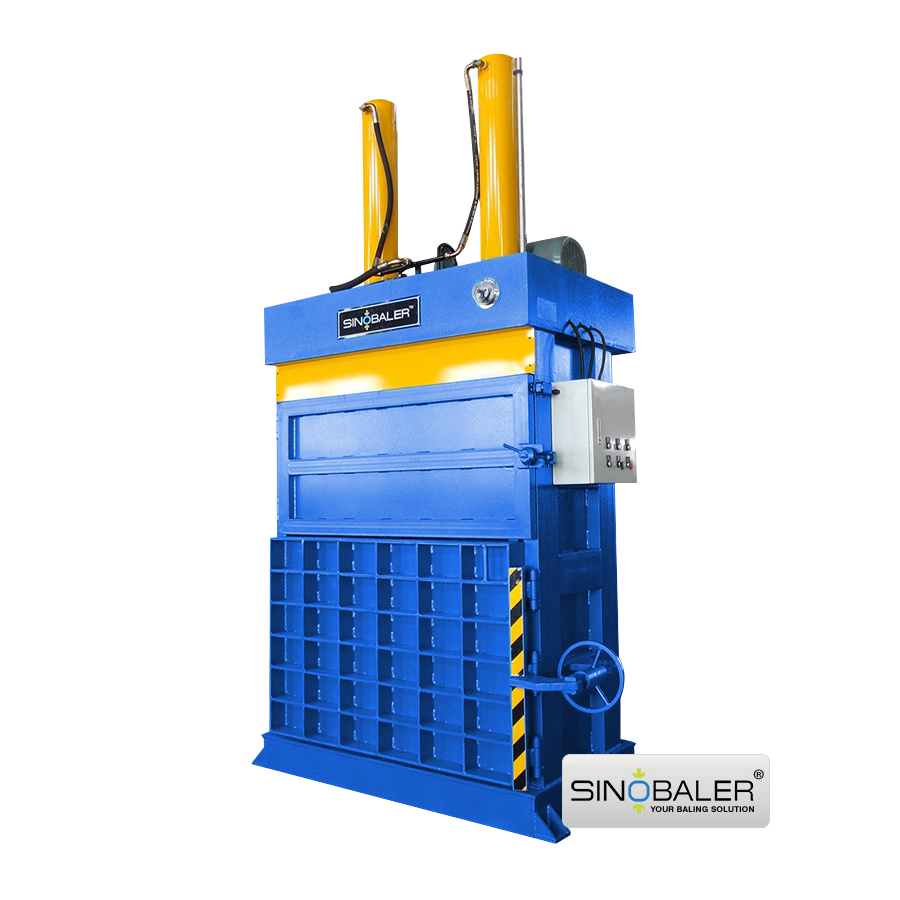
The Sinobaler Heavy Duty Dual Ram Baler delivers 80–200 tons of press force via its dual-ram system, ideal for compacting tough, fibrous, or rebounding materials, as well as soft ones requiring high bale density for optimized loading. It's perfect for natural and synthetic fibers, metal panels, tubes, profiles, and hard plastics like electronics shells and pipes. This baler reduces storage space, cuts transport costs, and boosts efficiency—making it a smart investment for modern recycling and waste handling.

Heavy Duty Baler for Fluffy Material (eg. Heavy Duty Fiber Balers)
These down stroke, manual tie, and feed balers are ideal for fiber recycling where labor is cost-effective. Depending on operator efficiency, throughput can reach up to 5 bales per hour. Sinobaler’s fiber balers offer a 15:1 compression ratio and 1100×700×600 mm bale size, with adjustable bale sizing and up to 120 bales per 40ft container. For custom machines or advanced models, contact our sales team. Auto-tie and conveyor-fed horizontal balers for higher output are also available.

Lifting Chamber Baler / Textile Baler / Clothes Baler
A lifting chamber baler, also called a used clothes or textile baler, is ideal for textile waste recycling. It's perfect for textile manufacturers, used clothing recyclers, second-hand shops, exporters, and rag graders. The lifting chamber design simplifies strapping, wrapping, and bale ejection for easy one-person operation, cutting labor costs. Bale weights range from 30kg to 600kg with up to 150 tons of force. For higher efficiency, the twin lifting chamber model allows simultaneous feeding and baling.

Swivel Twin Lifting Chamber Baler
The Swivel Twin Lifting Chamber Baler features a modern design and advanced engineering, making it an efficient solution for textile waste handling. It has two chambers connected by a central pivot—one chamber loads materials while the other compresses, bales, and straps them. This synchronized operation balances loading and processing, improving productivity. When a bale reaches its set compression, the chamber lifts automatically, signaling cycle completion and reducing downtime. Ideal for textile waste exporters and used clothing dealers, this baler offers efficiency, user-friendliness, and labor savings.
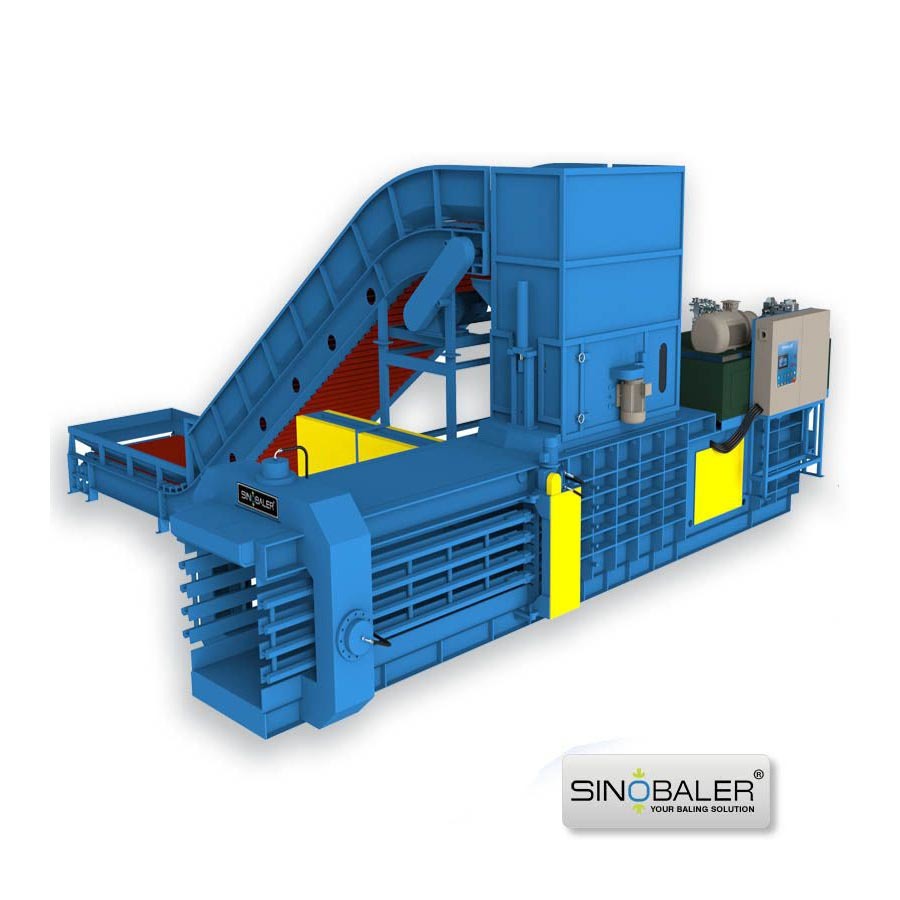
Fully Automatic Horizontal Baler
Sinobaler’s fully automatic horizontal baler (20–120 tons pressure) processes up to 15 tons/hour, ideal for high-volume recyclers handling cardboard/OCC, paper, plastic film, textile waste, and more. As our flagship open-end auto-tie baler, it features Mitsubishi PLC control, remote support, and simple operation. Bale weight/length is programmable via a touch screen for optimized container loading. The SHBA2-1200 model produces dense 1200kg rectangular bales, easy for transport/storage. CE-compliant with safety interlocking, SHBA2 is the perfect solution for large-scale soft waste recycling.
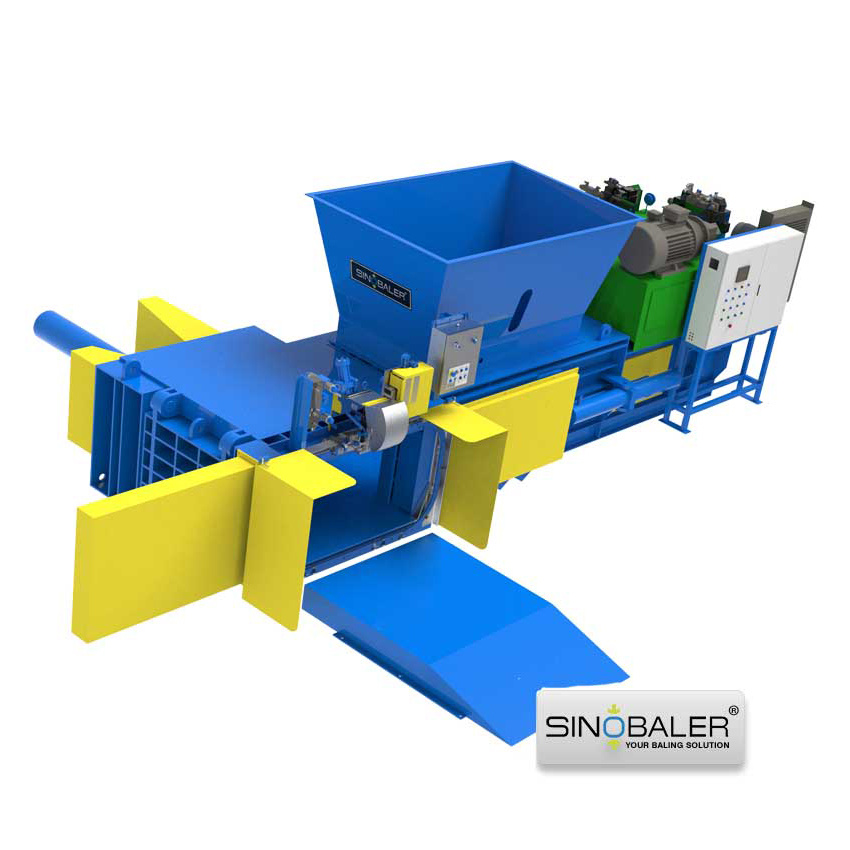
L-type Two Ram Automatic Horizontal Baler
The L-type two ram automatic horizontal baler is ideal for baling a wide range of recyclable waste. Compared to single ram balers, it offers greater versatility, supports both wire and plastic strapping, and produces high-density bales thanks to its separate strapping unit. Its flexible design can include features like a pre-compression lid to prevent cutting sensitive materials like textiles. Perfect for high-volume recycling centers, fodder exporters needing plastic straps, and municipal waste handlers seeking to avoid jams common in single ram balers.

Cardboard Baler (eg. Mill Size Baler)
The standard mill size baler is one of Sinobaler’s most popular vertical baling machines, ideal for handling cardboard and carton waste. Also known as a cardboard or carton baler, it suits recycling centers, cardboard manufacturers, supermarkets, stores, and print shops generating large cardboard waste. It compresses waste into dense bales up to 520kg with a size of 1520×760×1220mm, reducing volume by about 12:1. Easy to operate with manual door opening and auto bale ejection, it saves storage space, transport, and labor costs while meeting safety standards.

Mini Baler / Marine Baler / Multi Purpose Baling Machine
Sinobaler’s Multi-purpose Baler (Mini Baler) is a compact, versatile vertical baler ideal for malls, hotels, offices, hospitals, houses, and vessels, making it popular as a Marine Baler due to its small footprint and height. It meets marine industry needs with standard, waterproof, and explosion-proof versions, helping over 300 vessels reduce waste storage and disposal costs by up to 60%. This baler handles soft waste like cardboard, paper, cans, bottles, and film, with 10–20 tons press force, up to 800×600×800mm bale size, 20–100kg bale weight, and 12:1 compaction ratio for easy storage and transport.
Media and Gallery
Follow us


PRIVACY POLICY
We collect information from you when you fill out an inquiry or contact form. When submitting the form on our site, you may be asked to enter your name and contact details such as: e-mail address, mailing address and/or phone number, etc. Alternatively, you can choose not to complete our forms and visit our site anonymously. Any of the information we collect from you may be used to help us to better respond to your individual needs, and/or enable us to more effectively respond to your customer service requests and support needs. The email address you provided may also be used to send you information and updates pertaining to your inquiry and/or order, in addition to receiving occasional company news, updates, related product or service information, etc. SINOBALER does not sell, trade, or otherwise transfer to outside parties your personally identifiable information. This does not include trusted third parties who assist us in operating our website, conducting our business, or servicing you, so long as those parties agree to keep this information confidential. We may also release your information when we believe release is appropriate to comply with the law, enforce our site policies, or protect ours or others rights, property, or safety.
By using our site, you consent to our online privacy policy. If we decide to change our privacy policy, we will post those changes on this page. If you have any questions or concerns regarding our privacy policy, please e-mail info@sinobaler.com or mail your question to us at 1206 Yinzhou Shanghui Nan Lou, 1299 Yinxian Avenue, Yinzhou District, Ningbo 315192, P.R. China.
EXTERNAL LINKS & DISCLAIMER
Our web site has links to many other organizations with their permission. Upon leaving the SINOBALER web site, you are subject to the privacy policy of the new site which are not under our control. SINOBALER is not responsible for the content of any linked site or any link contained in a linked site. These links are provided to you as a service for you to better understand the different business relationships that SINOBALER has established, and/or to point the reader to other possible relevant resources.