







Home | Blog |

Case Study: How to Produce 2.8 kg, 1.4 kg and 0.7 kg Hay Bags with One Baling & Bagging Machine
When customers need to package the same loose hay into several different bag weights, buying a separate machine for each specification is usually unnecessary.
This case involved a customer looking for a hay bagging machine for loose hay with a particularly important requirement: the hay could not be compressed too tightly, because the final product would be used for animal bedding and feeding applications.
The customer needed one machine capable of producing three different target weights:
- 2.8 kg per bag
- 1.4 kg per bag
- 0.7 kg per bag
The challenge was therefore not only achieving different weights, but also maintaining a relatively loose and natural hay structure after compression and bagging.

Customer Requirement
The customer contacted SINOBALER with the following requirements:
“I am looking at buying a hay bagging machine that can bag loose hay. The hay cannot be packed too tight and each bag needs to weigh 2.8 kg. I would also like the ability to pack bags that are 1.4 kg and 0.70 kg as well.”
This created three key technical requirements:
- Accurate target-weight control for three different bag weights.
- Gentle compression so the hay would not be excessively compacted.
- One machine capable of handling all three product specifications.
SINOBALER's Recommended Solution
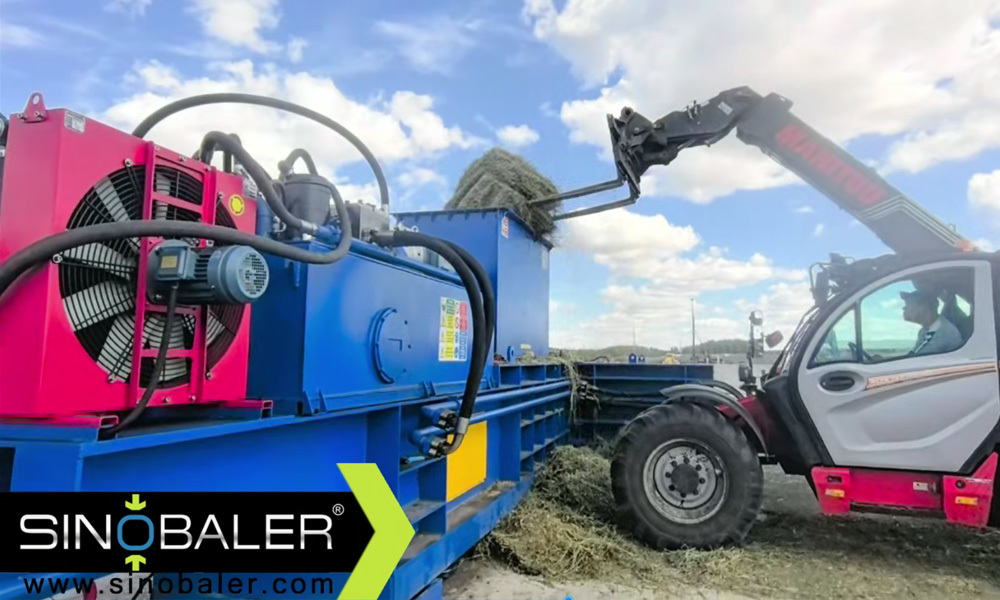
Based on the customer's requirements, SINOBALER recommended a customized Scale Weighing Bagging Baler SHB1-SW-50.
The machine was customized with a hydraulic sliding door in the bale chute to provide greater flexibility in controlling the final bale length.
Customized Loading Area
The customized loading area is:
L 1,200 × W 350 × H 125 mm
The hydraulic sliding door is particularly important for this application because the final bale length can be influenced by the amount of hay loaded into the compression chamber.
This gives the customer greater flexibility when producing different package weights with the same machine.
How Can One Machine Produce Different Hay Bag Weights?
The basic principle is to combine weighing control with adjustable compression and bale-length control.
The operating process can be summarized as:
Loose Hay Feeding
↓
Electronic Weighing
↓
Target Weight Reached
↓
Hydraulic Compression
↓
Bagging
↓
Bale Expansion in Bag
↓
Finished Hay Bag
The operator can select or set the required target weight according to the packaging specification.
For example:
Target Weight | Application |
|---|---|
0.7 kg | Small hay bag |
1.4 kg | Medium hay bag |
2.8 kg | Large hay bag |
The important point is that changing the target weight does not necessarily require changing to another machine.
Bale Length Changes with the Amount of Hay Loaded
For this customized machine, the hydraulic sliding door allows the bale length to be influenced by the quantity of material loaded into the compression chamber.
At the same hydraulic system pressure, a lighter bale contains less material and therefore requires a shorter bale length, while a heavier bale requires more material and a longer bale length.
For example, when comparing approximately 50 oz and 100 oz target weights under the same system pressure, the bale length of the 50 oz bale can be approximately half that of the 100 oz bale, depending on the actual hay characteristics and feeding conditions.
For the 100 oz configuration, the maximum bale length in this design is approximately 350 mm before expansion inside the bag.
After the compressed hay expands inside the packaging bag, the final length can reach approximately 360 mm, depending on the hay type, moisture content, feeding consistency and compression conditions.
Note: Actual bale dimensions and weight should always be confirmed through testing with the customer's actual hay. Hay density can vary significantly depending on species, moisture content, particle length and preparation method.
How to Prevent Hay from Being Packed Too Tightly
This was one of the most important requirements in this project.
For hay used as animal bedding or animal feed, excessive compression may not be desirable. Therefore, the objective is not simply to achieve the highest possible bale density.
Instead, SINOBALER can adjust the hydraulic compression parameters to achieve a suitable balance between:
- Target weight
- Bale dimensions
- Material density
- Bag size
- Product expansion
- Ease of handling
- Required production capacity
The hydraulic system pressure can be adjusted according to the actual test results.
If the customer finds that the finished 100 oz bale is significantly shorter than the expected approximately 360 mm after expansion, this indicates that the hay is being compressed more than desired.
In this situation, the hydraulic system pressure can be reduced through adjustment of the overflow valve, allowing the hay to form a longer and less densely compressed bale.
This is an important advantage of a customized hydraulic bagging baler: the machine can be tuned to the material and the desired final product rather than simply operating at maximum compression.
Why a Scale Weighing Bagging Baler Is Suitable for This Application
A conventional baler mainly focuses on compressing material to a predetermined bale size. For applications requiring specific package weights, a weighing system provides an additional level of control.
The customized SHB1-SW-50 combines:
1. Weighing Control
The weighing system helps control the amount of hay loaded before compression, making it possible to target different package weights.
2. Adjustable Compression
Hydraulic pressure can be adjusted according to the required hay density.
3. Hydraulic Sliding Door
The sliding door provides flexibility in controlling bale length and adapting the machine to different package specifications.
4. Bagging Function
The compressed hay is directly packaged, reducing additional handling after baling.
5. One Machine for Multiple Specifications
Instead of purchasing separate machines for 0.7 kg, 1.4 kg and 2.8 kg bags, one customized system can be configured to handle the different target weights.
What Information Is Needed to Design a Multi-Weight Hay Bagging Machine?
If you are looking for one baling and bagging machine that can produce several different weights, SINOBALER recommends providing the following information:
- Material: hay, alfalfa, straw, grass, etc.
- Target bag weights: e.g. 0.7 kg / 1.4 kg / 2.8 kg
- Bag dimensions
- Required bale dimensions
- Required production capacity: bags/hour or tons/hour
- Material moisture content
- Material length and bulk density
- Maximum acceptable compression density
- Feeding method: manual, conveyor, cyclone, etc.
- Bag material and bag-opening method
With this information, the compression chamber, weighing system, hydraulic pressure, feeding system and bagging configuration can be designed around the actual application.
Watch the SINOBALER Hay Bagging Baler in Operation
You can watch a demonstration of the SINOBALER Scale Weighing Bagging Baler SHB1-SW-50 here:
Watch the SHB1-SW-50 Hay Bagging Baler Demo
The video demonstrates the operating principle of the scale-weighing bagging baler and helps customers understand how loose agricultural materials can be weighed, compressed and bagged.
Need One Machine for Different Hay Bag Weights?
If your business needs to package loose hay into several different weights, such as 0.7 kg, 1.4 kg, 2.8 kg or other customized weights, a standard baler may not be the best solution.
A customized scale-weighing bagging baler can combine accurate weighing, adjustable hydraulic compression and flexible bale-length control in one system.
SINOBALER can evaluate your material and packaging requirements and recommend a suitable configuration.
For an exact quotation, please send us your material type, target bag weights, bag dimensions, required capacity and compression requirements. Our sales engineers can then recommend the appropriate baling and bagging solution for your application.
Explore more biomass size reduction solutions from PROSINO shredders and granulators.
Other Blogs

Case Study: Packaging Chopped Lucerne Hay & Straw into 6–10 kg Stockfeed Bags
2026/06/12
Discover how the SINOBALER SHB1-SW-100 Scale Weighing Horizontal Bagging Baler efficiently packages chopped lucerne hay and straw into accurate 6–10 kg stockfeed bags. Ideal for livestock feed producers seeking a cost-effective and reliable bagging solution.

How to Export Alfalfa Hay
2026/04/27
Complete guide to exporting alfalfa hay covering market requirements, harvesting, baling, container logistics, export documents, profit strategies, and common challenges.

How Much Does a Bale of Hay Weigh
2025/11/05
The weight of a bale of hay can vary widely depending on size, type, and moisture content. Small square bales typically weigh 40–75 pounds, while large square or round bales can range from 500 to over 1,500 pounds. Understanding these weights is vital for efficient farm management, safe handling, and proper feeding practices.

Chopped Hay Baler with Bagging Functionality
2024/04/22
Traditionally, hay baling involved the tedious process of compressing loose hay into bales and then manually transferring these bales into storage or transportation containers. However, the introduction of chopped hay baler has revolutionized this process by combining the functions of compression and bagging into a single machine. How It Works: The chopped hay baler […]

Hay Baler Machine: Revolutionizing the Farming Industry
2023/06/01
In the world of agriculture, efficiency and productivity are key factors in ensuring a successful harvest. One of the machines that has revolutionized the farming industry is the hay baler machine. This remarkable piece of equipment has simplified the process of collecting and bundling hay, making it easier for farmers to handle, transport, and store […]

Alfalfa Hay Compressing Machine
2019/09/12
Alfalfa is the good food source for rabbits, guinea pigs, hamsters, chinchillas, gerbils, prairie dogs, cows and other herbivores. You can feed alfalfa together with vitamin and mineral fortified feed to make sure animals receive complete essential nutrient. Normally at least alfalfa can accounts for 20% of the total diet. But how to keep the […]
Related Videos





Other Blogs
Case Study: Packaging Chopped Lucerne Hay & Straw into 6–10 kg Stockfeed Bags
2026/06/12
Discover how the SINOBALER SHB1-SW-100 Scale Weighing Horizontal Bagging Baler efficiently packages chopped lucerne hay and straw into accurate 6–10 kg stockfeed bags. Ideal for livestock feed producers seeking a cost-effective and reliable bagging solution.
2026/04/27
Complete guide to exporting alfalfa hay covering market requirements, harvesting, baling, container logistics, export documents, profit strategies, and common challenges.
How Much Does a Bale of Hay Weigh
2025/11/05
The weight of a bale of hay can vary widely depending on size, type, and moisture content. Small square bales typically weigh 40–75 pounds, while large square or round bales can range from 500 to over 1,500 pounds. Understanding these weights is vital for efficient farm management, safe handling, and proper feeding practices.
Chopped Hay Baler with Bagging Functionality
2024/04/22
Traditionally, hay baling involved the tedious process of compressing loose hay into bales and then manually transferring these bales into storage or transportation containers. However, the introduction of chopped hay baler has revolutionized this process by combining the functions of compression and bagging into a single machine. How It Works: The chopped hay baler […]
Hay Baler Machine: Revolutionizing the Farming Industry
2023/06/01
In the world of agriculture, efficiency and productivity are key factors in ensuring a successful harvest. One of the machines that has revolutionized the farming industry is the hay baler machine. This remarkable piece of equipment has simplified the process of collecting and bundling hay, making it easier for farmers to handle, transport, and store […]
Alfalfa Hay Compressing Machine
2019/09/12
Alfalfa is the good food source for rabbits, guinea pigs, hamsters, chinchillas, gerbils, prairie dogs, cows and other herbivores. You can feed alfalfa together with vitamin and mineral fortified feed to make sure animals receive complete essential nutrient. Normally at least alfalfa can accounts for 20% of the total diet. But how to keep the […]
Media and Gallery
Follow us


PRIVACY POLICY
We collect information from you when you fill out an inquiry or contact form. When submitting the form on our site, you may be asked to enter your name and contact details such as: e-mail address, mailing address and/or phone number, etc. Alternatively, you can choose not to complete our forms and visit our site anonymously. Any of the information we collect from you may be used to help us to better respond to your individual needs, and/or enable us to more effectively respond to your customer service requests and support needs. The email address you provided may also be used to send you information and updates pertaining to your inquiry and/or order, in addition to receiving occasional company news, updates, related product or service information, etc. SINOBALER does not sell, trade, or otherwise transfer to outside parties your personally identifiable information. This does not include trusted third parties who assist us in operating our website, conducting our business, or servicing you, so long as those parties agree to keep this information confidential. We may also release your information when we believe release is appropriate to comply with the law, enforce our site policies, or protect ours or others rights, property, or safety.
By using our site, you consent to our online privacy policy. If we decide to change our privacy policy, we will post those changes on this page. If you have any questions or concerns regarding our privacy policy, please e-mail info@sinobaler.com or mail your question to us at 1206 Yinzhou Shanghui Nan Lou, 1299 Yinxian Avenue, Yinzhou District, Ningbo 315192, P.R. China.
EXTERNAL LINKS & DISCLAIMER
Our web site has links to many other organizations with their permission. Upon leaving the SINOBALER web site, you are subject to the privacy policy of the new site which are not under our control. SINOBALER is not responsible for the content of any linked site or any link contained in a linked site. These links are provided to you as a service for you to better understand the different business relationships that SINOBALER has established, and/or to point the reader to other possible relevant resources.