







Home | Blog |

How to Export Alfalfa Hay
✅ Request Alfalfa Baling Solution | FAQ | Request Layout Design | Watch Demo
Exporting alfalfa hay has become a fast-growing international business driven by increasing demand for high-quality animal feed in regions with limited farmland or water resources. Countries in Asia, the Middle East, and parts of Europe rely heavily on imported forage to support dairy and livestock industries.
🌱 1. Understand Export Market Requirements
Before exporting, identify your target market because each country has different standards.
Key Factors Buyers Care About
- Protein content (typically 17–22%)
- Moisture level (usually below 12–14%)
- Fiber quality (ADF/NDF)
- Leaf retention
- Absence of mold, weeds, or pests
- Consistent bale size
Major Import Markets
- China – dairy industry expansion
- Japan & Korea – premium feed demand
- UAE & Saudi Arabia – water conservation policies
- Southeast Asia – growing livestock sector
👉 Export success starts with producing hay that meets feed quality specifications, not just volume.
🚜 2. Harvest and Prepare Alfalfa for Export
Proper harvesting determines export value.
Best Practices
✅ Cut at early bloom stage
✅ Dry rapidly to preserve leaves
✅ Avoid rain exposure
✅ Minimize handling losses
Ideal Export Specifications
- Moisture: 10–14%
- Bale Density: High compression preferred
- Uniform color: green, not yellow
Poor curing leads to mold growth — the #1 reason export shipments get rejected.
📦 3. Baling and Compression for Export

Transportation cost is the biggest expense in hay exporting.
Because hay is bulky, exporters use high-density compression to maximize container loading efficiency.
Common Bale Types
- Large square bales
- Double-compressed export bales
- High-density compressed blocks
Why Compression Matters
- Reduces shipping cost per ton
- Increases container payload
- Improves handling efficiency
- Makes long-distance export economical
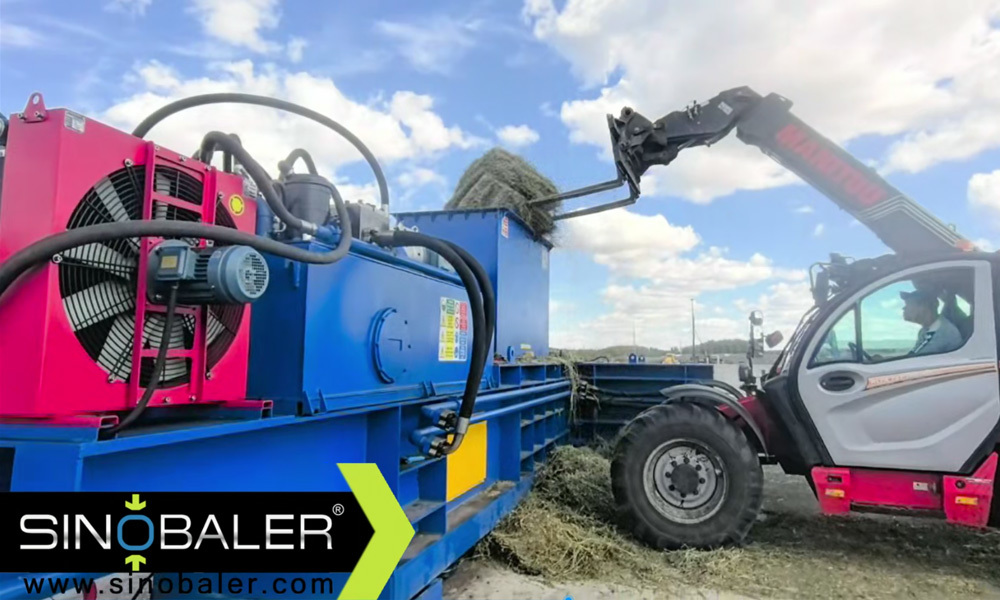
👉 Many exporters install compression or bagging balers to create standardized export packages.
🚢 4. Container Loading & Logistics
Efficient loading directly affects profitability.
Typical Container Setup
- 40HQ container commonly used
- Payload target: 24–28 tons (depending on compression)
- Tight stacking reduces movement during transport
Key Logistics Steps
- Bale inspection
- Weight verification
- Phytosanitary compliance
- Container stuffing
- Sealing & shipping documentation
📑 5. Export Documentation Required
Most importing countries require:
- Commercial Invoice
- Packing List
- Phytosanitary Certificate
- Certificate of Origin
- Fumigation Certificate (if required)
- Bill of Lading
Always confirm requirements with the destination country before shipment.
💰 6. How Exporters Increase Profit Margins
Successful exporters do more than ship hay — they optimize the whole chain.
Profit Strategies
✅ High-density compression to lower freight cost
✅ Long-term contracts with dairy farms
✅ Consistent bale specifications
✅ In-house processing and packaging
✅ Export-oriented storage systems
Many companies discover that processing equipment investment pays back quickly by reducing logistics costs and increasing sale price stability.
🌍 7. Common Challenges in Alfalfa Hay Export
Challenge | Solution |
|---|---|
High freight cost | Increase bale density |
Mold risk | Strict moisture control |
Quality inconsistency | Standardized processing |
Market price fluctuation | Contract-based selling |
Loading inefficiency | Automated handling systems |
✅ Final Thoughts
Exporting alfalfa hay is no longer just farming — it is a logistics and processing business.
The most successful exporters focus on three core elements:
- Quality production
- High-density compression
- Efficient global logistics
When these are combined, alfalfa hay becomes a highly profitable international commodity with stable long-term demand.
Other Blogs

Automatic Alfalfa Baling Machine
2025/09/02
An automatic alfalfa baling machine is specialized agricultural equipment that collects loose alfalfa and compresses it into dense, uniform bales. Unlike manual or semi-automatic balers, these machines are equipped with fully automated feeding, compressing, and ejecting systems, minimizing human intervention and increasing productivity.

Alfalfa Hay Compressing Machine
2019/09/12
Alfalfa is the good food source for rabbits, guinea pigs, hamsters, chinchillas, gerbils, prairie dogs, cows and other herbivores. You can feed alfalfa together with vitamin and mineral fortified feed to make sure animals receive complete essential nutrient. Normally at least alfalfa can accounts for 20% of the total diet. But how to keep the […]

Dehydrated Alfalfa Automatic Baler Machine
2019/07/16
What is dehydrated alfalfa? Alfalfa is widely grown in many countries around the world such as USA, Romania, Puerto Rica etc, and due to its richness of protein, it is most often used as animal food for feeding cattle, horse, chinchilla, and many other pets. Dehydrated alfalfa is a meal product resulting from the rapid […]

Alfalfa Hay Baler Machine
2019/05/10
Baling alfalfa is a normal work for every farmer who owns a cattle. Because alfalfa is the excellent feed for the cattle. How to make sure the quality of alfalfa? So it is very important to control the moisture which cannot be too low or too high. The most economical alfalfa is high in palatability, […]

Alfalfa Baler: An Efficient Baling Machine for Recycling
2016/11/17
The agricultural lands make use of the efficient technique of baling the waste products or the hay materials to maximize their productivity and outputs. The hay products like the grasses and shrubs including alfalfa and clover; are baled or recycled using the alfalfa baler by many farmers nowadays. Many farmers make use of the technique […]
Related Videos



Other Blogs
Automatic Alfalfa Baling Machine
2025/09/02
An automatic alfalfa baling machine is specialized agricultural equipment that collects loose alfalfa and compresses it into dense, uniform bales. Unlike manual or semi-automatic balers, these machines are equipped with fully automated feeding, compressing, and ejecting systems, minimizing human intervention and increasing productivity.
Alfalfa Hay Compressing Machine
2019/09/12
Alfalfa is the good food source for rabbits, guinea pigs, hamsters, chinchillas, gerbils, prairie dogs, cows and other herbivores. You can feed alfalfa together with vitamin and mineral fortified feed to make sure animals receive complete essential nutrient. Normally at least alfalfa can accounts for 20% of the total diet. But how to keep the […]
Dehydrated Alfalfa Automatic Baler Machine
2019/07/16
What is dehydrated alfalfa? Alfalfa is widely grown in many countries around the world such as USA, Romania, Puerto Rica etc, and due to its richness of protein, it is most often used as animal food for feeding cattle, horse, chinchilla, and many other pets. Dehydrated alfalfa is a meal product resulting from the rapid […]
2019/05/10
Baling alfalfa is a normal work for every farmer who owns a cattle. Because alfalfa is the excellent feed for the cattle. How to make sure the quality of alfalfa? So it is very important to control the moisture which cannot be too low or too high. The most economical alfalfa is high in palatability, […]
Alfalfa Baler: An Efficient Baling Machine for Recycling
2016/11/17
The agricultural lands make use of the efficient technique of baling the waste products or the hay materials to maximize their productivity and outputs. The hay products like the grasses and shrubs including alfalfa and clover; are baled or recycled using the alfalfa baler by many farmers nowadays. Many farmers make use of the technique […]
Media and Gallery
Follow us


PRIVACY POLICY
We collect information from you when you fill out an inquiry or contact form. When submitting the form on our site, you may be asked to enter your name and contact details such as: e-mail address, mailing address and/or phone number, etc. Alternatively, you can choose not to complete our forms and visit our site anonymously. Any of the information we collect from you may be used to help us to better respond to your individual needs, and/or enable us to more effectively respond to your customer service requests and support needs. The email address you provided may also be used to send you information and updates pertaining to your inquiry and/or order, in addition to receiving occasional company news, updates, related product or service information, etc. SINOBALER does not sell, trade, or otherwise transfer to outside parties your personally identifiable information. This does not include trusted third parties who assist us in operating our website, conducting our business, or servicing you, so long as those parties agree to keep this information confidential. We may also release your information when we believe release is appropriate to comply with the law, enforce our site policies, or protect ours or others rights, property, or safety.
By using our site, you consent to our online privacy policy. If we decide to change our privacy policy, we will post those changes on this page. If you have any questions or concerns regarding our privacy policy, please e-mail info@sinobaler.com or mail your question to us at 1206 Yinzhou Shanghui Nan Lou, 1299 Yinxian Avenue, Yinzhou District, Ningbo 315192, P.R. China.
EXTERNAL LINKS & DISCLAIMER
Our web site has links to many other organizations with their permission. Upon leaving the SINOBALER web site, you are subject to the privacy policy of the new site which are not under our control. SINOBALER is not responsible for the content of any linked site or any link contained in a linked site. These links are provided to you as a service for you to better understand the different business relationships that SINOBALER has established, and/or to point the reader to other possible relevant resources.