







Home | Blog |

Used Clothing Baler for Compact Textile Bales | 40'HC Container Loading Case Study
A used-clothing recycling company needed a high-pressure baler for loose used clothes and second-hand textiles, with compact and stable rectangular bales designed for export in 40-foot high-cube containers.
The customer initially targeted 400–500 kg per bale, but the most important requirement was the finished bale size, approximately 1,150 × 750 × 700–800 mm, so the bales could be efficiently arranged inside a 40'HC container.
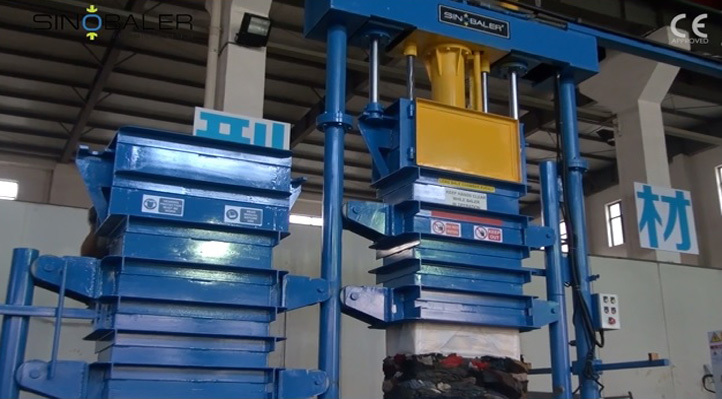
SINOBALER recommended a customized SVBT2-L1-1000 Lifting Chamber Baler with 100-ton pressing force, with a customized chamber designed around the customer's required bale dimensions and container-loading method.
Customer Requirement
The customer specializes in the collection, sorting and recycling of used clothing and second-hand textiles.
After sorting, the material consists mainly of loose garments with relatively low bulk density compared with paper and cardboard.
The customer needed bales that were:
- Compact and rectangular
- Stable enough for stacking
- Suitable for export transportation
- Optimized for 40-foot high-cube container loading
- Approximately 1,150 mm long
- Approximately 750–765 mm wide
- Approximately 700–800 mm high
- Ideally 400–500 kg per bale
The customer specifically asked what pressing chamber dimensions and pressing force would be required to achieve the desired finished bale.
The Baling Challenge: Bale Size vs. Bale Weight
Used clothing behaves differently from materials such as cardboard.
Loose garments are bulky, compressible and relatively low in density. Therefore, bale dimensions, compression force and bale weight cannot be considered independently.
For this application, the customer's most important requirement was the final bale footprint:
Approx. 1,150 × 750 mm
The bale height could vary according to the compression result.
At the same time, the customer wanted to maximize the amount of textile loaded into each 40'HC container.
This created an important engineering consideration:
A larger bale weight does not necessarily mean better container utilization if the finished bale dimensions already reach the available loading space and container weight limit.
SINOBALER's Customized Solution
For this application, SINOBALER recommended the SVBT2-L1-1000 Lifting Chamber Baler, equipped with a 100-ton pressing force.
The machine can be customized with a chamber size of:
W1100 × D700 mm
The bale dimensions before expansion are approximately:
W1100 × D700 × H variable mm
After compression and natural expansion of the textile material, the final bale dimensions are expected to be no more than approximately:
W1150 × D750 × H 500–1000 mm
The expected final bale density is approximately:
430–450 kg/m³
Recommended Machine
Model: SVBT2-L1-1000
Machine type: Lifting Chamber Baler
Pressing force: 100 tons
Customized chamber: W1100 × D700 mm
Final bale width: ≤ approx. 750 mm
Final bale length: ≤ approx. 1150 mm
Final bale height: Variable according to compression
Application: Used clothing / second-hand textiles
What Bale Weight Can Be Achieved?
The final bale weight depends strongly on the finished bale volume and actual compressed density.
For example, with a final bale size of approximately:
1150 × 750 × 800 mm
and an expected density of approximately 430–450 kg/m³, the resulting bale weight is approximately:
290–310 kg per bale
This is an important finding for this project.
Although the customer's initial target was 400–500 kg per bale, achieving 400–500 kg while maintaining a final height of only approximately 800 mm would require a substantially higher bale density and/or a larger bale volume.
Therefore, the bale dimensions should be prioritized first when container loading is the key objective.
40'HC Container Loading Calculation
The customer provided a specific loading arrangement for the finished textile bales.

Based on the proposed final bale dimensions of:
1150 × 750 × 800 mm
the bales can be arranged approximately as:
15 bales × 7 bales = 105 bales per container
At an estimated bale weight of 290–310 kg, the theoretical total bale weight would be:
- 105 × 290 kg = 30,450 kg
- 105 × 310 kg = 32,550 kg
Therefore, the calculated bale weight would be approximately:
30.5–32.6 tons per 40'HC container
This is already above the customer's stated 28-ton maximum loading weight.
What does this mean?
It means that the customer does not need to increase the pressing force to 150 tons simply to achieve a higher bale weight.
With the proposed bale dimensions, the available container volume can already accommodate more bale weight than the stated container weight limit allows.
In practical export operations, the actual allowable payload must also be confirmed according to the specific container, carrier, route and applicable regulations.
Why a 100-Ton Baler Can Be Sufficient
The container-loading calculation changes the way the baler should be selected.
If the customer were to use a higher-force baler to increase bale density and bale weight, the resulting bales could become unnecessarily heavy for the available container payload.
For this application, the objective is therefore not simply:
“Make the heaviest possible bale.”
Instead, the engineering objective is:
Compact bale + stable shape + suitable density + efficient container loading + compliance with payload limits
The customized 100-ton SVBT2-L1-1000 provides the pressing force and chamber configuration required for this application while allowing the final bale dimensions to be controlled according to the customer's logistics requirements.
Used Clothing Baling Process
The Lifting Chamber Baler is particularly suitable for whole garments and used clothes because the material can be compressed without requiring a cutting or shredding process.
A typical workflow is:
Sorted Used Clothes → Feeding → Compression → Bale Formation → Bale Tying/Strapping → Storage → Container Loading
This approach helps maintain the integrity of the garments while producing compact rectangular bales for storage, transportation and export.
Key Technical Considerations
When selecting a baler for used clothes, several parameters should be considered together.
1. Finished Bale Dimensions
For export applications, the bale footprint can be more important than maximum bale weight.
The customer's target of approximately 1,150 × 750 mm provides a clear basis for chamber customization.
2. Bale Weight
Bale weight depends on:
- Material type
- Material density
- Feeding condition
- Compression force
- Final bale volume
- Compression ratio
A target such as 500 kg/bale should therefore always be evaluated together with the required finished dimensions.
3. Bale Density
For this project, the estimated final density is approximately 430–450 kg/m³.
Density is particularly important when the customer's objective is to maximize the amount of material transported per container.
4. Container Payload
Container loading is not determined by volume alone.
Even when there is enough physical space for additional bales, the shipment may reach its allowable payload before the container is completely filled.
This is why bale dimensions, bale weight and container payload should be calculated together before selecting the baler.
Final Solution Summary
| Item | Customer Requirement / Solution |
|---|---|
| Material | Used clothing / second-hand textiles |
| Material condition | Loose, sorted garments |
| Machine | SVBT2-L1-1000 Lifting Chamber Baler |
| Pressing force | 100 tons |
| Customized chamber | W1100 × D700 mm |
| Final bale length | ≤ approx. 1150 mm |
| Final bale width | ≤ approx. 750 mm |
| Final bale height | Approx. 500–1000 mm, variable |
| Example bale size | 1150 × 750 × 800 mm |
| Estimated density | 430–450 kg/m³ |
| Example bale weight | Approx. 290–310 kg |
| Example loading | 15 × 7 = 105 bales |
| Calculated total bale weight | Approx. 30.5–32.6 tons |
| Key consideration | Container payload can limit total loading before available volume is fully utilized |
Need a Customized Used Clothing Baler?
If your company is exporting used clothes, second-hand garments or waste textiles, bale dimensions should be determined together with your container-loading plan.
SINOBALER can customize the pressing chamber, bale dimensions and machine configuration according to your required bale size, bale weight, material characteristics and transportation requirements.
To recommend the right used-clothing baler, please send us:
- Material: used clothes, sorted textiles or other garments
- Target bale size: L × W × H
- Target bale weight: kg/bale
- Required capacity: kg/hour or tons/day
- Container type: 20'GP, 40'GP or 40'HC
- Photos or videos of the loose textile material
- Your preferred loading arrangement, if available
Send your requirements to SINOBALER for a customized baling solution and quotation.
FAQ
Can a 100-ton baler produce 500 kg used-clothing bales?
The achievable bale weight depends on the final bale dimensions and material density. For the example size of 1,150 × 750 × 800 mm and an estimated density of 430–450 kg/m³, the calculated bale weight is approximately 290–310 kg. A 400–500 kg target would require a different final bale volume and/or higher achieved density.
What chamber size is recommended for 1,150 × 750 mm textile bales?
For this project, SINOBALER proposed a customized chamber of approximately 1,100 × 700 mm, with the final bale expanding to no more than approximately 1,150 × 750 mm in length and width.
Why not simply use a 150-ton baler?
Higher pressing force is not automatically beneficial. For the proposed bale dimensions, the calculated weight of 105 bales can already exceed the stated 28-ton container payload. Increasing bale density further could therefore leave container space unused because of the weight limit.
Is the bale height fixed at 800 mm?
No. The final bale height can vary depending on the compression conditions and required bale weight. For this project, the proposed final bale height range is approximately 500–1000 mm.
Other Blogs

How to Export Used Clothes from Ningbo China to Nigeria | SINOBALER Textile Baler Guide
2026/07/24
Learn how to export used clothes from Ningbo, China to Nigeria. Discover sorting, packaging, shipping steps and SINOBALER hydraulic clothing balers for efficient textile bale export.

Second-Hand Clothes Baler in the Textile Recycling Industry
2023/07/24
The fashion industry has long been criticized for its massive waste generation. A significant portion of clothing produced eventually ends up in landfills, contributing to environmental pollution and resource depletion. Addressing this challenge requires innovative approaches that extend the lifespan of textiles and divert them from landfills. One significant step towards reducing textile waste and […]

Double Chamber Clothes Baler
2025/07/30
A double chamber clothes baler is a specialized vertical baling machine designed to compress used clothing, rags, and other textile waste into compact, stackable bales. Its two-chamber design allows for continuous operation—while one chamber is compressing, the other can be loaded—dramatically improving efficiency and productivity in textile recycling centers, second-hand clothing exporters, and garment factories.
Clothes Recycling Baler
2025/09/04
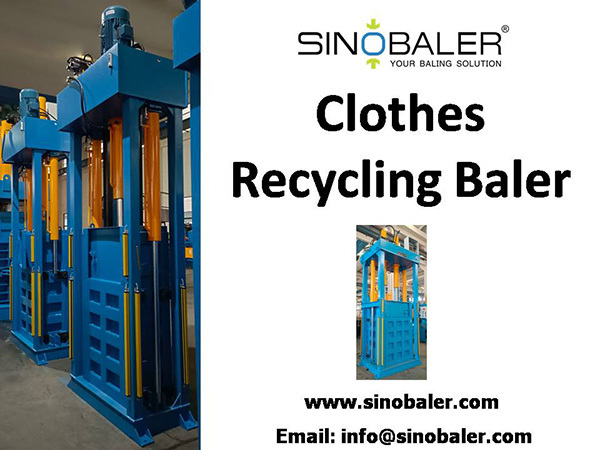
A clothes recycling baler is a specialized machine designed to compress post-consumer textiles—such as clothing, linens, and curtains—into compact, manageable bales. Similar to balers used for cardboard or plastic, these devices use hydraulic or mechanical force to reduce volume by up to 90%, simplifying storage, transportation, and recycling.

Textile Baler for Sale
2026/01/22
At SINOBALER, we offer a complete range of textile balers for sale, designed to meet the needs of textile factories, garment manufacturers, recycling centers, and waste management companies worldwide.

Textile Bagging Press
2025/07/28
A textile bagging press is a specialized baling machine designed to compress textile materials—such as used clothes, rags, towels, fabric scraps, or fibers—into compact bales and automatically wrap them in bags. This dual function of pressing and bagging makes the machine particularly valuable for recycling centers, textile exporters, donation organizations, and second-hand clothing distributors.
Related Videos



Other Blogs
How to Export Used Clothes from Ningbo China to Nigeria | SINOBALER Textile Baler Guide
2026/07/24
Learn how to export used clothes from Ningbo, China to Nigeria. Discover sorting, packaging, shipping steps and SINOBALER hydraulic clothing balers for efficient textile bale export.
Second-Hand Clothes Baler in the Textile Recycling Industry
2023/07/24
The fashion industry has long been criticized for its massive waste generation. A significant portion of clothing produced eventually ends up in landfills, contributing to environmental pollution and resource depletion. Addressing this challenge requires innovative approaches that extend the lifespan of textiles and divert them from landfills. One significant step towards reducing textile waste and […]
2025/07/30
A double chamber clothes baler is a specialized vertical baling machine designed to compress used clothing, rags, and other textile waste into compact, stackable bales. Its two-chamber design allows for continuous operation—while one chamber is compressing, the other can be loaded—dramatically improving efficiency and productivity in textile recycling centers, second-hand clothing exporters, and garment factories.
2025/09/04
A clothes recycling baler is a specialized machine designed to compress post-consumer textiles—such as clothing, linens, and curtains—into compact, manageable bales. Similar to balers used for cardboard or plastic, these devices use hydraulic or mechanical force to reduce volume by up to 90%, simplifying storage, transportation, and recycling.
2026/01/22
At SINOBALER, we offer a complete range of textile balers for sale, designed to meet the needs of textile factories, garment manufacturers, recycling centers, and waste management companies worldwide.
2025/07/28
A textile bagging press is a specialized baling machine designed to compress textile materials—such as used clothes, rags, towels, fabric scraps, or fibers—into compact bales and automatically wrap them in bags. This dual function of pressing and bagging makes the machine particularly valuable for recycling centers, textile exporters, donation organizations, and second-hand clothing distributors.
Media and Gallery
Follow us


PRIVACY POLICY
We collect information from you when you fill out an inquiry or contact form. When submitting the form on our site, you may be asked to enter your name and contact details such as: e-mail address, mailing address and/or phone number, etc. Alternatively, you can choose not to complete our forms and visit our site anonymously. Any of the information we collect from you may be used to help us to better respond to your individual needs, and/or enable us to more effectively respond to your customer service requests and support needs. The email address you provided may also be used to send you information and updates pertaining to your inquiry and/or order, in addition to receiving occasional company news, updates, related product or service information, etc. SINOBALER does not sell, trade, or otherwise transfer to outside parties your personally identifiable information. This does not include trusted third parties who assist us in operating our website, conducting our business, or servicing you, so long as those parties agree to keep this information confidential. We may also release your information when we believe release is appropriate to comply with the law, enforce our site policies, or protect ours or others rights, property, or safety.
By using our site, you consent to our online privacy policy. If we decide to change our privacy policy, we will post those changes on this page. If you have any questions or concerns regarding our privacy policy, please e-mail info@sinobaler.com or mail your question to us at 1206 Yinzhou Shanghui Nan Lou, 1299 Yinxian Avenue, Yinzhou District, Ningbo 315192, P.R. China.
EXTERNAL LINKS & DISCLAIMER
Our web site has links to many other organizations with their permission. Upon leaving the SINOBALER web site, you are subject to the privacy policy of the new site which are not under our control. SINOBALER is not responsible for the content of any linked site or any link contained in a linked site. These links are provided to you as a service for you to better understand the different business relationships that SINOBALER has established, and/or to point the reader to other possible relevant resources.