







Home | Blog |

Hay Baler for Dairy Farm: How to Choose the Right Hay Baling Machine
A reliable hay baler for dairy farms can make a significant difference in how hay is handled, stored, transported, and prepared for feeding. By compressing loose hay into compact bales, a suitable hay baling machine can help reduce storage volume, improve handling efficiency, and streamline daily farm operations.
However, there is no single hay baler that is ideal for every dairy farm.
The right machine depends on several factors, including:
- Whether your hay is long-form or chopped
- Your expected bale weight
- Required bale dimensions
- Approximate daily hay volume
- Type of hay, such as alfalfa or grass hay
- Required level of automation
- Available feeding and bale-handling equipment
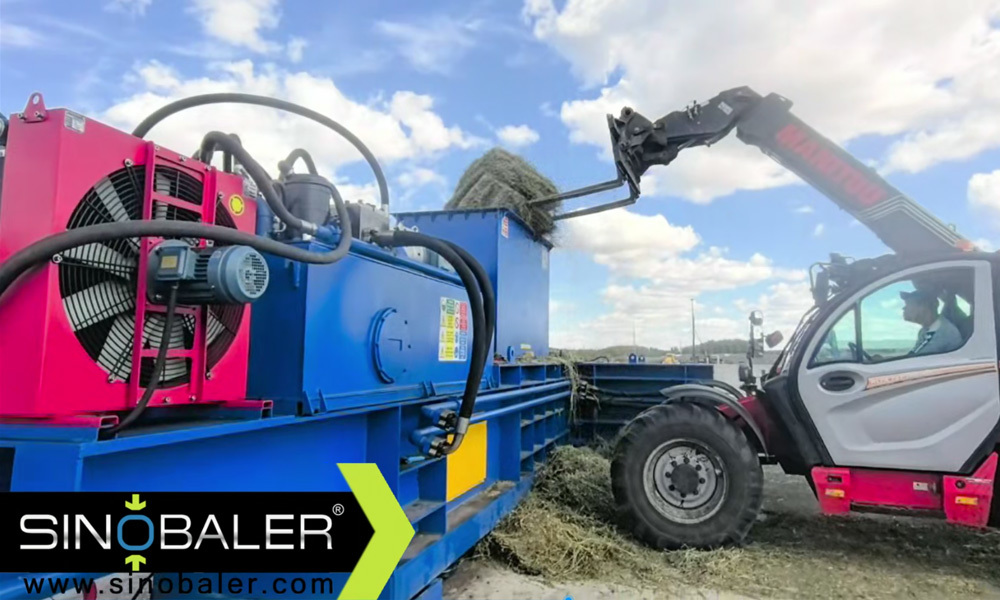
SINOBALER provides different hay baling solutions, including fully automatic horizontal balers for long-form hay and bagging balers for chopped / unchopped hay. Our bagging baler range also includes both small and large units, allowing the machine to be selected according to your target bale weight and production requirements.
What Is a Hay Baler for a Dairy Farm?
A hay baler is a machine designed to compress loose or chopped hay into compact bales for easier storage, transportation, handling, and feeding.
For dairy farms, common baling materials include:
- Alfalfa hay
- Grass hay
- Timothy hay
- Straw
- Chopped forage
- Other dry agricultural biomass
Depending on the application, hay can be compressed into small bales of around 20–50 kg or much larger bales of approximately 300–500 kg.
For farms supplying their own livestock, smaller bales may be convenient for manual handling and feeding. For larger dairy farms, feed producers, and commercial hay operations, larger bales can improve material-handling efficiency and reduce labor requirements.
Small vs. Large Hay Baler: Which One Is Better?
The most important factor when selecting a SINOBALER hay baler is generally the target bale weight.
Small Hay Bales: Approximately 20–50 kg
Small bagging balers are suitable when you need relatively lightweight bales that are easier to manually handle.
Typical applications include:
- Dairy farms with manual feeding
- Small and medium livestock farms
- Retail or commercial hay packaging
- Hay products requiring manageable bale weights
- Farms that need individual bags for cleaner handling
SINOBALER offers different small bagging baler configurations for producing approximately 20–50 kg bales, depending on the material and required bale specifications.
Large Hay Bales: Approximately 300–500 kg
For larger dairy farms or commercial agricultural operations, large bales can significantly reduce the number of individual bales that need to be handled.
Large hay bagging balers can be considered when:
- Daily hay volume is high
- Bale handling is mechanized
- Forklifts or other lifting equipment are available
- Large-volume storage is required
- Labor requirements need to be reduced
SINOBALER has large-scale bagging baler solutions designed for approximately 300–500 kg bales, with the exact capacity and bale weight depending on the selected model and material.
Why Use a Bagging Baler for Hay?
Compared with simply storing loose hay, baling can make the material substantially easier to manage.
1. Reduce Hay Volume
Compression reduces the volume occupied by loose hay, helping make better use of storage space.
2. Easier Handling
Compact bales are easier to move, stack, transport, and organize than loose hay.
3. More Efficient Transportation
Higher-density bales can help reduce the amount of space required for transportation.
4. Convenient Feeding
Depending on bale size and farm practices, baled hay can be moved to the feeding area using manual labor, forklifts, loaders, or other equipment.
5. Bagged Bale Handling
For applications requiring bagged hay, the bagging system can provide an additional packaging layer and help keep the compressed material together during handling and transportation.
Long Hay or Chopped Hay: Does It Matter?
Yes.
The physical form of your hay is an important consideration when selecting a hay baler.
Long-Form Hay
Long hay has longer fibers and may require different feeding and compression considerations compared with chopped material.
The feeding system, compression chamber, and bale-forming process should be evaluated according to the actual material characteristics.
Chopped Hay
Chopped hay has shorter pieces and can behave differently during feeding and compression. Depending on the particle size, moisture content, and target density, a different machine configuration may be more appropriate.
This is why SINOBALER recommends selecting the baler based on the actual hay material and production requirements rather than choosing a machine based only on its nominal tonnage.
How Much Hay Can a Dairy Farm Baler Process?
Production capacity should be considered together with your daily hay volume.
For example, if your dairy farm needs to process a certain number of tons during an 8-hour working day, the required hourly capacity can be estimated as:
Required hourly capacity = Daily hay volume ÷ 8 hours
However, the actual machine capacity can vary according to:
- Hay type
- Moisture content
- Hay particle length
- Feeding method
- Bale weight
- Bale dimensions
- Required bale density
- Operator efficiency
- Continuous or intermittent feeding
Therefore, simply comparing machines by "tons per hour" may not be enough.
How to Choose a Hay Baler for Your Dairy Farm
Before purchasing a hay baler, we recommend answering five key questions.
1. What Is Your Expected Bale Weight?
This is one of the most important specifications.
For example:
- 20 kg
- 25 kg
- 40 kg
- 50 kg
- 300 kg
- 500 kg
The required bale weight will strongly influence the appropriate machine size and configuration.
2. Do You Have a Specific Bale Dimension?
If you already have a required bale size, please provide it.
If not, SINOBALER can recommend a suitable bale dimension based on your target bale weight, material, and handling requirements.
3. How Much Hay Do You Need to Process?
Please provide your approximate hay volume for an 8-hour working day.
For example:
We need to process approximately 20 tons of hay per day.
This allows the required production rate to be estimated and helps determine the appropriate machine capacity.
4. Is the Hay Long or Chopped?
Please specify whether your material is:
- Long-form hay
- Short/chopped hay
- Mixed or partially chopped hay
Material form can affect feeding and compression performance.
5. What Type of Hay Are You Baling?
Please tell us whether the material is:
- Alfalfa
- Grass hay
- Timothy
- Straw
- Other forage
Different materials can have different characteristics during compression.
SINOBALER Hay Baling Solutions
SINOBALER provides small and large bagging balers for hay, allowing the machine configuration to be selected according to the customer's bale weight and production requirements. For unchopped hay baling, SINOBALER also provides fully automatic horizontal baler for option.
Rather than offering only one standard hay baler, SINOBALER can evaluate your requirements and recommend a suitable configuration.
Small Bale Solution
Typical bale weight: 20–50 kg
Suitable for applications where relatively lightweight bales are preferred for manual or easier mechanical handling.
Watch the SINOBALER small hay bale demonstration
Large Bale Solution
Typical bale weight: 300–500 kg
Suitable for larger-scale dairy farms, agricultural businesses, and commercial hay-processing operations where higher-volume production and mechanized handling are important.
Watch the SINOBALER large hay bale demonstration
Unchopped Hay Bale Solution – Fully Automatic Horizontal Baler
Watch the SINOBALER fully automatic baler hay baling demonstration
Hay Baler for Dairy Farm: Get the Right Model for Your Requirement
The best hay baler is not necessarily the biggest or most powerful machine. It is the machine that matches your bale weight, hay type, daily capacity, bale dimensions, and feeding/handling method.
If you are looking for a hay baler for a dairy farm, send SINOBALER the following information:
1. Expected bale weight:
2. Required bale dimensions:
3. Hay volume per 8-hour day:
4. Long hay or chopped hay:
5. Alfalfa, grass hay, straw, or other material:
Based on these details, SINOBALER can recommend a suitable hay bagging baler model and configuration for your application.
SINOBALER – Hay & Biomass Baling Solutions
FAQ: Hay Baler for Dairy Farm
What is the best hay baler for a dairy farm?
The best machine depends mainly on your required bale weight, daily production, hay type, bale dimensions, and feeding method. Small bagging balers may be suitable for 20–50 kg bales, while large systems can be used for approximately 300–500 kg bales.
Can a hay baler bale alfalfa?
Yes. SINOBALER bagging balers can be configured for agricultural biomass applications including alfalfa. The specific model should be selected according to the alfalfa's form, moisture, bale weight, and required capacity.
Can I bale chopped hay?
Yes, but the appropriate machine configuration depends on the chopped hay's particle size, moisture, target bale weight, and required production rate.
What information should I provide to choose a hay baler?
The five most useful pieces of information are bale weight, bale dimensions, daily hay volume, hay form, and hay type.
Does SINOBALER provide both small and large hay balers?
Yes. SINOBALER provides different sizes of bagging balers, including solutions for relatively small 20–50 kg bales and larger 300–500 kg bales. The final model should be selected according to the actual application.
What is the difference between a hay baler and a hay bagging baler?
A conventional horizontal baler forms compressed bales, while a bagging baler is designed to compress material into a bagged bale. For chopped hay where bagged packaging is desired, a bagging baler can be an ideal solution.
Other Blogs

Case Study: How to Produce 2.8 kg, 1.4 kg and 0.7 kg Hay Bags with One Baling & Bagging Machine
2026/08/17
If your business needs to package loose hay into several different weights, such as 0.7 kg, 1.4 kg, 2.8 kg or other customized weights, a standard baler may not be the best solution. A customized scale-weighing bagging baler can combine accurate weighing, adjustable hydraulic compression and flexible bale-length control in one system. SINOBALER can evaluate your material and packaging requirements and recommend a suitable configuration.

Case Study: Packaging Chopped Lucerne Hay & Straw into 6–10 kg Stockfeed Bags
2026/06/12
Discover how the SINOBALER SHB1-SW-100 Scale Weighing Horizontal Bagging Baler efficiently packages chopped lucerne hay and straw into accurate 6–10 kg stockfeed bags. Ideal for livestock feed producers seeking a cost-effective and reliable bagging solution.

How to Export Alfalfa Hay
2026/04/27
Complete guide to exporting alfalfa hay covering market requirements, harvesting, baling, container logistics, export documents, profit strategies, and common challenges.

How Much Does a Bale of Hay Weigh
2025/11/05
The weight of a bale of hay can vary widely depending on size, type, and moisture content. Small square bales typically weigh 40–75 pounds, while large square or round bales can range from 500 to over 1,500 pounds. Understanding these weights is vital for efficient farm management, safe handling, and proper feeding practices.

Hay Baler Machine: Revolutionizing the Farming Industry
2023/06/01
In the world of agriculture, efficiency and productivity are key factors in ensuring a successful harvest. One of the machines that has revolutionized the farming industry is the hay baler machine. This remarkable piece of equipment has simplified the process of collecting and bundling hay, making it easier for farmers to handle, transport, and store […]
Related Videos




Other Blogs
Case Study: How to Produce 2.8 kg, 1.4 kg and 0.7 kg Hay Bags with One Baling & Bagging Machine
2026/08/17
If your business needs to package loose hay into several different weights, such as 0.7 kg, 1.4 kg, 2.8 kg or other customized weights, a standard baler may not be the best solution. A customized scale-weighing bagging baler can combine accurate weighing, adjustable hydraulic compression and flexible bale-length control in one system. SINOBALER can evaluate your material and packaging requirements and recommend a suitable configuration.
Case Study: Packaging Chopped Lucerne Hay & Straw into 6–10 kg Stockfeed Bags
2026/06/12
Discover how the SINOBALER SHB1-SW-100 Scale Weighing Horizontal Bagging Baler efficiently packages chopped lucerne hay and straw into accurate 6–10 kg stockfeed bags. Ideal for livestock feed producers seeking a cost-effective and reliable bagging solution.
2026/04/27
Complete guide to exporting alfalfa hay covering market requirements, harvesting, baling, container logistics, export documents, profit strategies, and common challenges.
How Much Does a Bale of Hay Weigh
2025/11/05
The weight of a bale of hay can vary widely depending on size, type, and moisture content. Small square bales typically weigh 40–75 pounds, while large square or round bales can range from 500 to over 1,500 pounds. Understanding these weights is vital for efficient farm management, safe handling, and proper feeding practices.
Hay Baler Machine: Revolutionizing the Farming Industry
2023/06/01
In the world of agriculture, efficiency and productivity are key factors in ensuring a successful harvest. One of the machines that has revolutionized the farming industry is the hay baler machine. This remarkable piece of equipment has simplified the process of collecting and bundling hay, making it easier for farmers to handle, transport, and store […]
Media and Gallery
Follow us


PRIVACY POLICY
We collect information from you when you fill out an inquiry or contact form. When submitting the form on our site, you may be asked to enter your name and contact details such as: e-mail address, mailing address and/or phone number, etc. Alternatively, you can choose not to complete our forms and visit our site anonymously. Any of the information we collect from you may be used to help us to better respond to your individual needs, and/or enable us to more effectively respond to your customer service requests and support needs. The email address you provided may also be used to send you information and updates pertaining to your inquiry and/or order, in addition to receiving occasional company news, updates, related product or service information, etc. SINOBALER does not sell, trade, or otherwise transfer to outside parties your personally identifiable information. This does not include trusted third parties who assist us in operating our website, conducting our business, or servicing you, so long as those parties agree to keep this information confidential. We may also release your information when we believe release is appropriate to comply with the law, enforce our site policies, or protect ours or others rights, property, or safety.
By using our site, you consent to our online privacy policy. If we decide to change our privacy policy, we will post those changes on this page. If you have any questions or concerns regarding our privacy policy, please e-mail info@sinobaler.com or mail your question to us at 1206 Yinzhou Shanghui Nan Lou, 1299 Yinxian Avenue, Yinzhou District, Ningbo 315192, P.R. China.
EXTERNAL LINKS & DISCLAIMER
Our web site has links to many other organizations with their permission. Upon leaving the SINOBALER web site, you are subject to the privacy policy of the new site which are not under our control. SINOBALER is not responsible for the content of any linked site or any link contained in a linked site. These links are provided to you as a service for you to better understand the different business relationships that SINOBALER has established, and/or to point the reader to other possible relevant resources.