







Home | Blog |

Rice Husk Bagging Baler Case Study: 3.2 T/H Capacity with 40 kg Bales
✅ Get a Rice Husk Baler Recommendation | FAQ | Request Layout Design | Watch Demo
South America Rice Mill Project for High-Density Rice Husk Logistics Bales
A rice mill customer in South America was looking for a reliable rice husk compaction line to convert loose, difficult-to-handle rice husk into transport-ready compressed bales.
The customer's main objective was not simply to reduce the volume of rice husk. The finished bales needed to achieve a real minimum density of approximately 480–500 kg/m³, weigh around 40 kg each, and reach a production capacity of approximately 3.2 tons per hour or higher.
After reviewing the material characteristics, target bale density, bale weight, throughput, and continuous-operation requirements, SINOBALER recommended a customized Heavy-Duty Horizontal Bagging Baler SHB1-WS-1000 with an 80-ton-class or higher compression force configuration.

Project Requirements at a Glance
Requirement | Customer Target | SINOBALER Solution |
Material | Dry rice husk | Rice husk of 10-15% moisture |
Material characteristic | High silica / abrasive | Heavy-duty wear-resistant configuration |
Bale weight | 40 kg ±5% | Approx. 40–42 kg |
Minimum target density | 480–500 kg/m³ | Designed around required bale dimensions |
Required capacity | ≥3.2 t/h | Approx. 3.5 t/h |
Bale production | — | Approx. 80–100 bales/hour |
Feeding | Continuous | Enlarged hopper + infeed belt conveyor |
Control | PLC | PLC + HMI touchscreen |
Hydraulic system | Industrial | Heavy-duty dual-pump hydraulic system |
Motor | — | 40 HP |
Cooling | — | Air cooling system |
Machine weight | — | Approx. 7.8 tons |
Application | Logistics / transportation | High-density transport-ready bales |
The Customer's Rice Husk Baling Challenge
Rice husk presents a different compression challenge from many other biomass materials.
The customer was processing dry rice husk from rice mills. Because rice husk contains a relatively high proportion of silica, it is abrasive and can be more demanding on feeding and compression equipment.
At the same time, the customer required a relatively high finished density:
480–500 kg/m³ minimum
while maintaining a bale weight of approximately:
40 kg per bale
and a production target of:
3.2 tons/hour or higher
This combination means the baler needs to deliver not only sufficient compression force but also a stable feeding rate and repeatable bale dimensions.
A machine that can produce a high-pressure bale intermittently is not enough for this application. The complete system needs to maintain a consistent material feed and repeatable compression cycle for continuous industrial operation.
Why Rice Husk Requires a Heavy-Duty Bagging Baler
Rice husk is relatively difficult to densify because its particles are hard, irregular and abrasive. The material also contains considerable air volume when it is loosely accumulated.
During compression, the machine must first overcome the resistance created by particle rearrangement and air removal before achieving the required final density.
For this reason, rice husk normally requires a higher compression force than softer and more easily deformable biomass materials.
For this project, SINOBALER considered a higher compression force to be a practical starting point for achieving the customer's required density and production performance.
The exact force required in any project should be confirmed through material testing because rice husk bulk density, moisture content, particle characteristics and target bale density can all influence the required compression force.
Recommended Solution: SHB1-WS-1000 Heavy-Duty Horizontal Bagging Baler
Based on the customer's requirements, SINOBALER recommended the SHB1-WS-1000 Heavy-Duty Horizontal Bagging Baler with a customized configuration.
The machine is designed for demanding industrial bagging applications where the material must be compressed into consistent, transportable bags/bales at high throughput.
For this rice husk project, the machine is configured with:
- Heavy-duty hydraulic compression system
- 100-ton-class pressing force
- 40 HP motor
- Dual-pump hydraulic system
- PLC automatic control
- HMI touchscreen operation interface
- Air cooling system
- Enlarged material hopper
- Infeed belt conveyor
- Customized bale chamber and bale chute
- Continuous feeding capability
- Heavy-duty construction for abrasive biomass
- Approx. 7.8-ton machine weight
This configuration provides the hydraulic power and continuous feeding capability required for the customer's target production.
40 kg Rice Husk Bale Design
For this application, SINOBALER proposed a bale/chute size of approximately:
L750 × W250 × H450 mm
The final bale weight is expected to be approximately 40 kg, with the possibility of producing slightly heavier bales in the range of 41–42 kg, depending on actual material bulk density and operating conditions.
The customer's specified tolerance is:
40 kg ±5%
which corresponds to an acceptable range of approximately:
38–42 kg per bale
The final bale weight should be confirmed during commissioning and material testing because rice husk properties can vary from one rice mill to another.
How the System Can Reach Approximately 3.5 Tons/Hour
The target production rate is approximately 3.2 tons/hour or higher.
With the proposed configuration, SINOBALER estimates a production rate of approximately:
80–100 bales/hour
If the average bale weight is approximately 40–42 kg:
At 80 bales/hour
80 × 40 kg = 3,200 kg/hour
≈ 3.2 tons/hour
At 90 bales/hour
90 × 40 kg = 3,600 kg/hour
≈ 3.6 tons/hour
At 100 bales/hour
100 × 40 kg = 4,000 kg/hour
≈ 4.0 tons/hour
Therefore, the proposed configuration provides a reasonable operating range to meet the customer's 3.2 t/h target, with an estimated nominal production capability of around 3.5 t/h under suitable material and operating conditions.
Actual production will depend on material bulk density, moisture, feeding consistency, bale weight, compression cycle and other operating parameters.
Continuous Feeding for 3.2+ T/H Rice Husk Production
For a capacity target above 3 tons/hour, feeding consistency becomes extremely important.
Instead of relying on intermittent manual feeding, this project uses:
Rice Mill / Storage
↓
Rice Husk Conveying
↓
Infeed Belt Conveyor
↓
Enlarged Hopper
↓
SHB1-WS-1000 Bagging Baler
↓
40–42 kg Compressed Rice Husk Bale
↓
Seal the Compressed Bale Bag
↓
Bale Handling & Logistics
The enlarged hopper and infeed belt conveyor help maintain a more consistent material supply to the baler.
Continuous feeding also allows the hydraulic compression system to operate as part of an integrated production process rather than functioning as a manually loaded standalone machine.
PLC + HMI Control for Stable Industrial Operation
The proposed SHB1-WS-1000 configuration uses PLC control with an HMI touchscreen interface.
This allows the operator to monitor and control important operating parameters from a centralized interface.
The control system can be configured to manage:
- Feeding operation
- Compression cycle
- Bale formation
- Bale ejection
- Machine interlocks
- Alarm conditions
- Operating status
- Production settings
For a continuous rice husk operation, PLC-based control can also help reduce variations caused by manual operation.
Heavy-Duty Hydraulic System
The compression system is one of the most important parts of a rice husk bagging baler.
For this application, SINOBALER proposes a dual-pump hydraulic system.
The purpose is not simply to provide high hydraulic pressure. The hydraulic system needs to balance:
Compression force + cycle speed + continuous operation
A properly configured hydraulic system can provide high force when the material reaches the main compression stage while maintaining efficient hydraulic operation during other stages of the cycle.
This is particularly important when the target is approximately 80–100 bales per hour.
40 HP Motor and Air Cooling System
The proposed machine is equipped with a 40 HP motor and an air cooling system.
For a continuous 3.2+ t/h application, thermal management is important because the hydraulic system may operate for extended periods.
The cooling system helps manage heat generated during continuous hydraulic operation and supports stable machine performance.
Designed for Abrasive Rice Husk
Rice husk is not simply another loose biomass material.
Its relatively high silica content makes it abrasive, so material-contact components and feeding components should be considered carefully during machine design.
For this reason, the machine configuration should pay particular attention to:
- Hopper construction
- Conveyor design
- Material-contact areas
- Wear-prone components
- Hydraulic cylinder protection
- Sealing components
- Maintenance accessibility
The objective is to provide a machine that can withstand continuous industrial operation rather than designing the equipment only around the nominal compression force.
Why Bagging Instead of Conventional Bale Tying?
For rice husk intended for logistics and transportation, bagging provides several practical advantages.
A bag contains the compressed rice husk and helps maintain the bale shape during handling and transportation.
The general process is:
Loose Rice Husk
→ Controlled Feeding
→ Compression
→ Bag Filling
→ Bale Formation
→ Bag Sealing
→ Transport / Storage
This can be particularly useful when the final product needs to be handled as a packaged biomass product rather than as a loose material.
Key Engineering Considerations for Rice Husk Bagging
Before selecting a rice husk baler, buyers should evaluate more than just the nominal hydraulic force.
1. Required Bale Density
The customer's target of 480–500 kg/m³ is critical.
A larger compression chamber does not automatically mean better performance. If the chamber becomes too large without a corresponding increase in compression force, the available force is distributed over a larger cross-sectional area.
Therefore:
Compression force + chamber size + material characteristics + target density
must be evaluated together.
2. Bale Weight
The required 40 kg bale weight affects the required bale volume.
A useful engineering relationship is:
Bale Volume = Bale Weight ÷ Bale Density
For example, at 40 kg and 500 kg/m³:
40 ÷ 500 = 0.08 m³
Therefore, the finished compressed bale needs an approximate volume of 0.08 m³ at 500 kg/m³.
This is why bale dimensions should be designed together with the target density rather than selected independently.
3. Material Moisture
Although this project uses dry rice husk, actual moisture content should still be measured.
Moisture can affect:
- Bulk density
- Compressibility
- Bale weight
- Storage stability
- Friction
- Machine performance
4. Continuous Feeding
At more than 3 tons/hour, inconsistent feeding can become a bottleneck.
The conveyor and hopper should therefore be sized according to the actual loose bulk density and required hourly throughput.
Project Result
Based on the customer's requirements, SINOBALER proposed a customized SHB1-WS-1000 Heavy-Duty Horizontal Bagging Baler designed around the following target:
40 kg Rice Husk Bale
Target bale weight: 40 kg ±5%
Proposed bale weight: approximately 40–42 kg
Target density: 480–500 kg/m³
Target production: ≥3.2 t/h
Estimated production: approximately 80–100 bales/h
Estimated throughput: approximately 3.2–4.0 t/h depending on bale weight and operating conditions
The combination of high compression force, continuous feeding, dual-pump hydraulics, PLC control, HMI operation, enlarged hopper and infeed conveyor provides a practical configuration for high-throughput rice husk compaction.
Why This Rice Husk Baling Solution Is Different
This project demonstrates an important point when selecting a biomass bagging baler:
The highest-capacity machine is not necessarily the machine with the highest hydraulic force.
The complete system must be designed around:
Material → Density → Bale Weight → Chamber Size → Compression Force → Cycle Time → Feeding → Throughput
For rice husk, the abrasive nature of the material adds another engineering consideration: the machine needs to be designed for continuous heavy-duty operation, not merely for achieving a specified compression force.
Looking for a Rice Husk Bagging Baler for 3+ Tons/Hour?
If you are processing rice husk and need 40 kg or other customized bale weights, SINOBALER can design the compression chamber, feeding system, hydraulic configuration and control system around your required output.
Please send us the following information for a preliminary recommendation:
- Rice husk moisture content
- Loose bulk density
- Required bale weight
- Required bale dimensions
- Target bale density
- Required tons/hour
- Feeding method
- Bag type and dimensions
- Available electrical power
- Destination country
Need a rice husk bagging solution for 3.2 t/h or higher? Contact SINOBALER for a customized recommendation based on your material and target bale density.
Frequently Asked Questions
What compression force is required for a rice husk bagging baler?
For demanding rice husk applications, an 80-ton-class or higher bagging baler can be a practical configuration, particularly when high bale density and high throughput are required. The exact force should be determined from the required bale density, chamber dimensions and actual material properties.
Can rice husk be compressed into 40 kg bales?
Yes. A customized bagging baler can be designed for approximately 40 kg rice husk bales. For this project, SINOBALER proposed approximately 40–42 kg per bale within the customer's 40 kg ±5% requirement.
Can a rice husk baler achieve 3.2 tons per hour?
Yes, depending on the bale weight, cycle time, material characteristics and feeding system. For this project, the proposed configuration is estimated at 80–100 bales/hour, corresponding to approximately 3.2–4.0 tons/hour with 40 kg bales.
Why does rice husk require high compression force?
Rice husk is relatively hard and abrasive and has a high silica content. Its particle structure and low loose bulk density make densification more challenging than many softer biomass materials. Higher compression force can therefore be necessary to achieve a high final bale density.
Is continuous feeding necessary for 3.2 t/h production?
For a production target above 3 tons/hour, continuous and consistent feeding is highly recommended. An appropriately sized infeed belt conveyor and enlarged hopper can help maintain a stable material supply to the baler.
Can the bale weight be adjusted?
The bale weight can generally be adjusted within a suitable operating range by controlling the amount of material entering the compression chamber. However, the achievable weight range depends on the chamber dimensions, target density, material bulk density and machine configuration.
Is rice husk abrasive to baling equipment?
Yes. Rice husk contains a significant amount of silica and can be abrasive. Wear-prone components, material-contact surfaces, feeding equipment and maintenance requirements should therefore be considered when configuring the complete system.
Technical Summary
Application: Rice Husk Compaction & Bagging
Customer Location: South America
Material: Dry Rice Husk
Target Bale Weight: 40 kg ±5%
Proposed Bale Weight: Approximately 40–42 kg
Target Density: 480–500 kg/m³
Target Capacity: ≥3.2 t/h
Estimated Capacity: Approximately 3.5 t/h
Estimated Production: 80–100 bales/hour
Recommended Machine: SHB1-WS-1000 Heavy-Duty Horizontal Bagging Baler
Compression Force: 100-ton-class configuration
Motor: 40 HP
Hydraulic System: Dual-pump
Control: PLC
Operator Interface: HMI touchscreen
Cooling: Air cooling
Feeding: Enlarged hopper + infeed belt conveyor
Machine Weight: Approximately 7.8 tons
Proposed Bale/Chute Dimensions: 750 × 250 × 450 mm
Application: Rice Husk Logistics Bales
Other Blogs

Rice Husk Packing Machine
2019/05/31
What is rice husk? Rice husk is the hard protecting coverings of grains of rice. During milling process, the rice hulls are separated from the rice grains. People used to consider rice husk as a waste product. So they often burn or dump into landfills. But nowadays, we are using rice husks as building material, […]

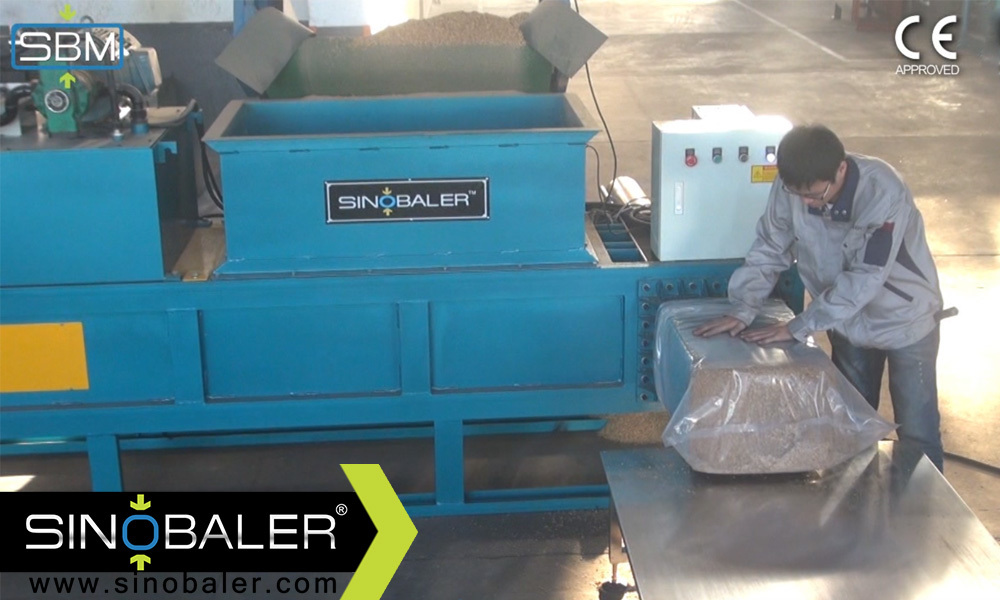
Rice Husk Baling Machine for Rice Husk Utilization
2016/04/01
Rice husk is a waste product from rice milling industry. It is the outer shell of the rice and takes approximately one fifth of the rice by weight. Each year, the rice production worldwide amounts up to 700 million tons, and it generates rice husks approx. 140 million tons per year globally. With so high […]
Related Videos

Other Blogs
2019/05/31
What is rice husk? Rice husk is the hard protecting coverings of grains of rice. During milling process, the rice hulls are separated from the rice grains. People used to consider rice husk as a waste product. So they often burn or dump into landfills. But nowadays, we are using rice husks as building material, […]
Rice Husk Baling Machine for Rice Husk Utilization
2016/04/01
Rice husk is a waste product from rice milling industry. It is the outer shell of the rice and takes approximately one fifth of the rice by weight. Each year, the rice production worldwide amounts up to 700 million tons, and it generates rice husks approx. 140 million tons per year globally. With so high […]
Media and Gallery
Follow us


PRIVACY POLICY
We collect information from you when you fill out an inquiry or contact form. When submitting the form on our site, you may be asked to enter your name and contact details such as: e-mail address, mailing address and/or phone number, etc. Alternatively, you can choose not to complete our forms and visit our site anonymously. Any of the information we collect from you may be used to help us to better respond to your individual needs, and/or enable us to more effectively respond to your customer service requests and support needs. The email address you provided may also be used to send you information and updates pertaining to your inquiry and/or order, in addition to receiving occasional company news, updates, related product or service information, etc. SINOBALER does not sell, trade, or otherwise transfer to outside parties your personally identifiable information. This does not include trusted third parties who assist us in operating our website, conducting our business, or servicing you, so long as those parties agree to keep this information confidential. We may also release your information when we believe release is appropriate to comply with the law, enforce our site policies, or protect ours or others rights, property, or safety.
By using our site, you consent to our online privacy policy. If we decide to change our privacy policy, we will post those changes on this page. If you have any questions or concerns regarding our privacy policy, please e-mail info@sinobaler.com or mail your question to us at 1206 Yinzhou Shanghui Nan Lou, 1299 Yinxian Avenue, Yinzhou District, Ningbo 315192, P.R. China.
EXTERNAL LINKS & DISCLAIMER
Our web site has links to many other organizations with their permission. Upon leaving the SINOBALER web site, you are subject to the privacy policy of the new site which are not under our control. SINOBALER is not responsible for the content of any linked site or any link contained in a linked site. These links are provided to you as a service for you to better understand the different business relationships that SINOBALER has established, and/or to point the reader to other possible relevant resources.