







Home | Blog |

Glass Wool Fiber Compaction and Bagging Solution | SINOBALER Case Study
Project Overview: Compacting and Bagging Crushed Glass Wool Fibers
A glass wool manufacturer was looking for an industrial compaction press with a bagging solution for crushed glass wool fibers, also known as blowing wool. The equipment needed to compact the lightweight fibrous material into bags while integrating with the factory's existing silo dosing system.
The key requirement was to automate the material weighing and transfer process before compaction, helping ensure a consistent material quantity for each bag.
SINOBALER proposed the SHB1-WS-T-600 Auto-weighing Tri-compression Bagging Baler as a potential solution for this application.
Customer Requirements
The customer specified several important requirements for the new equipment:
Material: Crushed glass wool fibers (blowing wool).
Compaction and bagging: Compress the loose fibers and package them in bags for easier handling, storage, and transportation.
Silo integration: Install the new equipment below the existing silo and integrate its operation with the silo dosing system.
1 m³ weighing box: Install a 1 m³ material box above the compactor, suspended from the silo platform and supported by a weighing scale.
Automatic batch weighing: Stop material feeding from the silo when the material in the box reaches the preset weight of 12 kg.
Controlled material discharge: Open the box's bottom flap after weighing to release the measured batch into the compaction chamber.
The proposed solution must coordinate material dosing, weighing, discharge, compaction, and bagging to suit the customer's production process.
SINOBALER's Proposed Solution: SHB1-WS-T-600 Bagging Baler
SINOBALER recommended the Auto-weighing Tri-compression Bagging Baler, model SHB1-WS-T-600, for further project evaluation.
This machine is designed to weigh and compress suitable loose materials before bagging them. Its three-direction compression principle helps reduce material volume, while its weighing and control functions support a more consistent packaging process.
For this glass wool project, the proposed equipment arrangement would place the bagging baler beneath the silo's weighing and dosing assembly. The weighing box, silo discharge mechanism, and machine controls would need to be coordinated according to the customer's existing system and the final engineering specifications.
Proposed Process Flow
Step 1: Fill the weighing box
Crushed glass wool fibers flow from the silo into the 1 m³ weighing box installed above the compactor.
Step 2: Stop feeding at 12 kg
The weighing system monitors the batch weight. When the preset weight of 12 kg is reached, the silo feeding mechanism stops material discharge into the box.
Step 3: Release the weighed batch
The bottom flap of the weighing box opens, allowing the measured fibers to fall into the compaction chamber.
Step 4: Compress the fibers
The bagging baler compresses the fibers using its three-direction compression principle to reduce their bulk volume.
Step 5: Bag the compressed material
The compressed package is transferred into a bag. The operator assists with positioning the bag, securing its opening, and removing the finished package, according to the machine configuration.
Important: The 1 m³ weighing box, 12 kg dosing logic, flap discharge mechanism, and integration with the existing silo controls are project-specific requirements. Their implementation must be confirmed during detailed engineering.
Watch the Bagging Baler in Operation
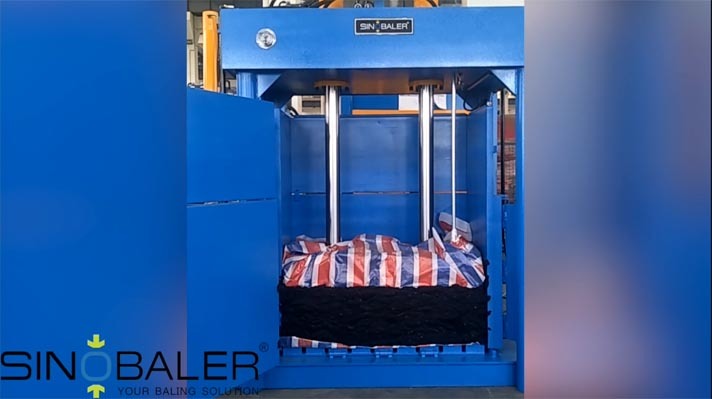
See the operating principle of SINOBALER's Auto-weighing Tri-compression Bagging Baler in this demonstration using alfalfa as the test material.
Watch the Auto-weighing Tri-compression Bagging Baler Demo
The video demonstrates the machine's weighing, feeding, compression, and bagging process. Although alfalfa is used in the demonstration, the video provides a reference for understanding the equipment's operating principle. Glass wool fiber processing performance would need to be evaluated separately.
Engineering Considerations for Glass Wool Fiber Compaction
Glass wool fibers behave differently from agricultural materials such as alfalfa. Before finalizing the machine configuration, SINOBALER would need to assess the following factors:
Material characteristics: Fiber length, bulk density, elasticity, dust generation, and the degree of fiber recovery after compression.
Target package: The required bag dimensions, finished package density, and acceptable weight tolerance.
Dosing accuracy: The weighing system's accuracy and repeatability at the 12 kg setpoint.
Control integration: Signals and interlocks between the silo dosing system, weighing box, bottom flap, and baler PLC.
Installation layout: Available headroom, silo platform structure, equipment clearance, and maintenance access.
Operator safety: Appropriate measures for handling glass wool fibers and controlling airborne dust, based on the material safety requirements.
The weighing box and its supporting structure must also be engineered for the actual installation conditions, including the loaded weight and dynamic forces during operation.
Request a Glass Wool Compaction and Bagging Proposal
Are you looking for a solution to compact and bag glass wool fibers, mineral wool, or other lightweight fibrous insulation materials?
SINOBALER can evaluate your material, required package weight, installation layout, and automation requirements to identify a suitable baling and bagging configuration.
To help us assess your project, please provide:
Material details: Photos or videos of the crushed glass wool fibers, including their approximate fiber size and current bulk density if available.
Target package: Required bag weight (e.g., 12 kg), bag dimensions, and desired finished package density.
Production capacity: Required throughput in kg/h or tonnes/day and expected operating hours.
Existing silo system: Silo outlet dimensions, available installation space, weighing system details, and control interface information.
Company and contact details: Company name, country, website, contact person, and email address or WhatsApp number.
Contact SINOBALER to discuss your glass wool fiber compaction and bagging requirements.
Email: inquiry@sinobaler.com
Share your material photos, process requirements, and installation layout with our team so we can evaluate the feasibility and recommend the appropriate next steps.
Other Blogs

Glass Wool Recycling Line
2025/12/02
A Glass Wool Recycling Line is an integrated system designed to process waste glass wool—commonly generated from insulation materials, construction debris, ventilation systems, and industrial manufacturing—into reusable, clean, and manageable forms. Since glass wool is lightweight, fluffy, and elastic, handling it without the right equipment can be extremely difficult. A specialized recycling line solves this challenge by breaking down, compacting, or reshaping the material for more efficient reuse or disposal.

Glass Wool Baler Machine
2019/08/14
Sand and recycled glass are the raw materials of glass wool. You can see glass wool rolls or glass wool slabs with different thermal and mechanical properties in the market. Glass wool is non-flammable and insoluble in water. Also it consists of air and insulates very well. So it is a quite popular insulation material […]

Advantages of using a Fiberglass Baler
2016/10/19
Fiberglass and Fiberglass Baler: Fiberglass is a material made by mixing of different components or composite material and used widely in different fields. In other words, you can say that composition of individual glass fibers in different forms. Automotive industry uses fiberglass these days in making different parts of the vehicles especially sports cars. As […]

Rock Wool Baler Machine
2019/10/21
What is rock wool and the application of rock wool? Rock wool also known as stone wool or mineral wool, usually comes from same minerals that exist in lava during a volcanic eruption. When making rock wool, furnace will reheat this lava rock to its molten state. Then a spinning machine will spin the material […]
Related Videos


Other Blogs
2025/12/02
A Glass Wool Recycling Line is an integrated system designed to process waste glass wool—commonly generated from insulation materials, construction debris, ventilation systems, and industrial manufacturing—into reusable, clean, and manageable forms. Since glass wool is lightweight, fluffy, and elastic, handling it without the right equipment can be extremely difficult. A specialized recycling line solves this challenge by breaking down, compacting, or reshaping the material for more efficient reuse or disposal.
2019/08/14
Sand and recycled glass are the raw materials of glass wool. You can see glass wool rolls or glass wool slabs with different thermal and mechanical properties in the market. Glass wool is non-flammable and insoluble in water. Also it consists of air and insulates very well. So it is a quite popular insulation material […]
Advantages of using a Fiberglass Baler
2016/10/19
Fiberglass and Fiberglass Baler: Fiberglass is a material made by mixing of different components or composite material and used widely in different fields. In other words, you can say that composition of individual glass fibers in different forms. Automotive industry uses fiberglass these days in making different parts of the vehicles especially sports cars. As […]
2019/10/21
What is rock wool and the application of rock wool? Rock wool also known as stone wool or mineral wool, usually comes from same minerals that exist in lava during a volcanic eruption. When making rock wool, furnace will reheat this lava rock to its molten state. Then a spinning machine will spin the material […]
Media and Gallery
Follow us


PRIVACY POLICY
We collect information from you when you fill out an inquiry or contact form. When submitting the form on our site, you may be asked to enter your name and contact details such as: e-mail address, mailing address and/or phone number, etc. Alternatively, you can choose not to complete our forms and visit our site anonymously. Any of the information we collect from you may be used to help us to better respond to your individual needs, and/or enable us to more effectively respond to your customer service requests and support needs. The email address you provided may also be used to send you information and updates pertaining to your inquiry and/or order, in addition to receiving occasional company news, updates, related product or service information, etc. SINOBALER does not sell, trade, or otherwise transfer to outside parties your personally identifiable information. This does not include trusted third parties who assist us in operating our website, conducting our business, or servicing you, so long as those parties agree to keep this information confidential. We may also release your information when we believe release is appropriate to comply with the law, enforce our site policies, or protect ours or others rights, property, or safety.
By using our site, you consent to our online privacy policy. If we decide to change our privacy policy, we will post those changes on this page. If you have any questions or concerns regarding our privacy policy, please e-mail info@sinobaler.com or mail your question to us at 1206 Yinzhou Shanghui Nan Lou, 1299 Yinxian Avenue, Yinzhou District, Ningbo 315192, P.R. China.
EXTERNAL LINKS & DISCLAIMER
Our web site has links to many other organizations with their permission. Upon leaving the SINOBALER web site, you are subject to the privacy policy of the new site which are not under our control. SINOBALER is not responsible for the content of any linked site or any link contained in a linked site. These links are provided to you as a service for you to better understand the different business relationships that SINOBALER has established, and/or to point the reader to other possible relevant resources.