







Forklift
For large balers or bulky materials, forklifts can be used to load materials into the hopper or feed chute.
Best for:
- Large-scale recycling operations
- Bulky or palletized waste materials
Advantages:
- Ideal for high-volume applications
- Reduces manual labor
- Enables quick feeding of large batches
Disadvantages:
- Requires skilled forklift operator
- Suitable only for balers with wide/top-loading access
- Higher space requirement

Heavy Duty Horizontal Bagging Machine
One main use of a horizontal baling and bagging machine is for loose materials like sawdust, wood chips, rags, peanut shells, cotton seeds, and rice hulls. These are hard to handle, but this machine automatically feeds, compresses, and bags them for easier storage, transport, or resale. Sinobaler’s Horizontal Baling & Bagging Machine features PLC control, one-button operation, and a safety sensor switch. It produces 60 bales/hour (88 lbs each, 28×16×12 in). Ideal for textile recyclers, pet food plants, farms, fertilizer factories, and any site generating loose waste.
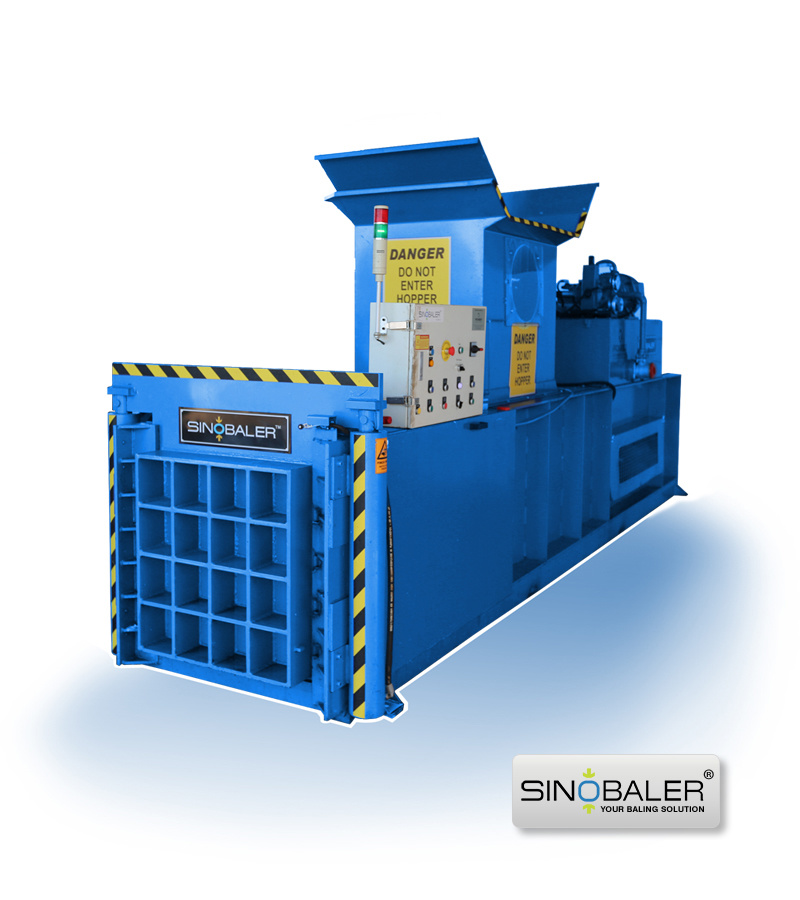
Sinobaler’s Manual Tie Horizontal Baler, also called a semi-automatic horizontal baler, handles solid and hollow waste like cardboard, PET bottles, textiles, and more. Ideal for facilities processing under 4 tons/hour with low labor costs, it offers automatic feeding, compressing, door control, and bale ejection—only the tying is manual. Press force ranges from 40 to 120 tons, with bale weights from 200kg to 850kg. Custom chamber sizes, power packs (up to 45kW), and conveyor options are available to boost productivity up to 5 bales/hour.

Open-end Manual-tie Horizontal Baler
Sinobaler SHB1-O series open-end manual-tie horizontal baler features an open-end design for continuous bale output, improving productivity by 50% over close-end balers. Strapping setup is needed only once, saving labor like a fully automatic baler. It supports various strapping materials—steel wire, PET strap, rope, etc.—making it ideal for high-volume solid waste or biomass baling. Not suited for hollow plastics due to lower density. A cost-effective choice for mid-scale recyclers or facilities needing efficient, labor-saving baling with limited investment.

Open-end Manual-tie Horizontal Baler With Wire Threader
This open-end manual-tie horizontal baler with wire threader offers nearly all functions of a fully automatic baler—except automatic tying. The built-in threading mechanism pushes wire or belt into strapping slots automatically, unlike standard manual-tie balers. While its productivity is about 20% less than a full-auto baler of the same size, it allows flexible strapping materials like steel wire, PET belt, or rope. Ideal for medium-scale recyclers or producers of solid waste, animal bedding, or feed who need efficient, cost-effective baling without sharp metal in bales. Best suited for soft or solid waste, not hollow plastic containers.
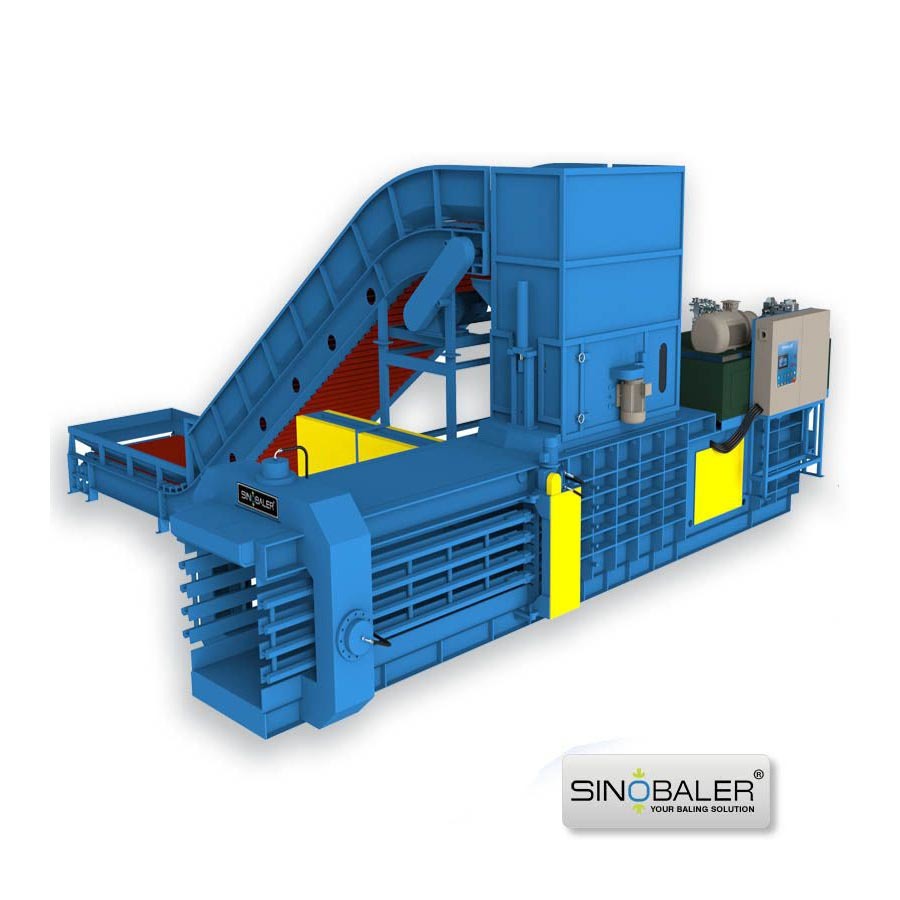
Fully Automatic Horizontal Baler
Sinobaler’s fully automatic horizontal baler (20–120 tons pressure) processes up to 15 tons/hour, ideal for high-volume recyclers handling cardboard/OCC, paper, plastic film, textile waste, and more. As our flagship open-end auto-tie baler, it features Mitsubishi PLC control, remote support, and simple operation. Bale weight/length is programmable via a touch screen for optimized container loading. The SHBA2-1200 model produces dense 1200kg rectangular bales, easy for transport/storage. CE-compliant with safety interlocking, SHBA2 is the perfect solution for large-scale soft waste recycling.
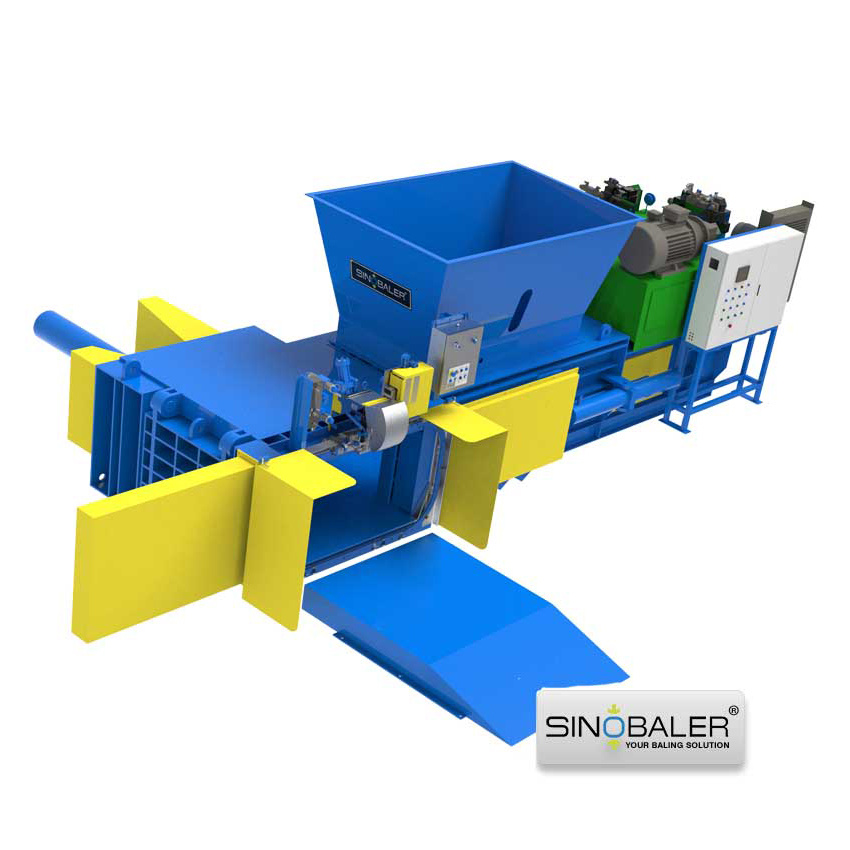
L-type Two Ram Automatic Horizontal Baler
The L-type two ram automatic horizontal baler is ideal for baling a wide range of recyclable waste. Compared to single ram balers, it offers greater versatility, supports both wire and plastic strapping, and produces high-density bales thanks to its separate strapping unit. Its flexible design can include features like a pre-compression lid to prevent cutting sensitive materials like textiles. Perfect for high-volume recycling centers, fodder exporters needing plastic straps, and municipal waste handlers seeking to avoid jams common in single ram balers.

Horizontal Briquetting Machine / Block Making Machine
Our horizontal briquetting machine is a smart solution for compressing loose materials like sawdust, chopped straw, rice husks, and peanut shells—materials that are hard to bale or transport. Instead of bagging, this machine compacts them into hard, regular-shaped briquettes that are easy to handle, store, or even burn as fuel. With a PLC system and hydraulic lifting door, it operates automatically and continuously. When paired with automatic feeding, no operator is needed. Compact in size, it fits almost anywhere and is widely used in farms, fertilizer plants, and bedding material factories.

Our Closed-door fully automatic horizontal baler is designed for efficient and high-performance baling of a wide range of waste materials, including cardboard, paper, film, bags, bottles, etc., perfectly suited for both professional recycling companies and in-house waste management. Attributed to its door-equipped chamber, the baler produces exceptionally dense and uniform bales, optimizing storage and transportation. The fully automatic tying system ensures high efficiency and significantly reduces labor costs, making it an ideal solution for operations seeking to maximize productivity while minimizing manual handling.

A biomass bagging baler is an industrial machine designed to compress loose biomass materials and pack them into bags for convenient storage, handling, and transportation. It is widely used in biomass power plants, agricultural processing facilities, waste-to-energy projects, and recycling centers. By reducing volume and stabilizing loose biomass, bagging balers help improve logistics efficiency and protect materials from moisture and contamination.
Media and Gallery
Follow us


PRIVACY POLICY
We collect information from you when you fill out an inquiry or contact form. When submitting the form on our site, you may be asked to enter your name and contact details such as: e-mail address, mailing address and/or phone number, etc. Alternatively, you can choose not to complete our forms and visit our site anonymously. Any of the information we collect from you may be used to help us to better respond to your individual needs, and/or enable us to more effectively respond to your customer service requests and support needs. The email address you provided may also be used to send you information and updates pertaining to your inquiry and/or order, in addition to receiving occasional company news, updates, related product or service information, etc. SINOBALER does not sell, trade, or otherwise transfer to outside parties your personally identifiable information. This does not include trusted third parties who assist us in operating our website, conducting our business, or servicing you, so long as those parties agree to keep this information confidential. We may also release your information when we believe release is appropriate to comply with the law, enforce our site policies, or protect ours or others rights, property, or safety.
By using our site, you consent to our online privacy policy. If we decide to change our privacy policy, we will post those changes on this page. If you have any questions or concerns regarding our privacy policy, please e-mail info@sinobaler.com or mail your question to us at 1206 Yinzhou Shanghui Nan Lou, 1299 Yinxian Avenue, Yinzhou District, Ningbo 315192, P.R. China.
EXTERNAL LINKS & DISCLAIMER
Our web site has links to many other organizations with their permission. Upon leaving the SINOBALER web site, you are subject to the privacy policy of the new site which are not under our control. SINOBALER is not responsible for the content of any linked site or any link contained in a linked site. These links are provided to you as a service for you to better understand the different business relationships that SINOBALER has established, and/or to point the reader to other possible relevant resources.