







Selecting Baling Solutions
3 Types of Baling Solutions: Tied, Bagged & Block Baling | SINOBALER
Explore Different Baling Solutions for Recycling and Waste Management
Different materials require different compression, packaging, and handling methods. Choosing the right baling solution helps improve material handling efficiency, reduce storage space, and optimize transportation costs.
As an experienced baling equipment manufacturer, SINOBALER provides customized baling solutions for recycling, waste management, agriculture, and industrial applications.
Based on how compressed materials are secured, packaged, or formed, baling solutions can be classified into three main types:
-
Wire-Tied / Strap-Tied Baling Solutions – Compressed materials are secured with metal wires or plastic straps.
-
Bagging Baling Solutions – Compressed materials are packed directly into plastic or woven bags.
-
Block Baling & Briquetting Solutions – Materials are compressed into compact blocks or briquettes without conventional wire, strap, or bag packaging.
Compare the Three Types of Baling Solutions
| Comparison | Wire / Strap-Tied Bales | Bagging Bales | Block Baling / Briquetting |
|---|---|---|---|
| Packaging method | Metal wires or plastic straps | Plastic or woven bags | No conventional packaging |
| Finished product | Secured compressed bales | Bagged compressed materials | Compact blocks or briquettes |
| Packaging consumables | Wires or straps | Bags | None |
| Main advantage | Stable, stackable bales | Convenient material containment | Compact, dense products |
| Typical applications | Paper, cardboard, plastics, metals, textiles | Biomass, hay, fibers, loose materials | Metal chips, suitable biomass, selected industrial materials |
| Equipment | Vertical and horizontal balers | Vertical and horizontal bagging balers | Hydraulic block balers and briquetting machines |
How to Choose the Right Baling Solution?
Selecting the right baling method depends on your material characteristics, production requirements, and final product handling needs.
1. Material Characteristics
Consider the material's density, moisture content, particle size, fiber structure, and ability to retain its shape after compression.
2. Required Bale Weight and Dimensions
Determine the target bale weight, bale dimensions, and required density according to your storage, handling, and transportation arrangements.
3. Packaging and Transportation Requirements
-
Choose wire or strap tying when bales need to maintain a stable shape during handling, stacking, and long-distance transportation.
-
Choose bagging when loose materials need to be contained and conveniently packaged.
-
Consider block baling or briquetting when materials can form stable compressed blocks or briquettes without conventional packaging.
4. Production Capacity
Daily processing volume and required throughput will help determine the appropriate machine model, compression force, and automation level.
5. Factory Layout and Operating Conditions
Factory layout, feeding methods, available space, power supply, and downstream handling equipment should also be considered when designing a customized baling system.
Find Your Ideal Baling Solution with SINOBALER
As an experienced baling equipment manufacturer, SINOBALER provides customized solutions for recycling, waste management, agriculture, and industrial applications.
Whether you need wire-tied bales, bagged materials, or compact blocks and briquettes, our team can help evaluate your materials and recommend suitable equipment.
Not sure which baling method is right for your application? Let SINOBALER help you find the right solution.
Send us the following information for an initial evaluation:
-
Material type and photos or videos
-
Estimated daily or hourly processing capacity
-
Required bale or briquette weight and dimensions
-
Preferred packaging or compression method, if known
-
Available factory space and power supply
-
Feeding and discharging requirements
Contact SINOBALER
Email: inquiry@sinobaler.com
Website: https://www.sinobaler.com
SINOBALER – Baling Solutions for Recycling and Waste Management.

Drum Crusher Baler / Barrel Flattener
Drum crusher (also called drum press, barrel crusher, or barrel flattener) uses strong hydraulic force to flatten metal drums/barrels. Ideal for handling from a few to hundreds of drums daily, Sinobaler offers vertical drum crushers compacting up to 60-70 drums per hour (58-gallon/220L) with 88,000 lbs force. Easy to operate by one person, space-saving, and efficient for recycling, these crushers reduce drum volume for easier transport, storage, and scrap metal recycling.

Compared to traditional drum crushers, this automatic set requires no manual loading or removal of crushed drums. Once the feed conveyor starts and a drum is placed, the full cycle—feeding, crushing, ram returning, and ejecting—is automatic. It includes a rolling conveyor, crushing unit, and hydraulic ejector, all electrically interlocked for safety. Suitable for drums up to 220L (58 gallons), it can be customized for other sizes. An infrared sensor ensures safety by stopping operation if objects approach the chamber. Ideal for high-volume users to save labor, space, and transport costs.

Foam Shredding & Compacting Plant
This integrated foam shredding and compacting plant processes EPS and XPS foam via a mechanical, pollution-free cold pressing system. It includes an infeed conveyor, foam shredder, blower, silo, auger feeder, and hydraulic compactor—no foam densifier required—allowing safe operation even in residential areas. The system produces flat, dense blocks (over 360 kg/m³) with a 40:1 compression ratio, maximizing transport efficiency. Two compactor models are available to meet various productivity needs.
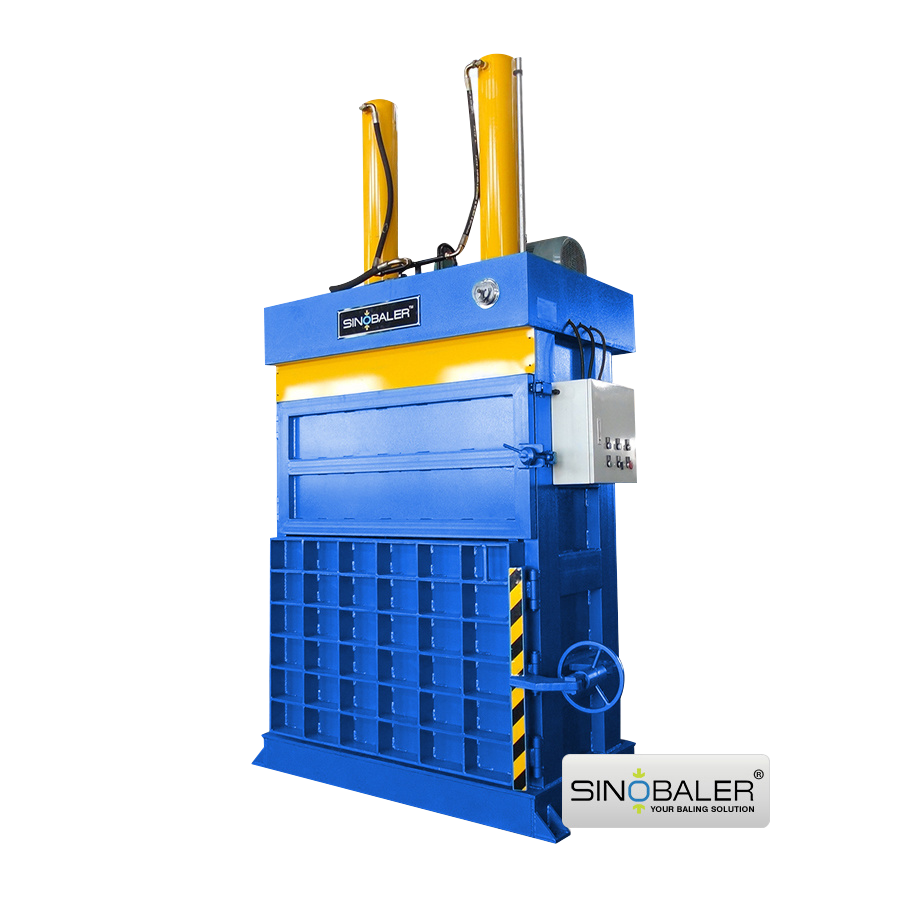
The Sinobaler Heavy Duty Dual Ram Baler delivers 80–200 tons of press force via its dual-ram system, ideal for compacting tough, fibrous, or rebounding materials, as well as soft ones requiring high bale density for optimized loading. It's perfect for natural and synthetic fibers, metal panels, tubes, profiles, and hard plastics like electronics shells and pipes. This baler reduces storage space, cuts transport costs, and boosts efficiency—making it a smart investment for modern recycling and waste handling.

Heavy Duty Baler for Fluffy Material (eg. Heavy Duty Fiber Balers)
These down stroke, manual tie, and feed balers are ideal for fiber recycling where labor is cost-effective. Depending on operator efficiency, throughput can reach up to 5 bales per hour. Sinobaler’s fiber balers offer a 15:1 compression ratio and 1100×700×600 mm bale size, with adjustable bale sizing and up to 120 bales per 40ft container. For custom machines or advanced models, contact our sales team. Auto-tie and conveyor-fed horizontal balers for higher output are also available.

Sinobaler’s four door opening baler is perfect for compressing used clothes, fabrics, fibers, rags, cotton, and wool. Ideal for textile makers, clothing recyclers, exporters, and rag graders, it produces dense bales from 65lbs to 990lbs with up to 80 tons of force. Its vertical design saves space and allows one-person operation, making it cost-friendly even for small shops. The four-door system ensures easy wrapping and cross-strapping, creating tight, protected bales for efficient storage and transport.

Optimized Heavy Duty Baler for High Rebound Material (eg. Tyre Balers )
The optimized tire baler from Sinobaler is a heavy-duty vertical machine designed to compact high-rebound materials like recycled tires into dense bales. Upgraded with a stronger hydraulic system and better cooling, it produces one bale of 120–140 car tires in just 7 strokes with a fast 35-second cycle time. This tire baler reduces tire volume for easier storage and transport, helping recyclers save space and costs. It fully meets safety standards, is simple to operate, and fits perfectly in tire recycling plants or tire manufacturing facilities thanks to its space-saving vertical design.

Standard Heavy Duty Baler for High Rebound Material (eg. Tire Balers )
"High rebound" materials like tires require a strong baler to counter their elastic nature. The Sinobaler tire baler is designed for tire dealers and recycling facilities to reduce tire disposal costs by minimizing storage and transport needs while producing valuable, tightly packed bales for resale. The SVB2-TB-1000 model creates dense bales of 120–140 car tires in just 9 strokes, achieving a 12:1 compressing ratio with up to 1200 kg per bale. These bales are reused in construction, road building, drainage, and landscaping, promoting efficiency, cost savings, and environmental responsibility.

Vertical Bagging Baler Machine
Vertical bagging baler machines are perfect for compressing and bagging small, loose materials for easy handling and transport. They press materials into compact bales and bag them in one step, ideal for factories handling pet food, animal bedding, fertilizers, fabrics, and more. Suitable materials include peanut shells, cotton seeds, chopped straw, hay, wood shavings, fibers, and rice hulls. One person can produce up to 30 bales per hour, each weighing 44–66 lbs. The removable bag feature adds versatility, allowing the machine to bale other materials without bagging when needed.

Scale Weighing Horizontal Bagging Baler
Scale weighing horizontal bagging baler is ideal for packing loose materials like rags, straw, hay, wood shavings, pet food, and textile scraps. Commonly used in pet food plants, farms, fertilizer factories, and recycling centers, it helps turn loose waste into valuable, bagged bales. Equipped with PLC control, one-button operation, and a hopper sensor switch, it can produce 25kg bales (700×400×310mm) at up to 60 bales/hour. The built-in scale ensures precise bale weight. It automatically compresses, bags, and ejects materials for easy handling, storage, and transport.

Heavy Duty Horizontal Bagging Machine
One main use of a horizontal baling and bagging machine is for loose materials like sawdust, wood chips, rags, peanut shells, cotton seeds, and rice hulls. These are hard to handle, but this machine automatically feeds, compresses, and bags them for easier storage, transport, or resale. Sinobaler’s Horizontal Baling & Bagging Machine features PLC control, one-button operation, and a safety sensor switch. It produces 60 bales/hour (88 lbs each, 28×16×12 in). Ideal for textile recyclers, pet food plants, farms, fertilizer factories, and any site generating loose waste.

Lifting Chamber Baler / Textile Baler / Clothes Baler
A lifting chamber baler, also called a used clothes or textile baler, is ideal for textile waste recycling. It's perfect for textile manufacturers, used clothing recyclers, second-hand shops, exporters, and rag graders. The lifting chamber design simplifies strapping, wrapping, and bale ejection for easy one-person operation, cutting labor costs. Bale weights range from 30kg to 600kg with up to 150 tons of force. For higher efficiency, the twin lifting chamber model allows simultaneous feeding and baling.

Swivel Twin Lifting Chamber Baler
The Swivel Twin Lifting Chamber Baler features a modern design and advanced engineering, making it an efficient solution for textile waste handling. It has two chambers connected by a central pivot—one chamber loads materials while the other compresses, bales, and straps them. This synchronized operation balances loading and processing, improving productivity. When a bale reaches its set compression, the chamber lifts automatically, signaling cycle completion and reducing downtime. Ideal for textile waste exporters and used clothing dealers, this baler offers efficiency, user-friendliness, and labor savings.

Long Stroke Baler (eg. Hollow Plastic Baler, PET Bottle Baler, Aluminum Can Baler)
The long stroke baler is ideal for compacting plastic bottles (like PET) and aluminum cans into tight, manageable bales. This vertical hydraulic press is designed for long-stroke compression, combining baling and draining in one step with a liquid tray that collects residual fluids, keeping recycling areas clean and safe. It can produce bales up to 770 lbs, depending on material density, with a volume reduction ratio up to 25:1 for maximum compaction. SINOBALER offers various models and chamber sizes to meet different business needs for baling hollow products.
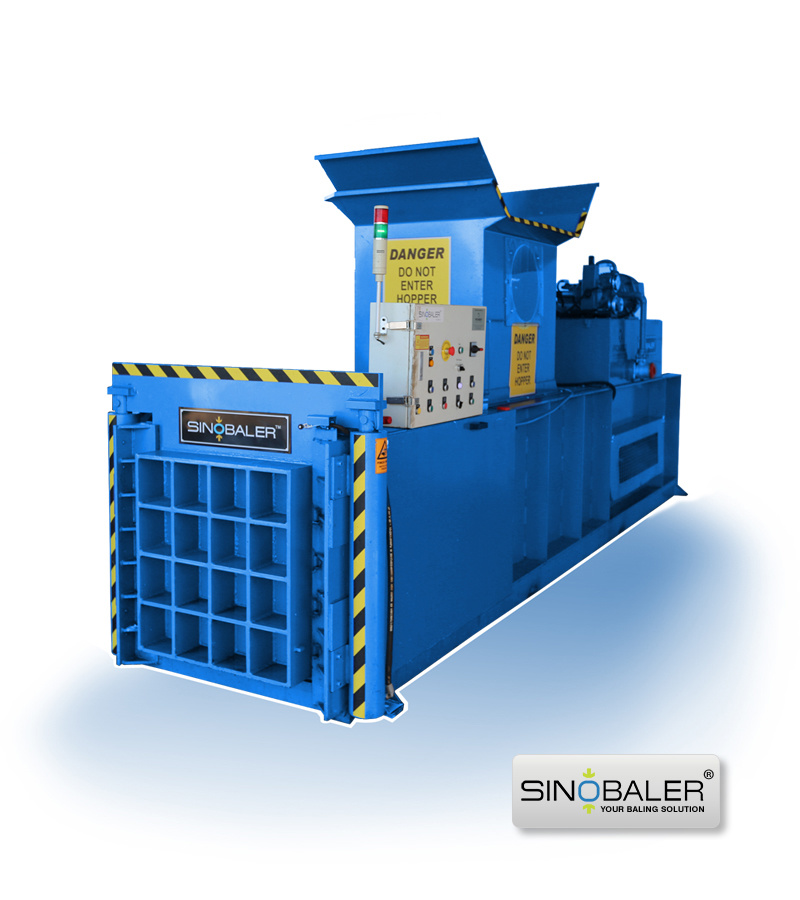
Sinobaler’s Manual Tie Horizontal Baler, also called a semi-automatic horizontal baler, handles solid and hollow waste like cardboard, PET bottles, textiles, and more. Ideal for facilities processing under 4 tons/hour with low labor costs, it offers automatic feeding, compressing, door control, and bale ejection—only the tying is manual. Press force ranges from 40 to 120 tons, with bale weights from 200kg to 850kg. Custom chamber sizes, power packs (up to 45kW), and conveyor options are available to boost productivity up to 5 bales/hour.

Open-end Manual-tie Horizontal Baler
Sinobaler SHB1-O series open-end manual-tie horizontal baler features an open-end design for continuous bale output, improving productivity by 50% over close-end balers. Strapping setup is needed only once, saving labor like a fully automatic baler. It supports various strapping materials—steel wire, PET strap, rope, etc.—making it ideal for high-volume solid waste or biomass baling. Not suited for hollow plastics due to lower density. A cost-effective choice for mid-scale recyclers or facilities needing efficient, labor-saving baling with limited investment.

Open-end Manual-tie Horizontal Baler With Wire Threader
This open-end manual-tie horizontal baler with wire threader offers nearly all functions of a fully automatic baler—except automatic tying. The built-in threading mechanism pushes wire or belt into strapping slots automatically, unlike standard manual-tie balers. While its productivity is about 20% less than a full-auto baler of the same size, it allows flexible strapping materials like steel wire, PET belt, or rope. Ideal for medium-scale recyclers or producers of solid waste, animal bedding, or feed who need efficient, cost-effective baling without sharp metal in bales. Best suited for soft or solid waste, not hollow plastic containers.
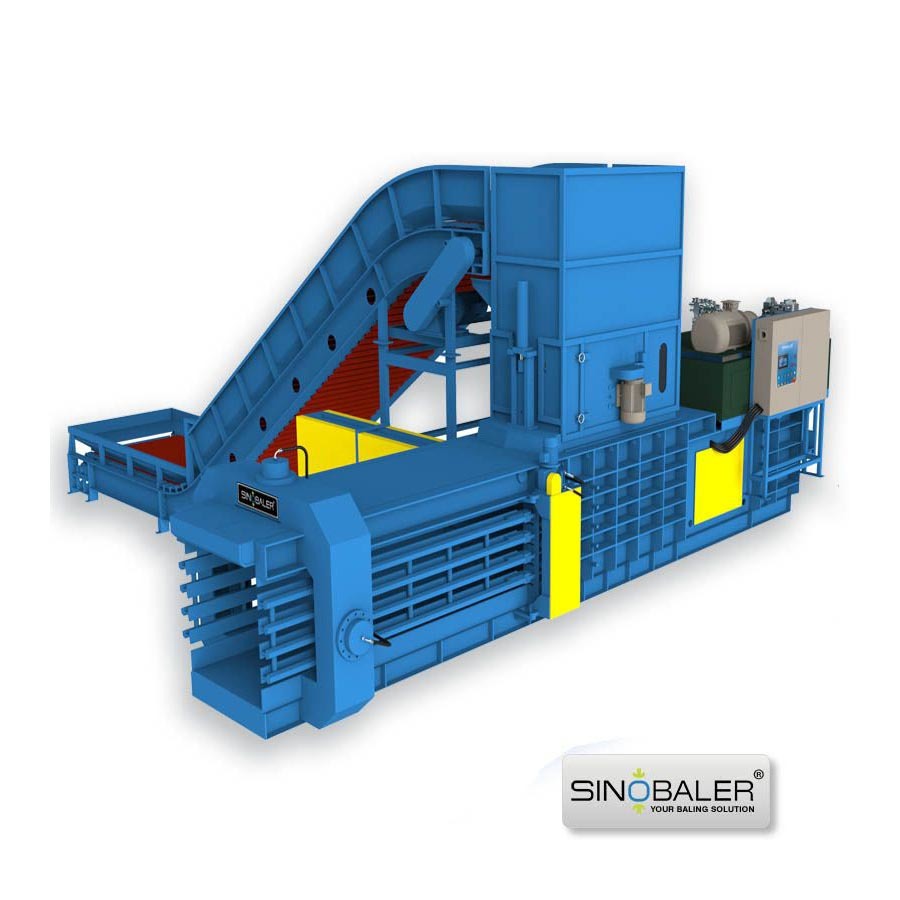
Fully Automatic Horizontal Baler
Sinobaler’s fully automatic horizontal baler (20–120 tons pressure) processes up to 15 tons/hour, ideal for high-volume recyclers handling cardboard/OCC, paper, plastic film, textile waste, and more. As our flagship open-end auto-tie baler, it features Mitsubishi PLC control, remote support, and simple operation. Bale weight/length is programmable via a touch screen for optimized container loading. The SHBA2-1200 model produces dense 1200kg rectangular bales, easy for transport/storage. CE-compliant with safety interlocking, SHBA2 is the perfect solution for large-scale soft waste recycling.
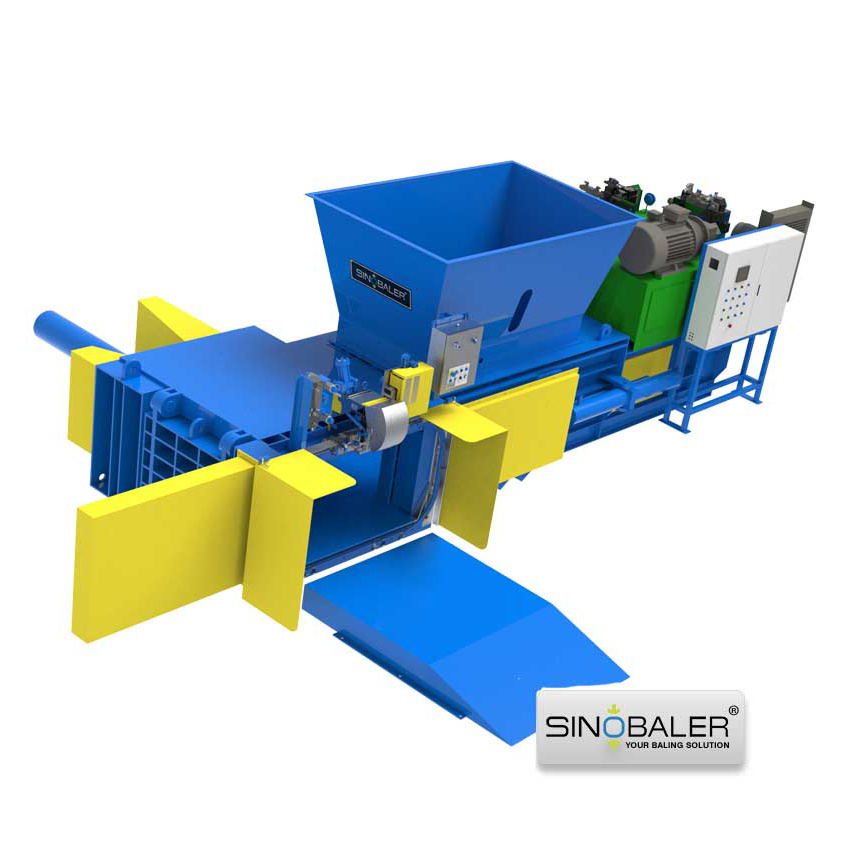
L-type Two Ram Automatic Horizontal Baler
The L-type two ram automatic horizontal baler is ideal for baling a wide range of recyclable waste. Compared to single ram balers, it offers greater versatility, supports both wire and plastic strapping, and produces high-density bales thanks to its separate strapping unit. Its flexible design can include features like a pre-compression lid to prevent cutting sensitive materials like textiles. Perfect for high-volume recycling centers, fodder exporters needing plastic straps, and municipal waste handlers seeking to avoid jams common in single ram balers.

Metal Baler (metal press) is a hydraulic machine that compresses loose metal scrap into dense, stackable blocks, making storage and transport easier. It's a smart, eco-friendly solution for efficient metal recycling. Ideal for machining plants, scrap yards, recycling centers, the automotive industry, and construction sites, it helps save space and improve scrap handling. The metal baler can process various types of metal waste, offering versatility and reliability across multiple industries, and is a key tool for boosting recycling efficiency and promoting sustainable waste management.
Media and Gallery
Follow us


PRIVACY POLICY
We collect information from you when you fill out an inquiry or contact form. When submitting the form on our site, you may be asked to enter your name and contact details such as: e-mail address, mailing address and/or phone number, etc. Alternatively, you can choose not to complete our forms and visit our site anonymously. Any of the information we collect from you may be used to help us to better respond to your individual needs, and/or enable us to more effectively respond to your customer service requests and support needs. The email address you provided may also be used to send you information and updates pertaining to your inquiry and/or order, in addition to receiving occasional company news, updates, related product or service information, etc. SINOBALER does not sell, trade, or otherwise transfer to outside parties your personally identifiable information. This does not include trusted third parties who assist us in operating our website, conducting our business, or servicing you, so long as those parties agree to keep this information confidential. We may also release your information when we believe release is appropriate to comply with the law, enforce our site policies, or protect ours or others rights, property, or safety.
By using our site, you consent to our online privacy policy. If we decide to change our privacy policy, we will post those changes on this page. If you have any questions or concerns regarding our privacy policy, please e-mail info@sinobaler.com or mail your question to us at 1206 Yinzhou Shanghui Nan Lou, 1299 Yinxian Avenue, Yinzhou District, Ningbo 315192, P.R. China.
EXTERNAL LINKS & DISCLAIMER
Our web site has links to many other organizations with their permission. Upon leaving the SINOBALER web site, you are subject to the privacy policy of the new site which are not under our control. SINOBALER is not responsible for the content of any linked site or any link contained in a linked site. These links are provided to you as a service for you to better understand the different business relationships that SINOBALER has established, and/or to point the reader to other possible relevant resources.